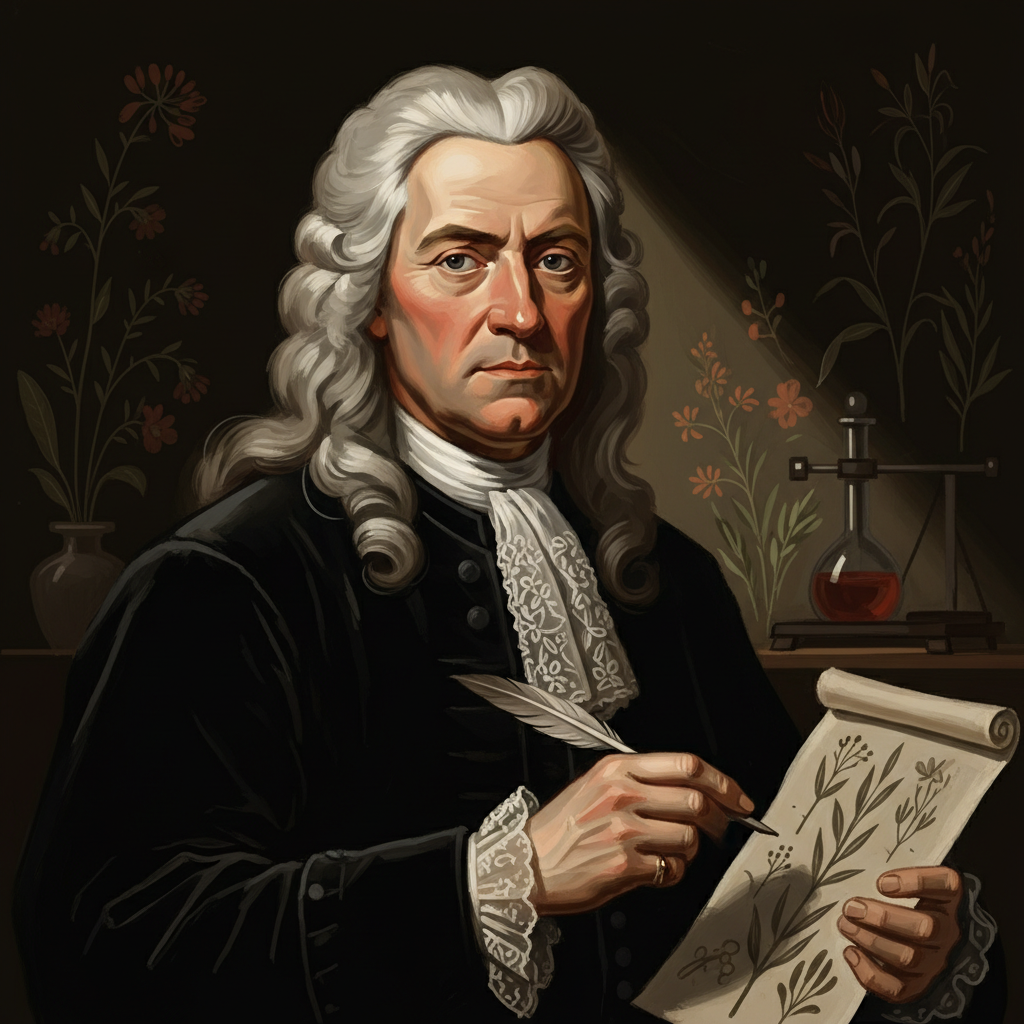
Carl Linnaeus — "I was born to be a botanist, and I have never regretted my choice."
I was born to be a botanist, and I have never regretted my choice.
I was born to be a botanist, and I have never regretted my choice.
Click any product to generate a realistic preview. Up to 3 at a time.
* Initial load can take up to 90 seconds — revising the preview in another color is nearly instant.
"I have established a new era in natural history."
"It is not God, but people themselves who shorten their lives by not keeping physically fit."
"The flower's leaves...serve as bridal beds which the Creator has so gloriously prepared, adorned with such noble bed curtains, and perfumed with so many sweet scents to induce the young bridegroom to …"
"I am not ashamed to confess that I have learned much from women."
"The species are the work of the divine hand, the genera are the work of reason."
Swedish botanist and the father of modern taxonomy whose Systema Naturae (1735) introduced binomial nomenclature for naming all species. Closely associated with Joseph Banks (British naturalist who carried Linnaean classification on Cook's voyages). For an intellectual contrast, see Comte de Buffon, French naturalist and Histoire Naturelle author (1749-1788) — Buffon explicitly attacked Linnaean fixed-categories taxonomy as artificial and rejected the binomial system; his gradualist, environment-shaped natural history was the explicit alternative. Anticipates the fixed-species-vs-evolution debate Darwin would later resolve.
A personal reflection on his chosen profession, likely from an autobiography or letters.
Date: c. 1770s
WisdomFound in 1 providers: gemini
1 source checked
A declaration of total alignment between identity and vocation. Feeling born for a pursuit means the work never felt like labor — it felt like living. The absence of regret signals not just satisfaction but something deeper: that every hardship and sacrifice along the way reinforced rather than undermined the commitment. It is what happens when curiosity and calling converge into a single lifelong obsession.
Linnaeus displayed botanical obsession from boyhood — his father called him 'the little botanist' before age five. Despite near-poverty during his Uppsala studies, he persisted, classifying over 7,700 plant species and formalizing binomial nomenclature. He declined lucrative medical careers for academic botany. His Systema Naturae, first published in 1735, became the foundation of biological classification — a lifework only possible from someone who never wavered from this singular calling.
Linnaeus worked during the Enlightenment, when European colonial expansion flooded natural historians with thousands of undescribed specimens from Asia, the Americas, and Africa. Classification had become urgently practical — botany underpinned medicine, agriculture, and trade. Yet career paths were still largely dictated by social class and church influence, making a deliberate vocation in natural science unusual. The era's faith in reason and observation made botany newly respectable, but choosing it over law or medicine was a meaningful personal statement.
AI-generated insights based on extensive research and information for context. Factual errors? Email [email protected].
Your cart is empty