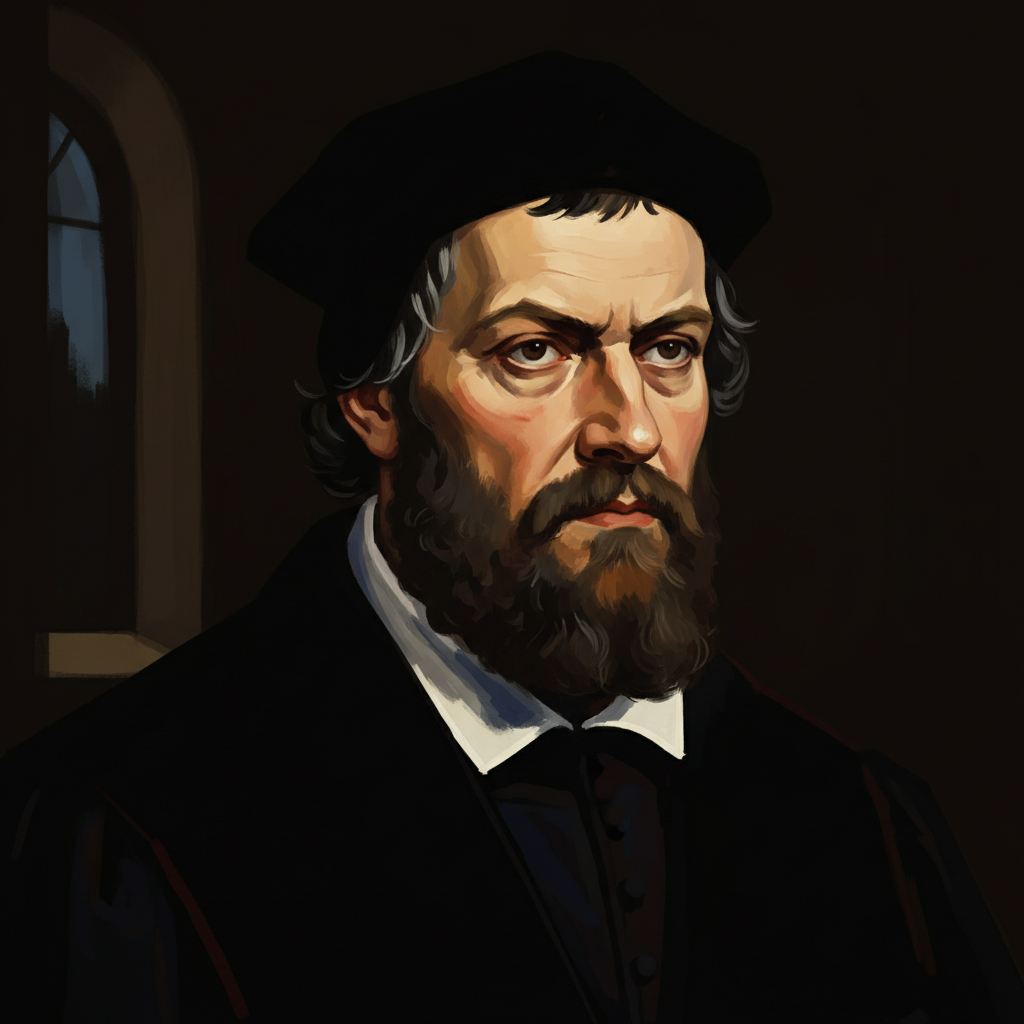
Martin Luther — "The more one reads the Bible, the more one loves it."
The more one reads the Bible, the more one loves it.
The more one reads the Bible, the more one loves it.
Click any product to generate a realistic preview. Up to 3 at a time.
* Initial load can take up to 90 seconds — revising the preview in another color is nearly instant.
"We consider EVERYTHING allowable against the deception and depravity of the papal antichrist."
"The Devil is a great artist, but he has no colors."
"If I am to be a Christian, I must be a Jew."
"I would rather have my tongue cut out than retract a single syllable."
"I have held many things in my hands, and I have lost them all; but whatever I have placed in God’s hands, that I still possess."
German theologian whose 95 Theses (1517) launched the Protestant Reformation and broke the Catholic Church's monopoly on Western Christianity. Closely associated with Philipp Melanchthon (Lutheran systematizer) and John Calvin (later Reformer who built on Luther's break). For an intellectual contrast, see Pope Leo X, Renaissance pope (1513-1521) — Leo X's indulgence sales triggered Luther's break and Leo excommunicated him in 1521 — Luther's entire Reformation is structured as a direct answer to the indulgence-funded Vatican Leo represented.
Found in 1 providers: grok
1 source checked
Regular, sustained engagement with Scripture deepens a person's affection for it. Familiarity does not breed boredom but rather genuine attachment, because each rereading reveals new layers of meaning, comfort, and challenge. The quote suggests that love for the Bible is not instant or automatic but grows through habitual exposure. The reader who keeps returning to the text discovers it becomes more rewarding, not less, the longer the relationship continues.
Luther translated the entire Bible into German so ordinary people could read it directly, a task that consumed years of his life. He believed Scripture alone (sola scriptura) was the final authority for Christian faith, not Church tradition or papal decree. Preaching thousands of sermons and lecturing on biblical books at Wittenberg, Luther embodied the conviction that personal, repeated encounter with the text transformed believers. This saying captures the lived experience behind his entire reforming project.
In early sixteenth-century Europe, the Bible was largely inaccessible to laypeople, locked in Latin and mediated by clergy. Gutenberg's printing press, perfected decades earlier, was beginning to flood Europe with affordable books. Luther's 1522 German New Testament and 1534 complete Bible exploited this technology, putting Scripture into household hands for the first time. His words reflect a revolutionary cultural moment when ordinary Christians could finally develop personal, repeated reading relationships with the sacred text.
AI-generated insights based on extensive research and information for context. Factual errors? Email [email protected].
Your cart is empty