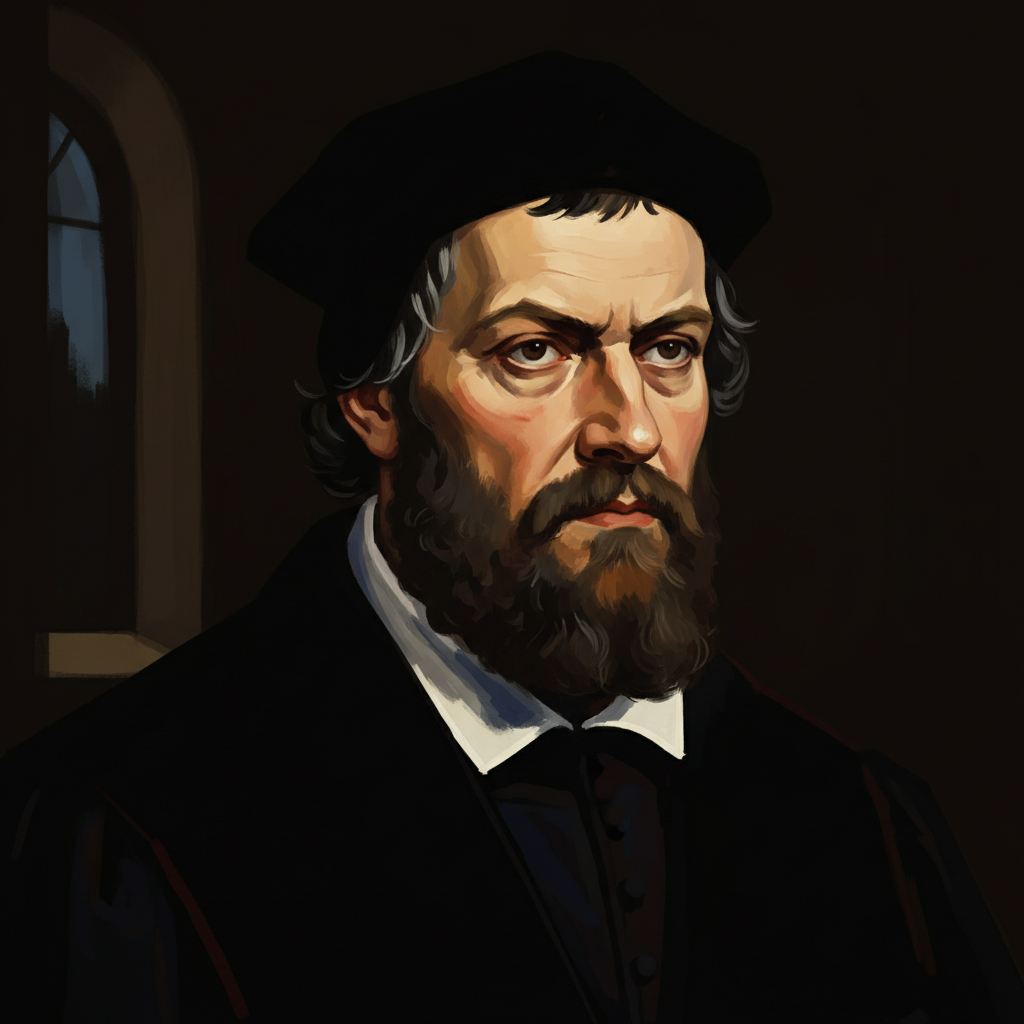
Martin Luther — "I would rather have my tongue cut out than retract a single syllable."
I would rather have my tongue cut out than retract a single syllable.
I would rather have my tongue cut out than retract a single syllable.
Click any product to generate a realistic preview. Up to 3 at a time.
* Initial load can take up to 90 seconds — revising the preview in another color is nearly instant.
"Christianity is nothing but a continual exercise in feeling that you have no sin although you sin, but that your sins are thrown on Christ."
"I would rather be a sow than a Christian if I had to believe that God is as cruel as some say."
"You people are more stupid than a block of wood."
"Here I stand; I can do no other. God help me. Amen."
"I would rather be a swineherd than a Pope."
German theologian whose 95 Theses (1517) launched the Protestant Reformation and broke the Catholic Church's monopoly on Western Christianity. Closely associated with Philipp Melanchthon (Lutheran systematizer) and John Calvin (later Reformer who built on Luther's break). For an intellectual contrast, see Pope Leo X, Renaissance pope (1513-1521) — Leo X's indulgence sales triggered Luther's break and Leo excommunicated him in 1521 — Luther's entire Reformation is structured as a direct answer to the indulgence-funded Vatican Leo represented.
Found in 1 providers: grok
1 source checked
The speaker declares absolute commitment to their words and convictions. They would sooner suffer physical mutilation—losing the ability to speak entirely—than take back even the smallest portion of what they have said. It is an extreme statement of integrity, refusing to soften, compromise, or walk back a position under pressure. The willingness to endure bodily harm signals that the truth of the statement matters more than personal safety or comfort.
Luther famously refused to recant his ninety-five theses and subsequent writings when ordered to by the Catholic Church, most dramatically at the Diet of Worms in 1521, where he reportedly said 'Here I stand, I can do no other.' His career was defined by stubborn refusal to soften doctrine despite excommunication, imperial ban, and constant threat of execution as a heretic. This quote distills his core trait: uncompromising theological conviction over self-preservation.
In early sixteenth-century Europe, retracting heretical statements was the standard path to survival—most accused heretics recanted to avoid burning at the stake. The Church held near-total authority over doctrine, and printing-press pamphlets had just begun spreading dissenting ideas rapidly. Luther's refusal to recant shattered this norm, splitting Western Christianity and triggering the Reformation, decades of religious war, and the rise of vernacular Bibles, literacy, and eventually modern ideas of individual conscience.
AI-generated insights based on extensive research and information for context. Factual errors? Email [email protected].
Your cart is empty