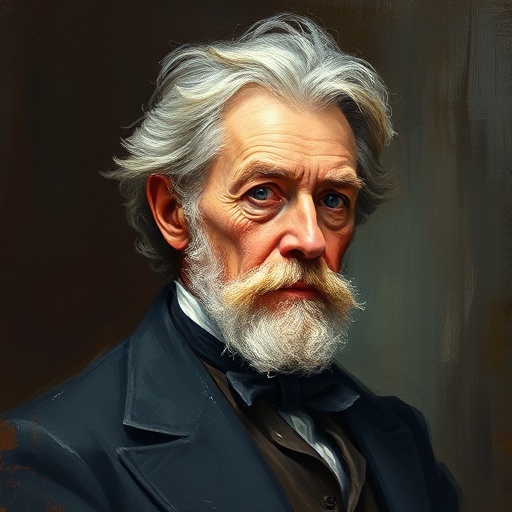
Michael Faraday — "The more we know of the laws of nature, the more we are led to believe in the wi…"
The more we know of the laws of nature, the more we are led to believe in the wisdom, intelligence, and design of God.
The more we know of the laws of nature, the more we are led to believe in the wisdom, intelligence, and design of God.
Click any product to generate a realistic preview. Up to 3 at a time.
* Initial load can take up to 90 seconds — revising the preview in another color is nearly instant.
"The greatest discovery is to find that which has always been there, but has never been seen."
"The greatest error is to believe that one knows everything."
"I shall be as patient as I can."
"I have in fact been a very lucky fellow; I have often said that I should be a very miserable creature if I could not feel that I was doing something for the good of other people."
"I am content to be a humble laborer in the field of science."
Attributed, reflecting his deep religious convictions.
Date: Mid 19th Century (approx.)
BiblicalFound in 1 providers: grok
1 source checked
Studying how nature works consistently and predictably reveals patterns so elegant and interconnected that they seem deliberately crafted rather than accidental. The deeper someone investigates physical laws, the harder it becomes to view the universe as random. Instead, the order, precision, and coherence point toward a purposeful intelligence behind it all. Scientific discovery, rather than displacing faith, strengthens the conviction that a thoughtful creator designed reality.
Faraday was a devout Sandemanian Christian who served as an elder in his small London congregation. He saw no conflict between his rigorous experimental work on electromagnetism, induction, and field theory and his faith. For him, uncovering mathematical regularities in electricity and magnetism was essentially reading God's handiwork. His humble, almost worshipful approach to laboratory work stemmed directly from this belief that nature's laws were divinely authored.
Faraday worked in early-to-mid nineteenth-century Britain, when science was rapidly secularizing and natural theology was giving way to materialist explanations. Darwin's Origin of Species appeared in 1859, challenging design arguments. Meanwhile, the Industrial Revolution made electromagnetic discoveries practically transformative. Faraday's pious stance represented a shrinking but still respectable position among working scientists, bridging Enlightenment natural philosophy's religious roots and the emerging professional, often agnostic scientific establishment of the later Victorian age.
AI-generated insights based on extensive research and information for context. Factual errors? Email [email protected].
Your cart is empty