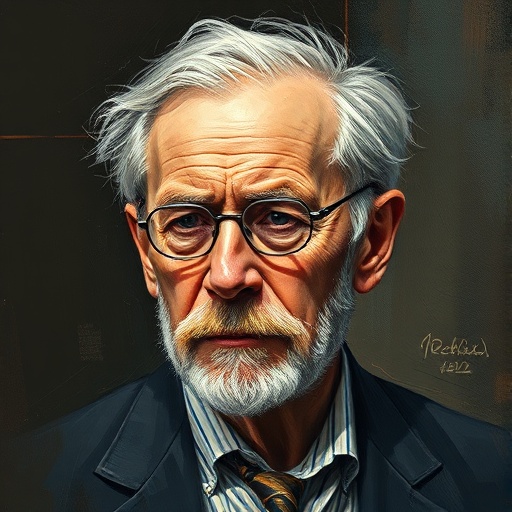
Erwin Schrodinger — "The most important thing is not to stop questioning. Curiosity has its own reaso…"
The most important thing is not to stop questioning. Curiosity has its own reason for existence.
The most important thing is not to stop questioning. Curiosity has its own reason for existence.
Click any product to generate a realistic preview. Up to 3 at a time.
* Initial load can take up to 90 seconds — revising the preview in another color is nearly instant.
"It is not possible that this unity of knowledge, feeling and choice which you call your own should have sprung into being from nothingness at a given moment not so long ago; rather this knowledge, fee…"
"The world is given to me only once, not one existing and one perceived. Subject and object are only one. The barrier between them cannot be said to have broken down as a result of recent experience in…"
"The total number of minds in the universe is one. In fact, consciousness is a singularity."
"The future of mankind depends on the wisdom of its leaders. And that is a very frightening thought."
"The universe is a grand illusion. But it is a very persistent one."
Austrian physicist who shared the 1933 Nobel for the wave equation that bears his name and the famous cat thought-experiment. Closely associated with Werner Heisenberg (matrix-mechanics rival who reached the same physics by different math) and Albert Einstein (his pen-pal on quantum interpretation). For an intellectual contrast, see Niels Bohr, Danish physicist and architect of the Copenhagen interpretation — Schrödinger's cat thought-experiment was specifically designed to ridicule Bohr's 'observer-dependent reality' reading of quantum mechanics — Schrödinger thought the Copenhagen interpretation was absurd; the cat was meant as reductio ad absurdum.
Attributed, often confused with Einstein, but themes resonate with Schrodinger's inquiries.
Date: Unknown
WisdomFound in 1 providers: grok
1 source checked
Curiosity doesn't need to justify itself with useful outcomes — it is its own justification. The quote urges us never to become intellectually complacent or satisfied. Asking questions is fundamental to understanding reality and to being fully human. Once we stop questioning, we stop growing. This applies beyond academia to daily life, demanding we remain genuinely open and perpetually willing to challenge what we think we already know.
Schrödinger spent his career questioning physics' foundations. His 1926 wave equation challenged particle-only quantum models. His famous cat paradox interrogated whether quantum superposition applied to the macroscopic world. In 1944's What is Life?, he crossed into biology, asking whether quantum physics explained genetic stability — directly inspiring Watson and Crick. Forced from Austria by Nazism, he rebuilt his career across multiple countries, embodying restless intellectual courage that refused comfortable certainty.
Schrödinger's most productive years spanned the 1920s–1940s, when classical physics was collapsing under quantum discoveries. Einstein, Bohr, Heisenberg, and Schrödinger were dismantling centuries of certainty about matter, causality, and observation. The rise of fascism disrupted European intellectual life, forcing scientists into exile. Curiosity itself became politically fraught — some science was deemed ideologically suspect. Amid such upheaval, insisting that questioning must never stop was both a scientific and a moral stance.
AI-generated insights based on extensive research and information for context. Factual errors? Email [email protected].
Your cart is empty