Isaac Newton — "It seems probable to me, that God in the beginning formed matter in solid, massy…"
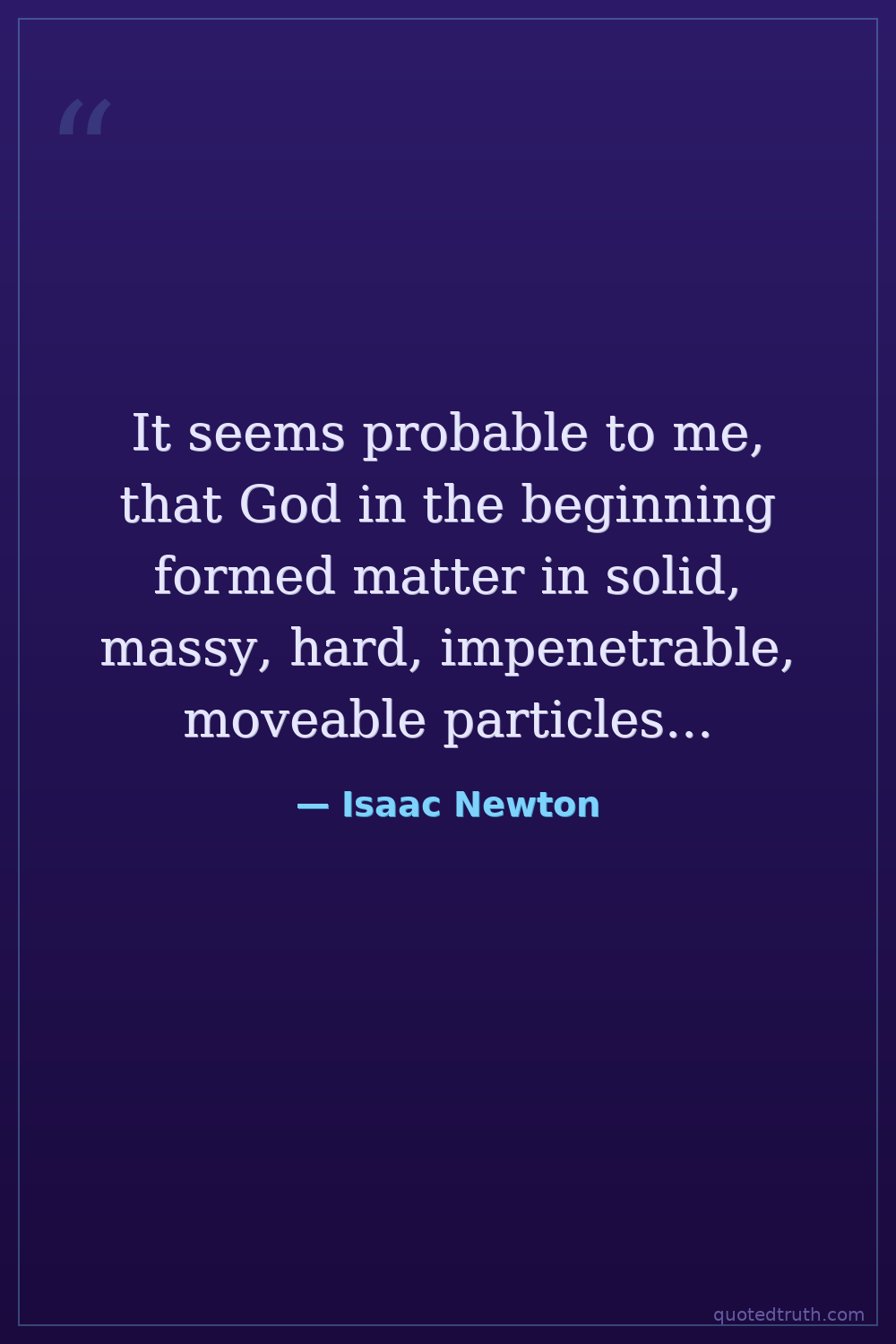
It seems probable to me, that God in the beginning formed matter in solid, massy, hard, impenetrable, moveable particles...
It seems probable to me, that God in the beginning formed matter in solid, massy, hard, impenetrable, moveable particles...
Click any product to generate a realistic preview. Up to 3 at a time.
* Initial load can take up to 90 seconds — revising the preview in another color is nearly instant.
"Hypotheses non fingo. (I frame no hypotheses.)"
"The parts of all homogeneal hard bodies which fully touch one another, stick together with a very strong attraction."
"I keep the subject constantly before me and wait till the first dawnings open slowly, by little and little, into a full and clear light."
"Opposition to godliness is atheism in profession and idolatry in practice. Atheism is so senseless."
"For the conservation of motion, it is necessary that the body should be moved in a vacuum."
Found in 1 providers: grok
1 source checked
God created matter from tiny, solid, indestructible particles that move through space — the fundamental building blocks of everything physical. Newton is proposing an atomic theory of matter: reality at its smallest scale consists of hard, indivisible pieces that cannot be broken down further, and their interactions produce all observable phenomena in the universe.
Newton saw mathematics and physics as tools for understanding God's design. His deep Anglican faith shaped his natural philosophy — he spent more time on theology than science. This atomic view reflects his mechanistic worldview: God engineered a universe running on precise, discoverable rules. His Principia unified celestial and terrestrial mechanics under the same God-ordained laws.
The late 17th century saw natural philosophy breaking from Aristotelian substance theory toward mechanistic materialism. Boyle's corpuscular theory, Descartes' mechanical universe, and growing interest in ancient atomism (Epicurus, Lucretius) made particle-based matter theories intellectually fashionable. Newton was synthesizing these currents while keeping God as first cause — the era's dominant scientific theology before materialism displaced divine engineering.
AI-generated insights based on extensive research and information for context. Factual errors? Email [email protected].
Your cart is empty