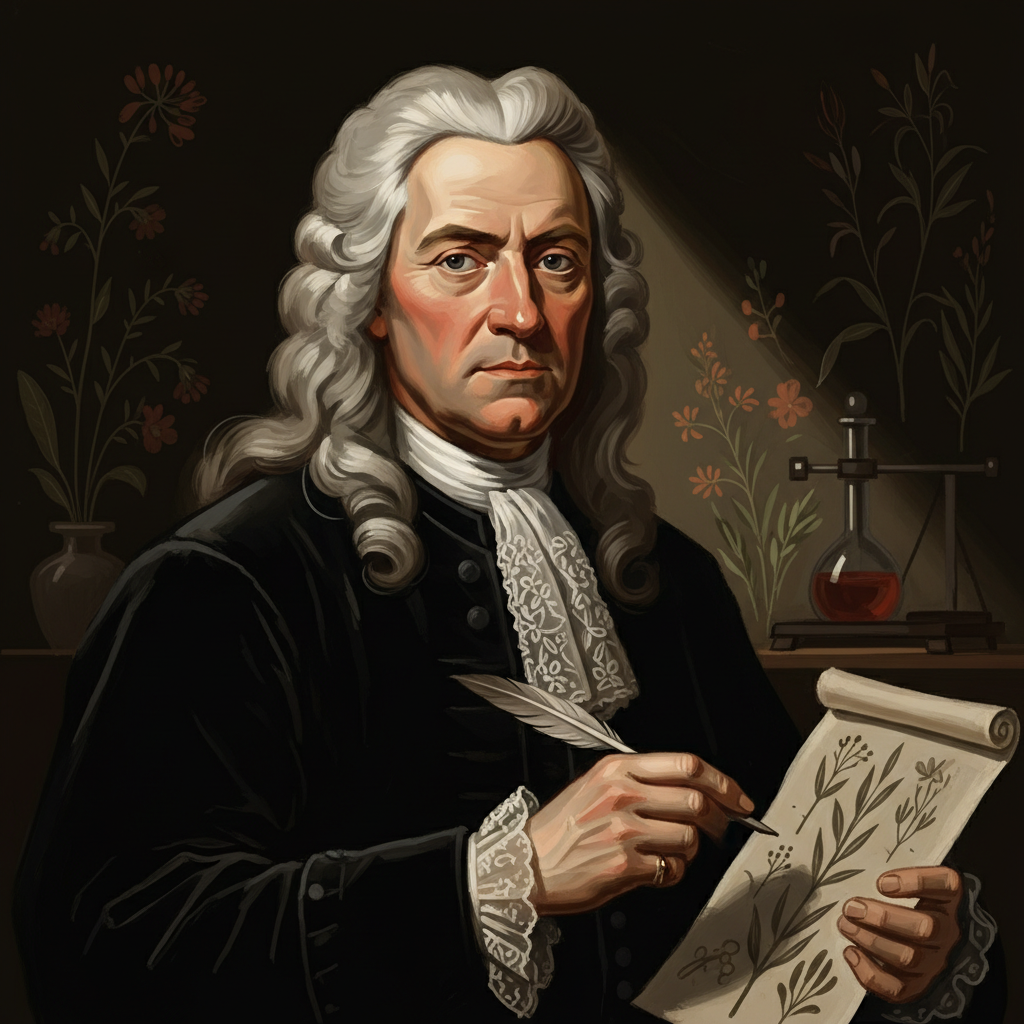
Carl Linnaeus — "The names of plants are the foundation of botany."
The names of plants are the foundation of botany.
The names of plants are the foundation of botany.
Click any product to generate a realistic preview. Up to 3 at a time.
* Initial load can take up to 90 seconds — revising the preview in another color is nearly instant.
"I have seen the Creator in His works."
"It is not God, but people themselves who shorten their lives by not keeping physically fit."
"For wealth disappears, the most magnificent houses fall into decay, the most numerous family at some time or another comes to an end: the greatest and the most prosperous kingdoms can be overthrown: b…"
"When the spiritual light is concentrated in the brain, everything else must be sinking in the dark."
"Nature is never exhausted; she has always new wonders for our admiration."
Swedish botanist and the father of modern taxonomy whose Systema Naturae (1735) introduced binomial nomenclature for naming all species. Closely associated with Joseph Banks (British naturalist who carried Linnaean classification on Cook's voyages). For an intellectual contrast, see Comte de Buffon, French naturalist and Histoire Naturelle author (1749-1788) — Buffon explicitly attacked Linnaean fixed-categories taxonomy as artificial and rejected the binomial system; his gradualist, environment-shaped natural history was the explicit alternative. Anticipates the fixed-species-vs-evolution debate Darwin would later resolve.
Found in 1 providers: grok
1 source checked
Precise, standardized naming is the bedrock of plant science. Without consistent names, botanists cannot communicate, compare findings, or build on each other's work. A plant called different things in different countries creates confusion; a universal name creates clarity. Naming is not merely labeling — it is the act of organizing nature into a comprehensible system that enables all further scientific inquiry to proceed reliably.
Linnaeus spent his career creating exactly this foundation. His 1753 work Species Plantarum introduced binomial nomenclature — two-part Latin names for every plant — replacing chaotic, lengthy descriptive phrases used before. He knew firsthand that conflicting names for the same plant paralyzed scientific exchange across Europe. This belief was not abstract philosophy; it was the practical engine behind his life's project of classifying every known organism.
In the early modern period, Europe's Age of Exploration flooded naturalists with thousands of undescribed plants from the Americas, Asia, and Africa. Different countries used entirely different names for the same species, making herbals and botanical gardens essentially incompatible. There was no international scientific language for nature. Linnaeus worked amid this nomenclature crisis, and his binomial system became the universal solution that finally unified global botany.
AI-generated insights based on extensive research and information for context. Factual errors? Email [email protected].
Your cart is empty