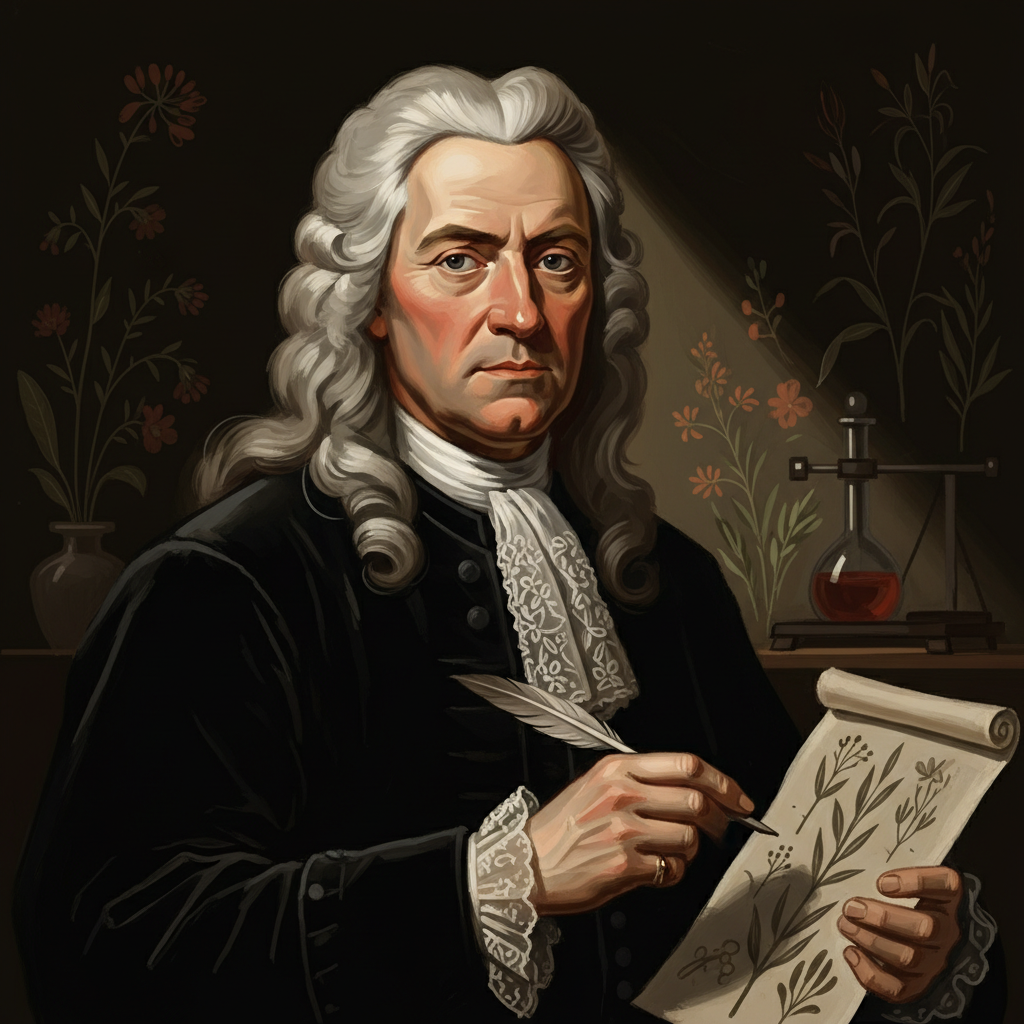
Carl Linnaeus — "Nature is never exhausted; she has always new wonders for our admiration."
Nature is never exhausted; she has always new wonders for our admiration.
Nature is never exhausted; she has always new wonders for our admiration.
Click any product to generate a realistic preview. Up to 3 at a time.
* Initial load can take up to 90 seconds — revising the preview in another color is nearly instant.
"The book of nature is the only book that offers a wealth of content on every one of its pages."
"The whole system of nature is nothing but a system of sexual generation."
"My life has been dedicated to the service of nature."
"I have explored the whole world of nature."
"I have not seen the genus Homo. I have seen many individuals."
Swedish botanist and the father of modern taxonomy whose Systema Naturae (1735) introduced binomial nomenclature for naming all species. Closely associated with Joseph Banks (British naturalist who carried Linnaean classification on Cook's voyages). For an intellectual contrast, see Comte de Buffon, French naturalist and Histoire Naturelle author (1749-1788) — Buffon explicitly attacked Linnaean fixed-categories taxonomy as artificial and rejected the binomial system; his gradualist, environment-shaped natural history was the explicit alternative. Anticipates the fixed-species-vs-evolution debate Darwin would later resolve.
An expression of his continuous awe and inspiration from the natural world.
Date: Uncertain (attributed)
Nature & WorldFound in 1 providers: gemini
1 source checked
The natural world is inexhaustible — no matter how much humans discover, it keeps revealing new organisms, phenomena, and mysteries. Curiosity about nature has no endpoint because nature itself has no bottom. Each question answered opens several more. Science is not a finite project with a finish line but a permanent encounter with complexity, and wonder is always the appropriate response to what the living world keeps offering.
Linnaeus spent his career cataloging life, naming over 12,000 species and establishing binomial nomenclature that still governs biology. Yet Systema Naturae expanded across twelve editions, each larger than the last, because new specimens kept arriving faster than he could classify them. His network of student-explorers, whom he called his apostles, fanned across every continent — embodying his conviction that the inventory of creation was genuinely endless.
Linnaeus worked during the 18th-century Age of Enlightenment, when European ships returned regularly from the Americas, Pacific, and Asia carrying hundreds of undescribed species. Cabinets of curiosities were becoming systematic natural history museums. The sheer scale of global biodiversity was suddenly visible and overwhelming. Traditional knowledge looked radically incomplete, making systematic classification urgent and making the sentiment that nature never runs out of surprises an observable, lived reality for naturalists of the period.
AI-generated insights based on extensive research and information for context. Factual errors? Email [email protected].
Your cart is empty