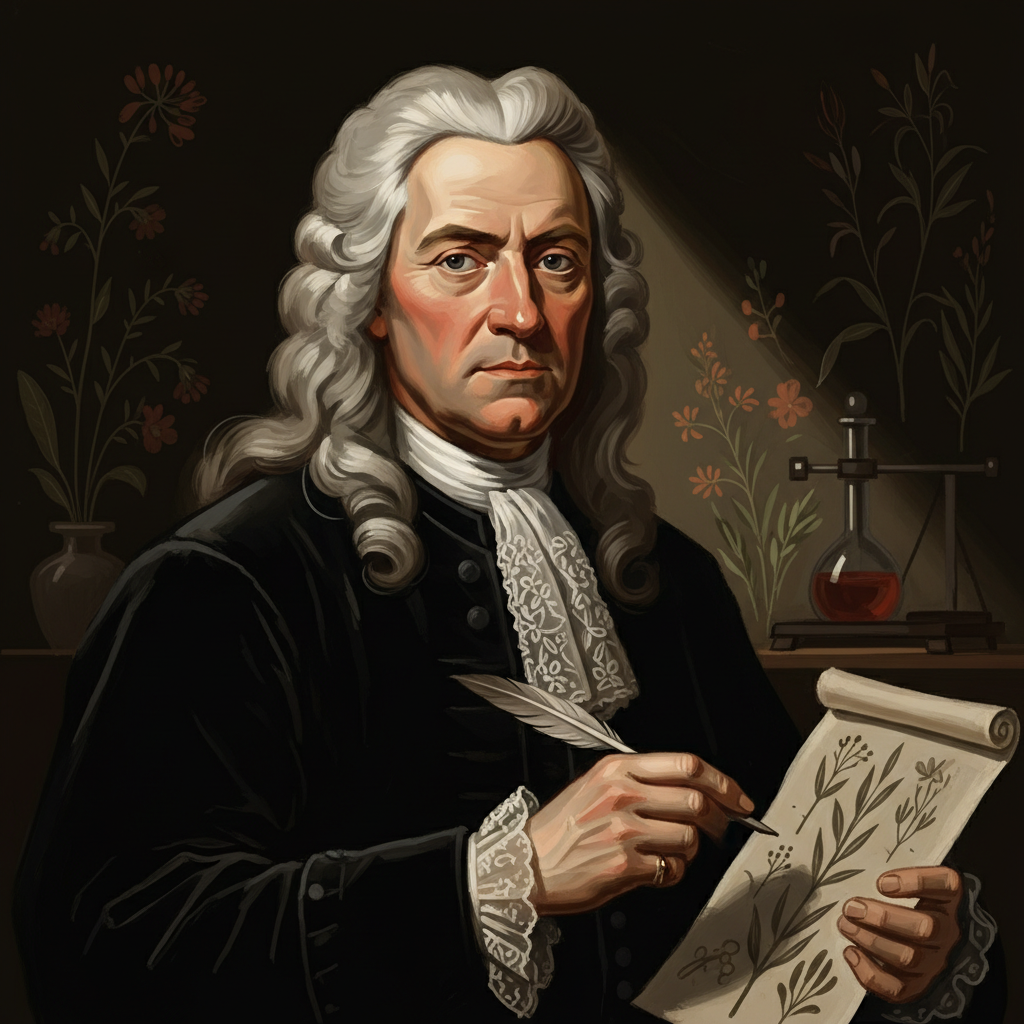
Carl Linnaeus — "I have seen the Creator in His works."
I have seen the Creator in His works.
I have seen the Creator in His works.
Click any product to generate a realistic preview. Up to 3 at a time.
* Initial load can take up to 90 seconds — revising the preview in another color is nearly instant.
"The knowledge of plants is a science, but the love of plants is an art."
"The greatest pleasure of a gardener is to survey his work, and to admire the result of his own industry."
"If a tree were to be a god, it would be a god of solitude."
"The Creator's wisdom is seen in the smallest insect as well as in the greatest elephant."
"I saw the infinite, all-knowing and all-powerful God from behind as he went away, and I grew dizzy. I followed his footsteps over nature's fields and saw everywhere an eternal wisdom and power, an ins…"
Swedish botanist and the father of modern taxonomy whose Systema Naturae (1735) introduced binomial nomenclature for naming all species. Closely associated with Joseph Banks (British naturalist who carried Linnaean classification on Cook's voyages). For an intellectual contrast, see Comte de Buffon, French naturalist and Histoire Naturelle author (1749-1788) — Buffon explicitly attacked Linnaean fixed-categories taxonomy as artificial and rejected the binomial system; his gradualist, environment-shaped natural history was the explicit alternative. Anticipates the fixed-species-vs-evolution debate Darwin would later resolve.
Reflects his deep religious conviction and the idea of natural theology, seeing God's design in nature.
Date: c. 1730s-1770s
ShockingFound in 1 providers: grok
1 source checked
The speaker claims direct, personal witness of God through studying the natural world. Not abstract faith but empirical encounter — observing nature closely enough reveals the intelligence behind its design. Creation itself becomes evidence of the Creator, making scientific observation a form of religious experience rather than a challenge to it.
Linnaeus spent his life cataloguing thousands of species, imposing systematic order on nature's diversity. His binomial nomenclature revealed nature's underlying logic, which he interpreted as God's rational design. A devout Lutheran, he saw taxonomy not as secular science but as reading the mind of God — each species a deliberate divine act.
In 18th-century Europe, natural theology flourished alongside Enlightenment science. Thinkers like Linnaeus navigated a world where botany and religious devotion coexisted comfortably. The 'argument from design' was intellectually dominant — nature's complexity proved God's existence. Darwin's challenge was decades away; systematic biology felt like decoding divine scripture, not displacing it.
AI-generated insights based on extensive research and information for context. Factual errors? Email [email protected].
Your cart is empty