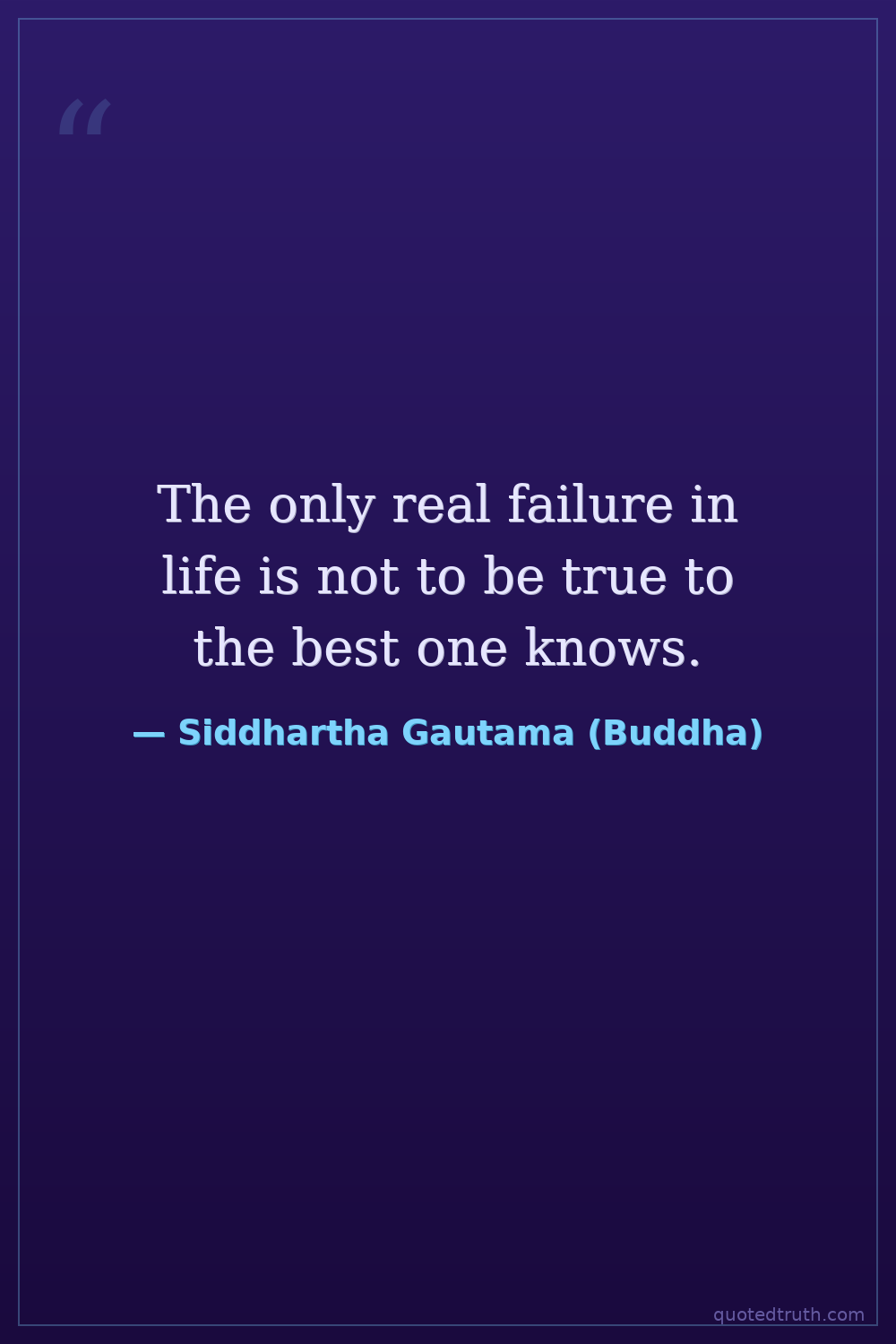
Siddhartha Gautama (Buddha) — "The only real failure in life is not to be true to the best one knows."
The only real failure in life is not to be true to the best one knows.
The only real failure in life is not to be true to the best one knows.
Click any product to generate a realistic preview. Up to 3 at a time.
* Initial load can take up to 90 seconds — revising the preview in another color is nearly instant.
"Whatever a monk keeps pursuing with his thinking and pondering, that becomes the inclination of his awareness."
"I will not look at another's bowl intent on finding fault: a training to be observed."
"Your worst enemy cannot harm you as much as your own unguarded thoughts."
"'As I am, so are they; as they are, so am I.' Comparing others with oneself, do not kill nor cause others to kill."
"The secret of health for both mind and body is not to mourn for the past, nor to worry about the future, but to live the present moment wisely and earnestly."
Attributed, often cited in various Buddhist texts and teachings.
Date: c. 5th century BCE
WisdomFound in 2 providers: grok,gemini
2 sources checked
Real failure is not external defeat but internal betrayal of what you know to be right. You can lose jobs, money, or reputation and still live well, but the moment you act against your own conscience and deepest understanding, you have genuinely failed. Success is measured by alignment between your convictions and your conduct, not by outcomes or comparisons to others. Live up to the highest truth you personally grasp.
The Buddha abandoned a royal palace, wife, and son to pursue the truth he sensed about suffering, because staying would have betrayed what he already knew in his heart. His entire teaching centers on right understanding, right intention, and right action — ethical self-honesty as the path to liberation. He refused inherited dogma and tested every truth through direct experience, embodying the principle that fidelity to one's deepest insight matters more than social success.
In 5th–6th century BCE India, rigid Vedic caste duty (dharma) dictated that a prince must rule, not wander as a beggar. Ritual orthodoxy and Brahmin authority defined virtue externally through birth and sacrifice. Siddhartha's departure coincided with the śramaṇa movement — wandering ascetics who rejected inherited religion in favor of personal realization. In that climate, teaching that authenticity to inner truth outranked social obligation was radical, reframing failure from caste violation to self-betrayal.
AI-generated insights based on extensive research and information for context. Factual errors? Email [email protected].
Your cart is empty