Wright Brothers (Orville & Wilbur) — "The problem was not to build a machine that would fly, but to build a machine th…"
The problem was not to build a machine that would fly, but to build a machine that would fly safely.
The problem was not to build a machine that would fly, but to build a machine that would fly safely.
Click any product to generate a realistic preview. Up to 3 at a time.
* Initial load can take up to 90 seconds — revising the preview in another color is nearly instant.
"We could not understand how it was that the best scientists could not fly a machine. We thought that they must be working on the wrong principle."
"No airship will ever fly from New York to Paris. That seems to me to be impossible. What limits the flight is the motor. No known motor can run at the requisite speed for four days without stopping, a…"
"The machine is now a commercial success."
"We were not looking for a fortune, but we were looking for a solution."
"We do not intend to fly for money, but for the love of the art."
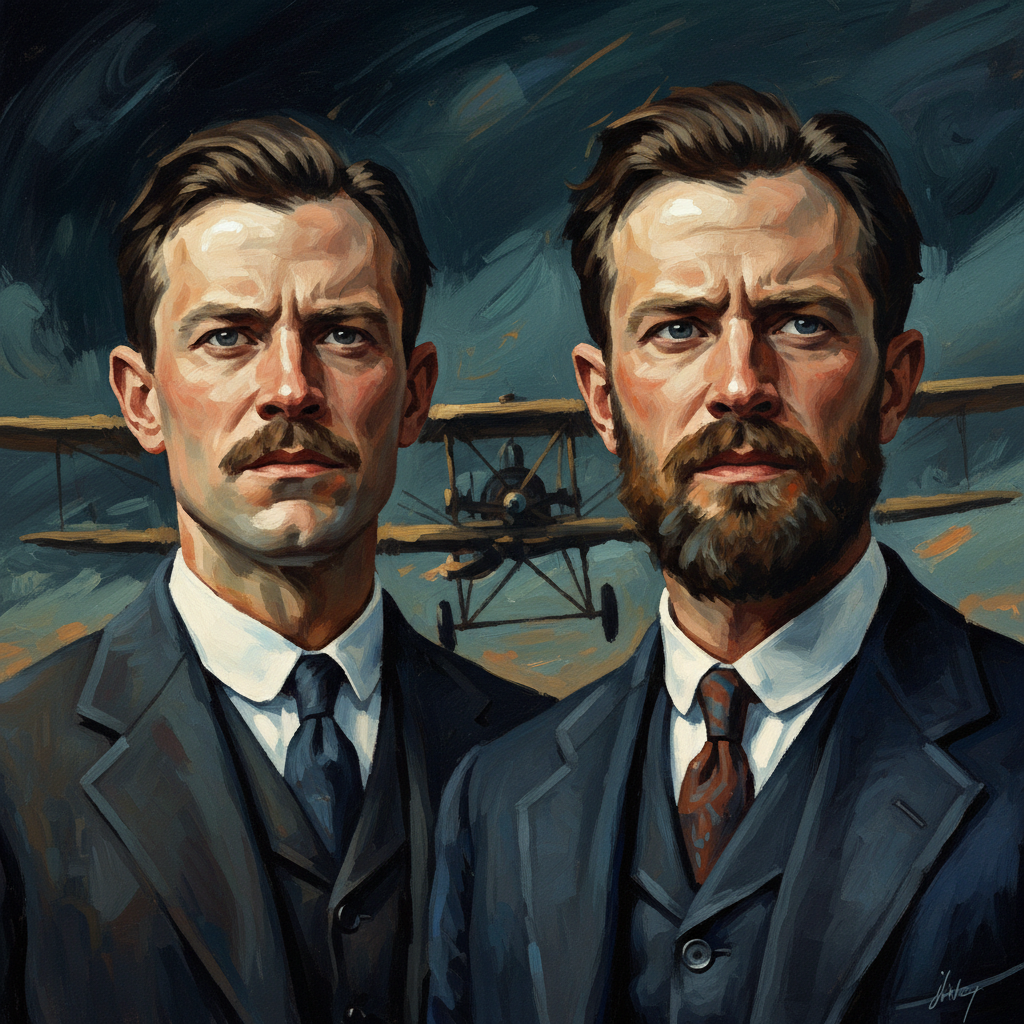
American aviation pioneers who achieved the first sustained powered controlled airplane flight at Kitty Hawk, NC, on December 17, 1903. Closely associated with Octave Chanute (their gliding mentor and aeronautical correspondent). For an intellectual contrast, see Samuel Pierpont Langley, Smithsonian Institution Secretary and government-funded aviation researcher — Langley's Aerodrome crashed twice into the Potomac in October-December 1903 with $50,000 of War Department funding; the Wright Brothers' bicycle-shop empiricism beat Langley's institutional Big Science by 9 days. The most-cited example in engineering history of empirical-tinkerer beating institution-funded credentialism.
Found in 1 providers: grok
1 source checked
Creating something that works once is far easier than creating something that works reliably and without killing its user. The real engineering challenge is not the initial breakthrough but controlling it, refining it, and making it dependable enough that ordinary people can trust their lives to it. Novelty is cheap; safety, stability, and repeatable performance are the hard, unglamorous problems that separate a stunt from a usable technology.
The Wrights obsessed over control, not just lift. While rivals like Langley chased raw power, Orville and Wilbur spent years on their wind tunnel, wing-warping system, and three-axis control precisely because unstable gliders had killed pioneers like Otto Lilienthal. Their 1903 Kitty Hawk flight was short, but their real achievement was the controllable 1905 Flyer III. Both bicycle mechanics, they understood that balance and rider safety mattered as much as propulsion.
At the turn of the 20th century, aviation was synonymous with death. Lilienthal died gliding in 1896; Langley's Aerodrome crashed into the Potomac weeks before Kitty Hawk. Newspapers mocked flying enthusiasts as cranks. The industrial age was producing automobiles, telephones, and electric light, but powered flight remained a graveyard of inventors. Public trust in any flying machine required proving it would not simply plunge its operator to earth, making safety the true barrier to adoption.
AI-generated insights based on extensive research and information for context. Factual errors? Email [email protected].
Your cart is empty