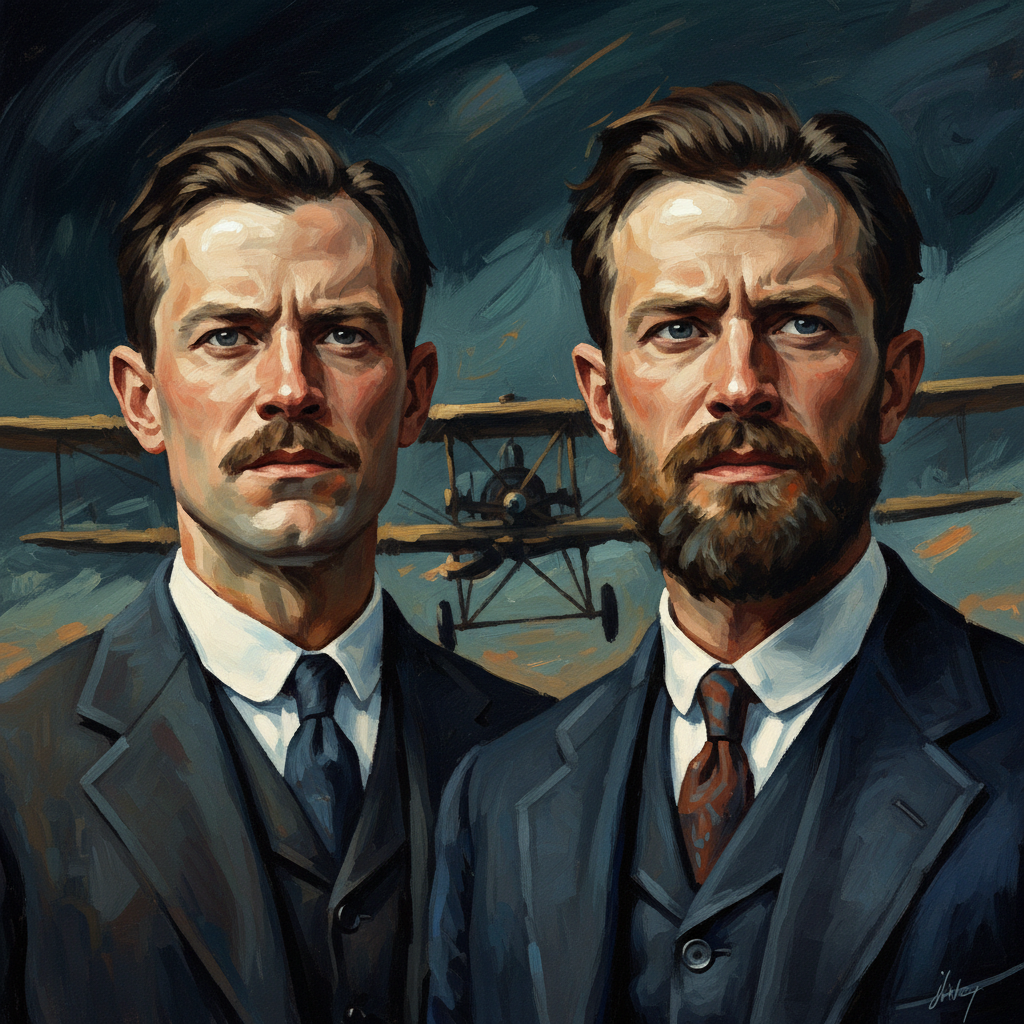
Wright Brothers (Orville & Wilbur) — "Success in inventing depends on the close observation of nature."
Success in inventing depends on the close observation of nature.
Success in inventing depends on the close observation of nature.
Click any product to generate a realistic preview. Up to 3 at a time.
* Initial load can take up to 90 seconds — revising the preview in another color is nearly instant.
"The machine had scarcely cleared the ground when it began to turn up, and the next instant it darted into the ground."
"No flying machine will ever fly from New York to Paris."
"The machine has been working very nicely and we have been making several flights each day."
"The machine is capable of carrying a passenger."
"We had to be our own mechanics, our own engineers, and our own scientists."
American aviation pioneers who achieved the first sustained powered controlled airplane flight at Kitty Hawk, NC, on December 17, 1903. Closely associated with Octave Chanute (their gliding mentor and aeronautical correspondent). For an intellectual contrast, see Samuel Pierpont Langley, Smithsonian Institution Secretary and government-funded aviation researcher — Langley's Aerodrome crashed twice into the Potomac in October-December 1903 with $50,000 of War Department funding; the Wright Brothers' bicycle-shop empiricism beat Langley's institutional Big Science by 9 days. The most-cited example in engineering history of empirical-tinkerer beating institution-funded credentialism.
Found in 1 providers: grok
1 source checked
Successful invention isn't about flashes of genius or random trial-and-error. It requires careful, sustained observation of how nature actually works — how forces behave, how structures bear load, how movement flows. By studying the natural world with precision and patience, inventors uncover the real principles that make new things possible. Without that grounding in observed reality, even brilliant ideas collapse when tested.
The Wright Brothers were obsessive observers of bird flight, especially how birds twisted their wing tips to maintain lateral balance — directly inspiring their wing-warping control system. They spent years studying Otto Lilienthal's glider research, built their own wind tunnel to measure lift and drag, and documented hundreds of glider tests at Kitty Hawk before committing to powered flight. Observation, not intuition, drove every design decision.
The late 1800s and early 1900s saw an explosion of scientific and industrial invention — electricity, telephone, automobiles, and aviation were all being pioneered simultaneously. Darwin's theory had elevated systematic natural observation as the gold standard of inquiry. Many aviation hopefuls crashed because they relied on intuition over data. The era rewarded those who treated nature as a laboratory rather than an obstacle, making close observation a decisive competitive advantage.
AI-generated insights based on extensive research and information for context. Factual errors? Email [email protected].
Your cart is empty