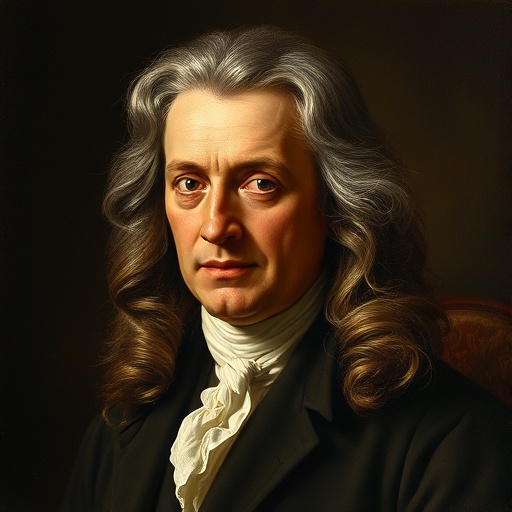
Isaac Newton — "The particles of light are exceedingly small, and move with exceeding swiftness."
The particles of light are exceedingly small, and move with exceeding swiftness.
The particles of light are exceedingly small, and move with exceeding swiftness.
Click any product to generate a realistic preview. Up to 3 at a time.
* Initial load can take up to 90 seconds — revising the preview in another color is nearly instant.
"The power of gravity is of such a nature as to penetrate to the very centres of the sun and planets, without suffering the least diminution of its force."
"No great discovery was ever made without a bold guess."
"This most beautiful system of the sun, planets and comets, could only proceed from the counsel and dominion of an intelligent and powerful Being."
"Opposition to godliness is atheism in profession and idolatry in practice. Atheism is so senseless."
"The light which comes from the sun, and from all fire, consists of all the primary colours mixed together."
Found in 1 providers: grok
1 source checked
Light is made of extremely tiny particles traveling at incredible speed. Newton is asserting a physical claim about the fundamental nature of light itself — that it has a corpuscular (particle-based) structure and that its velocity surpasses anything else in the observable world. He's grounding an abstract optical phenomenon in concrete physical terms anyone can grasp.
Newton championed the corpuscular theory of light in his Opticks (1704), directly opposing Huygens' wave theory. This reflects his empiricist commitment to observable, mechanical explanations for natural phenomena. His work on prisms, reflection, and refraction all built toward this particle model, and he defended it with the same mathematical rigor he applied to gravity and motion.
The late 1600s–early 1700s saw fierce debate over light's fundamental nature — particle versus wave — as natural philosophy shifted from Aristotelian tradition toward experimental science. The Royal Society era demanded mechanistic explanations. Newton's authority was so immense that his particle theory suppressed the wave theory for over a century, until Young's double-slit experiment in 1801 revived it.
AI-generated insights based on extensive research and information for context. Factual errors? Email [email protected].
Your cart is empty