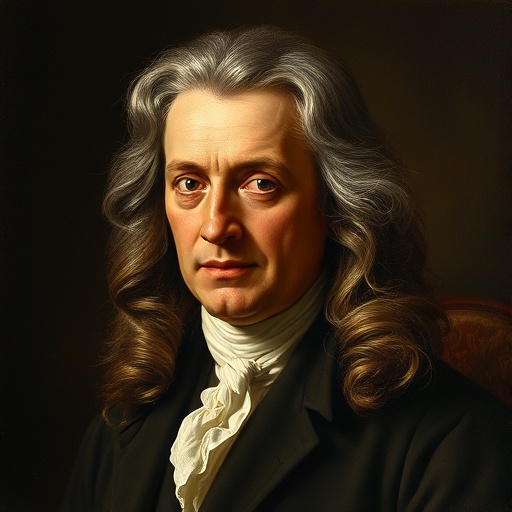
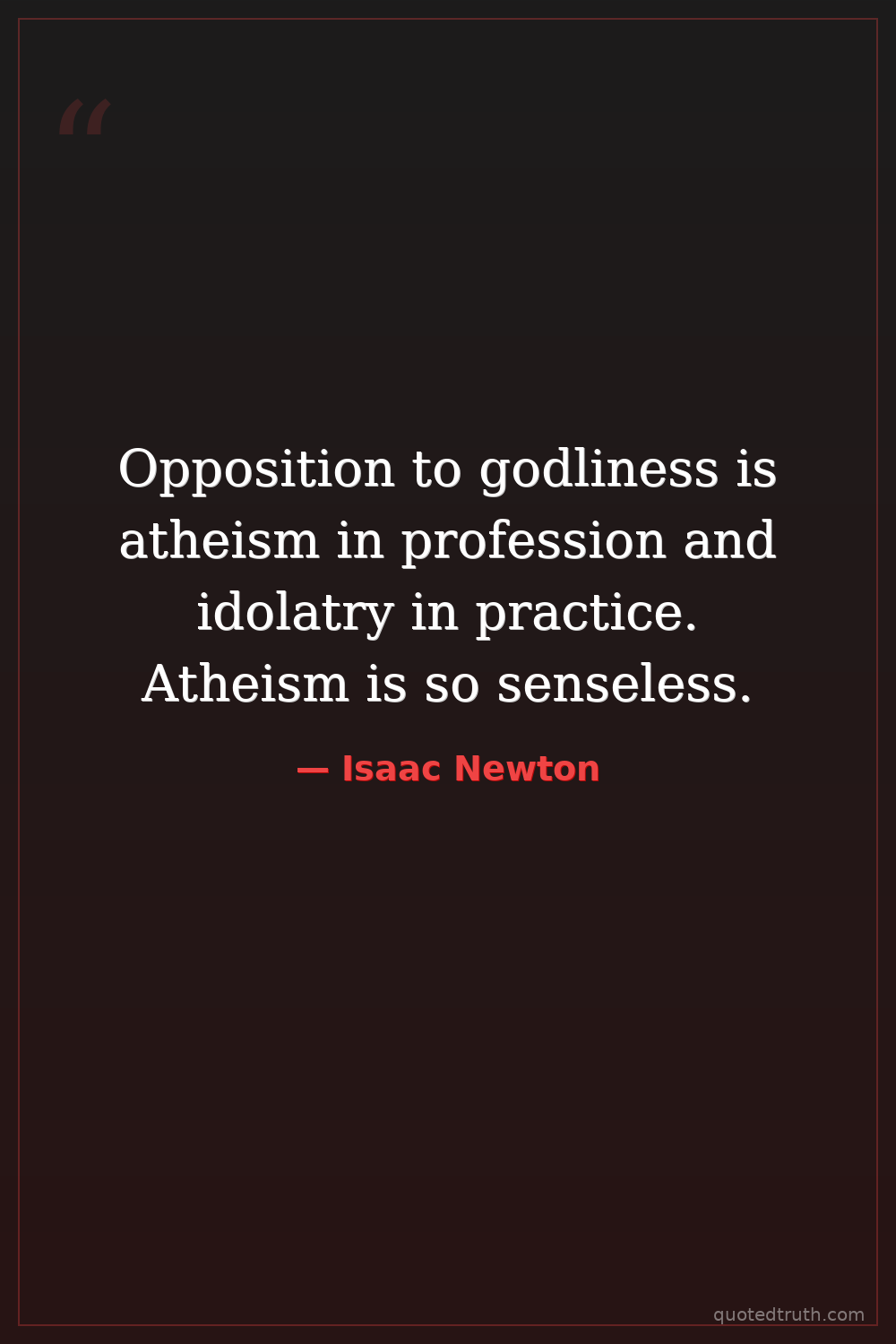
Isaac Newton — "Opposition to godliness is atheism in profession and idolatry in practice. Athei…"
Opposition to godliness is atheism in profession and idolatry in practice. Atheism is so senseless.
Opposition to godliness is atheism in profession and idolatry in practice. Atheism is so senseless.
Click any product to generate a realistic preview. Up to 3 at a time.
* Initial load can take up to 90 seconds — revising the preview in another color is nearly instant.
"For the best and safest way of philosophizing seems to be, first to inquire diligently into the properties of things, and of establishing them by experiment, and then to proceed more slowly to hypothe…"
"The greatest challenges to the truth of the Holy Scriptures are not the work of infidels, but of professing Christians."
"Atheism is so senseless and odious to mankind that it never had many professors."
"For if the experiments which I relate be accurate, the science of colours will be a new one; for although colours have been observed from antiquity, yet the cause of their productions has remained unk…"
"What goes up must come down."
Found in 1 providers: deepseek
1 source checked
Newton argues that rejecting godliness takes two forms: openly declaring atheism or practicing idolatry — worshipping the wrong things. He considers atheism fundamentally irrational, not just morally wrong. The universe's intricate order constitutes overwhelming evidence of a Creator, so denying God requires willful blindness rather than reasoned thought. True opposition to God manifests either through explicit creed or through misplaced devotion to lesser things.
Newton wrote more on theology than on science — his private papers contain millions of words on biblical prophecy and divine nature. He viewed the Principia's mathematical laws as revealing God's architecture directly. Though an Arian who rejected the Trinity, his faith was fierce and personal. His scientific method was inseparable from theology: discovering cosmic order meant discovering God's mind. Atheism contradicted everything his own research demonstrated to him.
Newton lived during the Scientific Revolution, when Hobbes and Spinoza were accused of dangerous atheism and pantheism. In 17th-century England, atheism was legally punishable and socially ruinous. Yet the era's new rational inquiry created genuine theological anxiety: could a mechanical universe still need God? Newton's circle — Boyle, Locke, the Royal Society — actively argued science proved divine design. This quote reflects that contested moment when natural philosophy and Christian faith were vigorously defended as mutually reinforcing.
AI-generated insights based on extensive research and information for context. Factual errors? Email [email protected].
Your cart is empty