What it means
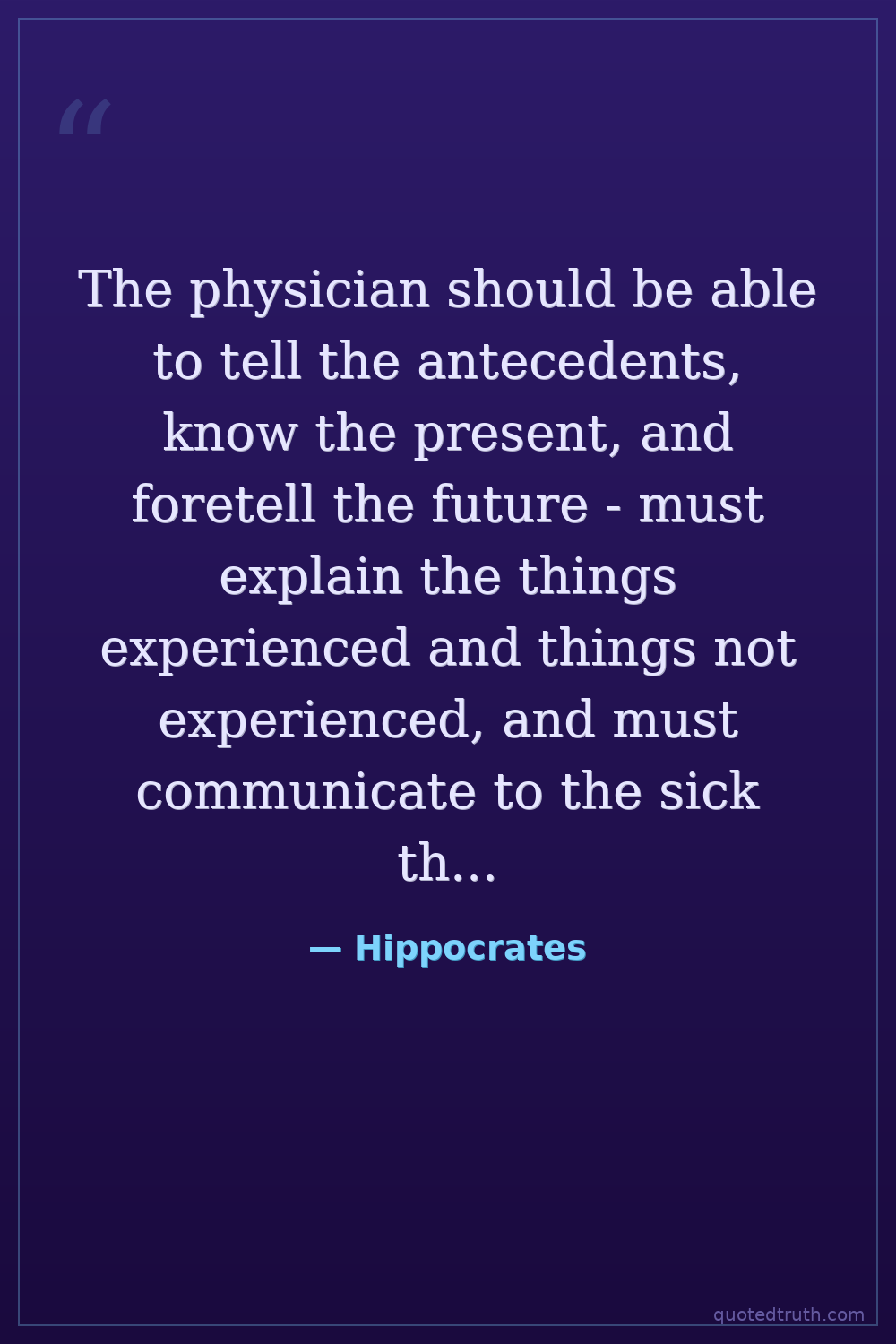
A good doctor must understand a patient's full history, accurately assess their current condition, and predict how the illness will progress. Beyond diagnosis, the physician must explain both what the patient has already experienced and what lies ahead, then clearly communicate what actions or treatments are needed. This is a call for holistic, transparent medicine built on observation, prognosis, and honest patient communication.
Relevance to Hippocrates
Hippocrates built Western medicine on systematic clinical observation rather than superstition, traveling across Greece documenting patient cases. He pioneered prognosis—predicting disease outcomes—and created detailed case histories in the Hippocratic Corpus. This quote directly mirrors his method: gather history, assess the present, forecast progression, and keep the patient informed. It encapsulates the empirical, patient-centered approach that earned him the title Father of Medicine.
The era
In ancient Greece around 400 BCE, illness was commonly attributed to divine punishment, with temple priests serving as healers. Hippocrates challenged this by insisting disease had natural, observable causes. Standardized medical training was nonexistent, making arbitrary treatment the norm. His demand that physicians study past, present, and future was revolutionary—paralleling the broader rational turn in Greek thought led by Socrates and Plato, replacing mysticism with evidence-based inquiry.
AI-generated insights based on extensive research and information for context. Factual errors? Email [email protected].