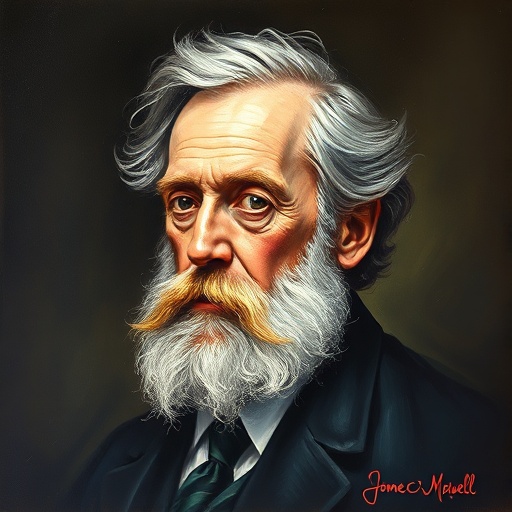
James Clerk Maxwell — "The present state of science is such that we cannot hope to explain all the phen…"
The present state of science is such that we cannot hope to explain all the phenomena of nature by means of a few simple laws.
The present state of science is such that we cannot hope to explain all the phenomena of nature by means of a few simple laws.
Click any product to generate a realistic preview. Up to 3 at a time.
* Initial load can take up to 90 seconds — revising the preview in another color is nearly instant.
"The only way of discovering the extent of the laws of nature is to try to transcend them."
"The true beginning of all knowledge is the discovery of something we do not know."
"The only use of a knowledge of the past is to equip us for the present."
"I have looked into most philosophical systems and I have seen that none will work without God."
"I have been battering away at Saturn, returning to the charge every now and then. I have effected several breaches in the solid ring, and now I am splash into the fluid one, amid a clash of symbols tr…"
Found in 1 providers: grok
1 source checked
Science has grown complex enough that we cannot reduce every natural phenomenon to a handful of tidy rules. Nature contains layers of behavior—mechanical, thermal, electrical, magnetic, chemical—that resist unification into one sweeping framework. Any honest researcher must accept that multiple partial theories, each accurate in its domain, will coexist. Expecting one master equation to cover everything is naive; real progress comes from carefully mapping where each law applies and where it breaks down.
Maxwell said this despite being the man who unified electricity, magnetism, and light into four equations—arguably the greatest reduction in physics before Einstein. The humility is striking: even after achieving unification in one domain, he recognized thermodynamics, molecular behavior, and gravitation still resisted tidy synthesis. As a devout Presbyterian and rigorous experimentalist who also worked on color vision, Saturn's rings, and statistical mechanics, he knew firsthand how different domains demanded different mathematical tools.
Maxwell wrote during the Victorian scientific explosion (1850s–1870s), when thermodynamics, kinetic theory, electromagnetism, and Darwinian biology were all erupting simultaneously. Laplace's earlier dream of a single deterministic mechanics governing everything was fracturing. Statistical methods were entering physics through Boltzmann and Maxwell himself, suggesting nature was probabilistic at small scales. The era's confidence in grand unification was giving way to specialization, and Maxwell sat at that hinge point, watching physics fragment into sub-disciplines even as he unified one.
AI-generated insights based on extensive research and information for context. Factual errors? Email [email protected].
Your cart is empty