What it means
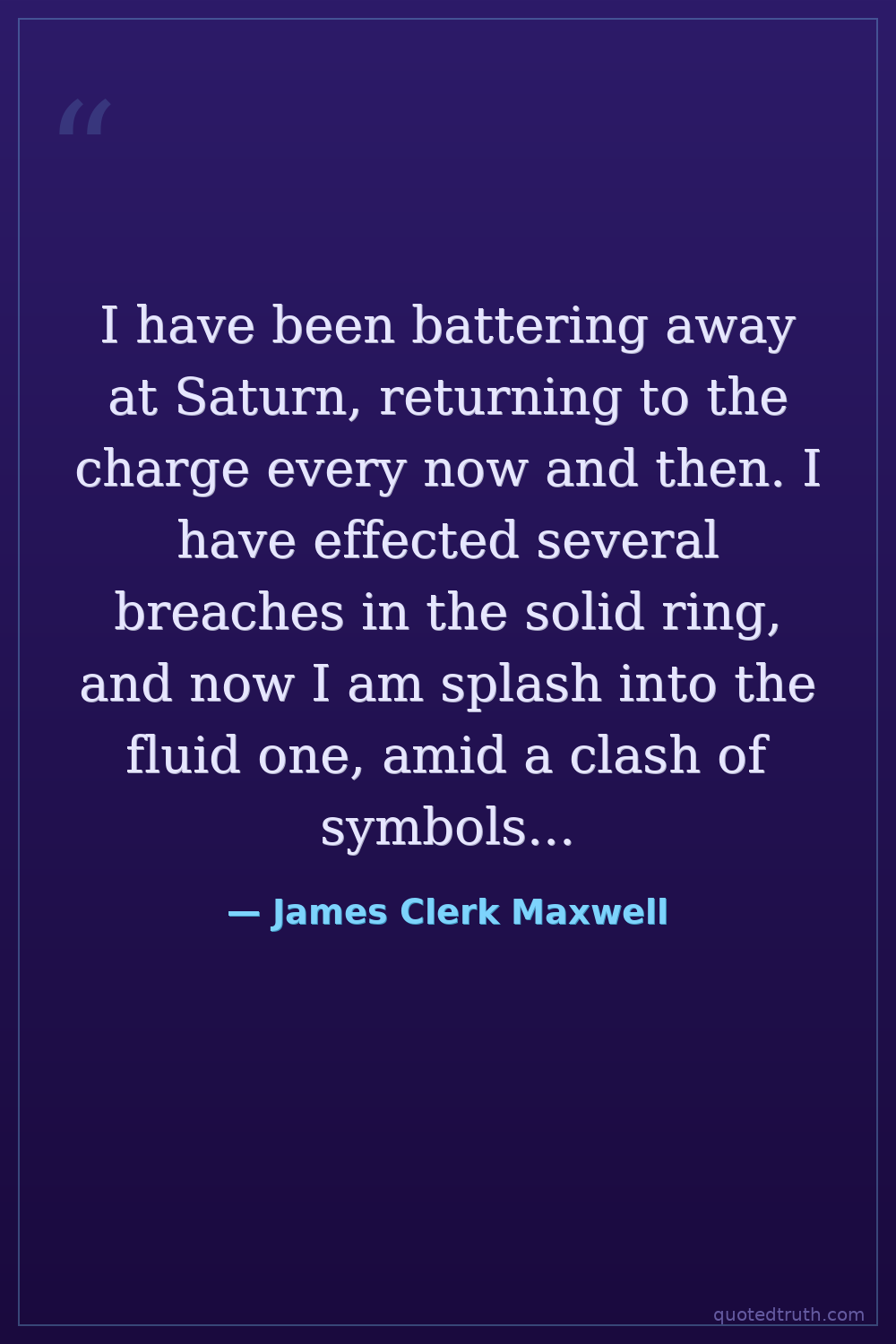
The speaker describes persistent intellectual work on a difficult problem about Saturn's rings, repeatedly returning to it like a soldier assaulting a fortress. He has made progress disproving the idea of a solid ring and is now tackling the fluid-ring hypothesis, drowning in a chaotic mess of mathematical equations. The pun on 'clash of symbols' (cymbals) signals both the noisy difficulty of the algebra and his playful relief at wrestling with it.
Relevance to James Clerk Maxwell
Maxwell won the 1857 Adams Prize for proving Saturn's rings must be countless small particles, not solid or fluid sheets. This letter captures his actual research process: dogged, iterative, and drenched in dense mathematics. The wordplay reflects his lifelong love of puns and verse, while the military metaphor mirrors how he attacked every problem—from electromagnetism to color vision—by demolishing competing hypotheses one equation at a time.
The era
Mid-1850s Cambridge mathematical physics was wrestling with celestial mechanics inherited from Laplace, and the Adams Prize specifically challenged scholars to settle Saturn's ring composition, unresolved for two centuries. Telescopes had improved but could not resolve the rings' structure, so the problem was purely theoretical. Maxwell's era prized rigorous mathematical proof over speculation, and his solid-ring disproof helped establish Britain's growing dominance in mathematical physics alongside Stokes, Kelvin, and Tait.
AI-generated insights based on extensive research and information for context. Factual errors? Email [email protected].