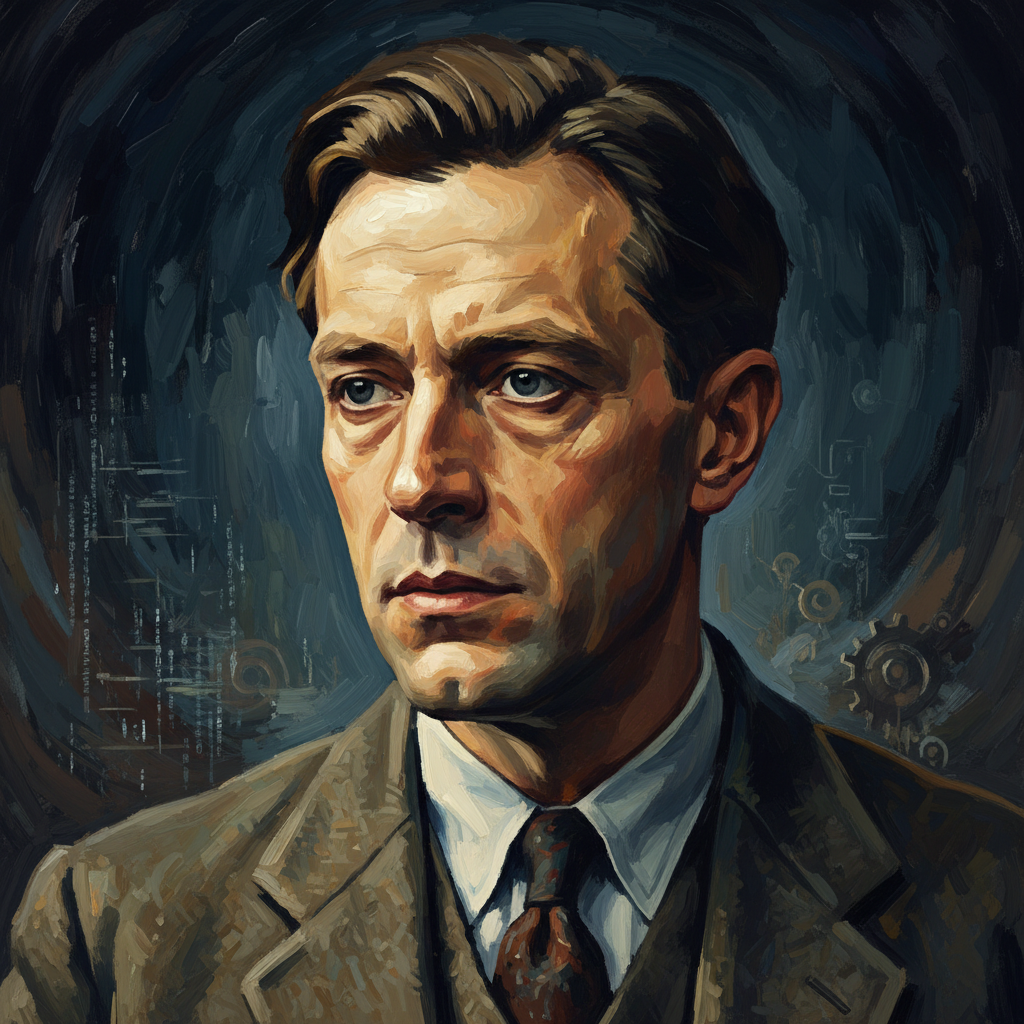
Alan Turing — "The problem of intelligence is a very difficult one."
The problem of intelligence is a very difficult one.
The problem of intelligence is a very difficult one.
Click any product to generate a realistic preview. Up to 3 at a time.
* Initial load can take up to 90 seconds — revising the preview in another color is nearly instant.
"The question of whether machines can think is a philosophical one, not a scientific one."
"The problems of biology can be reduced to physics and chemistry."
"No, I'm not interested in developing a powerful brain. All I'm interested in is a moderately trained brain. The kind that would be useful in daily life."
"The idea of a 'soul' is a philosophical concept, not a scientific one."
"The popular view is that the brain is a kind of telephone exchange. I believe that it is not quite as simple as that."
Found in 1 providers: grok
1 source checked
Intelligence resists simple definition or measurement. It encompasses learning, reasoning, adaptation, and creativity in ways that overlap and resist clear boundaries. Understanding it well enough to replicate or even fully describe it demands confronting questions about mind, consciousness, and what separates thinking from computation. The difficulty lies not just in building intelligent systems, but in agreeing on what intelligence actually is before any systematic study or engineering can begin.
Turing spent his career directly attacking this problem. His 1950 paper 'Computing Machinery and Intelligence' proposed the Imitation Game — now called the Turing Test — precisely because defining intelligence philosophically was intractable, so he proposed testing it behaviorally instead. He designed early neural network concepts he called 'unorganised machines' and broke Enigma by modeling human reasoning patterns. The admission of difficulty reflects genuine intellectual honesty from someone who understood the problem's depth better than almost anyone.
Turing made this observation in the late 1940s and early 1950s, when the first electronic computers were just emerging — ENIAC, Colossus, Manchester Mark 1. No formal discipline of artificial intelligence yet existed; that term would not be coined until 1956 at Dartmouth, two years after his death. The question of machine thought was wide open and contested. Cold War pressures pushed investment in computing, making the stakes of understanding and potentially replicating human intelligence suddenly practical, not just philosophical.
AI-generated insights based on extensive research and information for context. Factual errors? Email [email protected].
Your cart is empty