Alan Turing — "The question whether machines can think is as meaningless as the question whethe…"
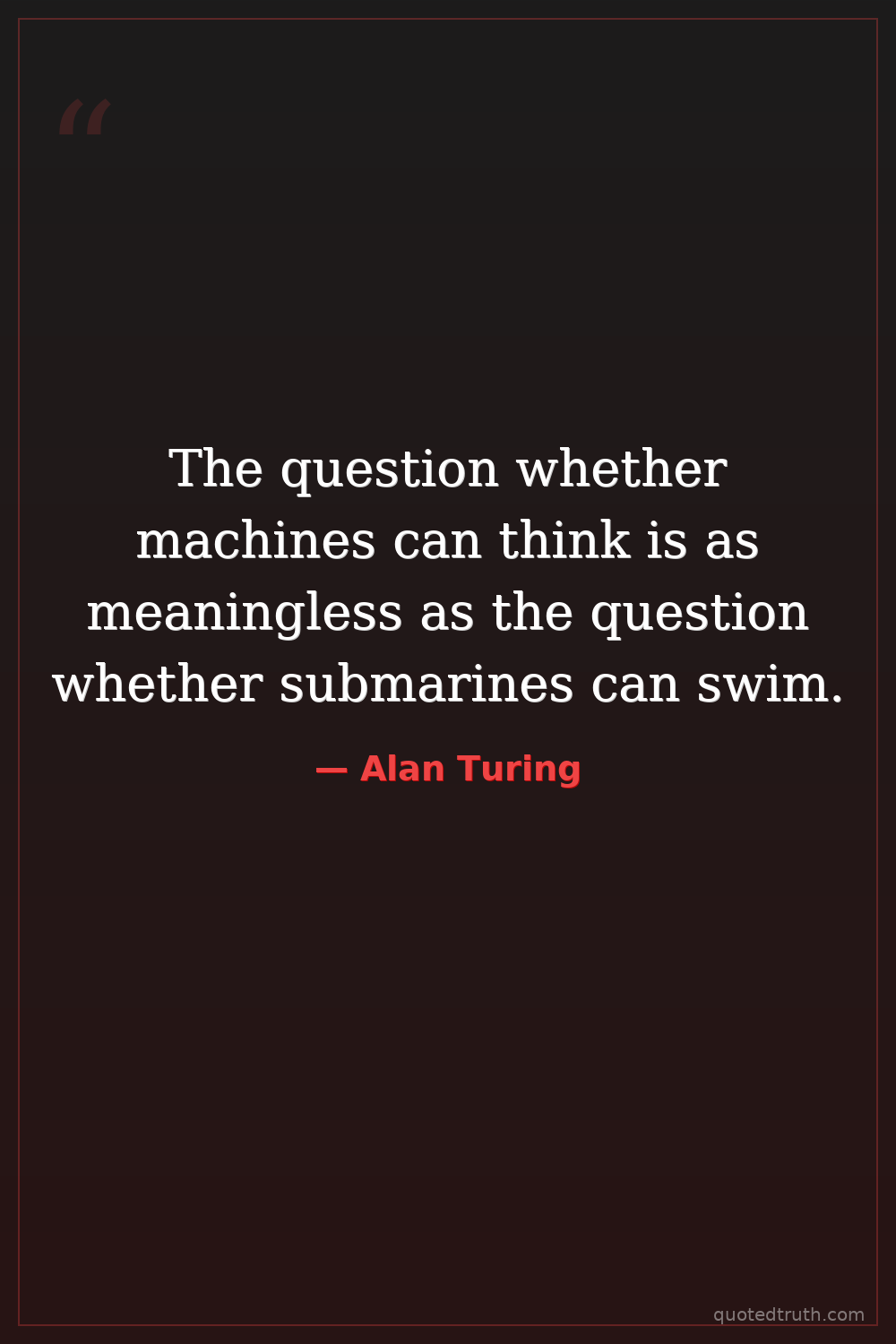
The question whether machines can think is as meaningless as the question whether submarines can swim.
The question whether machines can think is as meaningless as the question whether submarines can swim.
Click any product to generate a realistic preview. Up to 3 at a time.
* Initial load can take up to 90 seconds — revising the preview in another color is nearly instant.
"Once the machine thinking method had started, it would not take long to outstrip our feeble powers."
"Arguments against the hope of artificial intelligence included that 'you will never be able to make [a machine] to do' any of these: Be kind, resourceful, beautiful, friendly, have initiative, have a …"
"The question of whether machines can think is a philosophical one, not a scientific one."
"The digital computer is a universal machine, capable of simulating any other machine."
"The machine should be able to learn from experience."
Attributed, a popular quote, but its exact wording and source are sometimes debated. Reflects his operational definition of 'thinking'.
Date: Unknown, likely 1950s
GeneralFound in 1 providers: grok
1 source checked
Asking whether machines can think is a pointless semantic debate. The word 'think' carries biological baggage that clouds the real question. What matters is whether a machine can perform intelligent behavior indistinguishably from a human — a functional test, not a philosophical one. Reframing the question around observable behavior cuts through circular arguments about consciousness and gets to something actually measurable.
Turing spent his career building machines that solved problems humans considered purely mental — cracking Enigma required intuition, pattern recognition, creative leaps. He invented the Turing Test precisely to sidestep unanswerable questions about machine consciousness. His own brilliant, methodical mind made him skeptical of definitions that privileged biology over function.
In the 1950s, computing was newborn and scientists fiercely debated whether machines could ever be truly intelligent. Cold War pressures accelerated computer development while philosophers questioned the nature of mind. Turing's reframing challenged both religious assumptions about the soul's uniqueness and academic philosophy's tendency toward unresolvable abstraction — radical pragmatism in a deeply ideological moment.
AI-generated insights based on extensive research and information for context. Factual errors? Email [email protected].
Your cart is empty