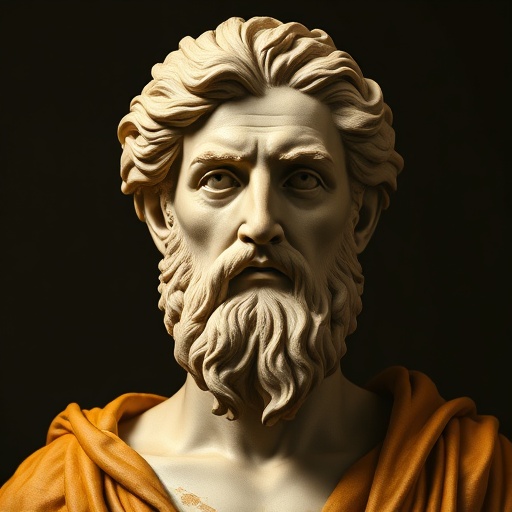
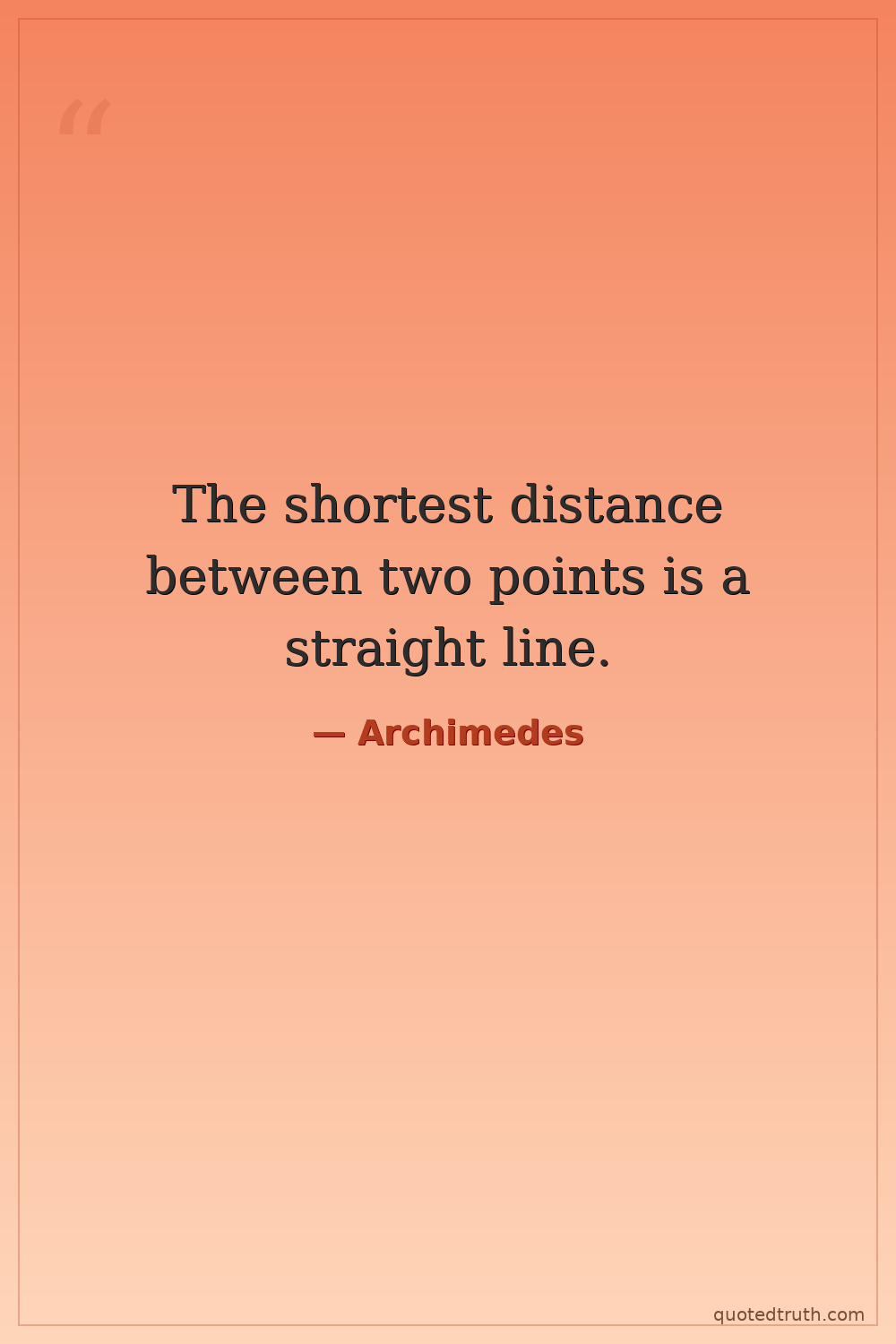
Archimedes — "The shortest distance between two points is a straight line."
The shortest distance between two points is a straight line.
The shortest distance between two points is a straight line.
Click any product to generate a realistic preview. Up to 3 at a time.
* Initial load can take up to 90 seconds — revising the preview in another color is nearly instant.
"The surface of any sphere is four times its greatest circle."
"The sun is a very large body, much larger than the Earth."
"No difficulty can be too great for the human mind, if it applies itself with diligence and skill."
"There are some who think that the number of the sand is infinite in multitude."
"It is a property of the circle that the ratio of its circumference to its diameter is the same for all circles."
Found in 1 providers: grok
1 source checked
A straight line is always the most efficient path between two locations — no curved or indirect route can ever be shorter. In everyday terms, taking a direct approach, physically, logically, or strategically, is always more efficient than a roundabout one. It captures a mathematical truth underlying navigation, engineering, and problem-solving: efficiency means eliminating the unnecessary and moving directly toward the goal.
Archimedes spent his life reducing complex physical and geometric problems to their essential truths. He calculated the area of a parabola, the volume of a sphere, and the mechanics of levers — all requiring rigorous geometric reasoning. This axiom mirrors his core methodology: strip away complexity, find the most direct logical path. His engineering feats in Syracuse, including war machines and the Archimedes screw, demanded exactly this discipline of geometric efficiency.
In 3rd-century BCE Syracuse, Greek mathematicians were building the logical foundations of Western science. Euclid had recently systematized geometry in his Elements, establishing provable axioms as the bedrock of knowledge. Archimedes worked within this tradition, applying geometric principles to real engineering challenges — from defending Syracuse against Roman siege to lifting water. This axiom embodied the Greek ideal: universal, provable truths derived by pure reason and applicable to any problem in the physical world.
AI-generated insights based on extensive research and information for context. Factual errors? Email [email protected].
Your cart is empty