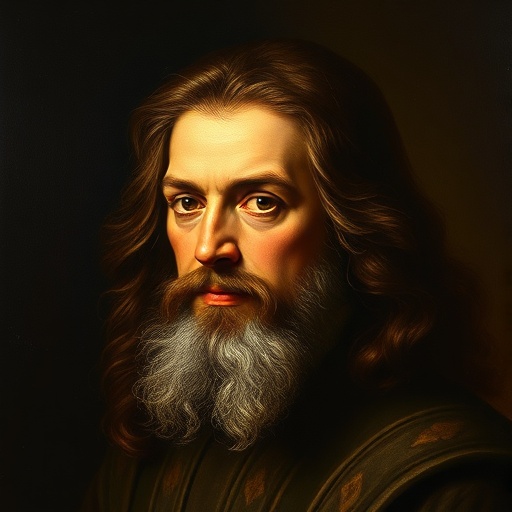
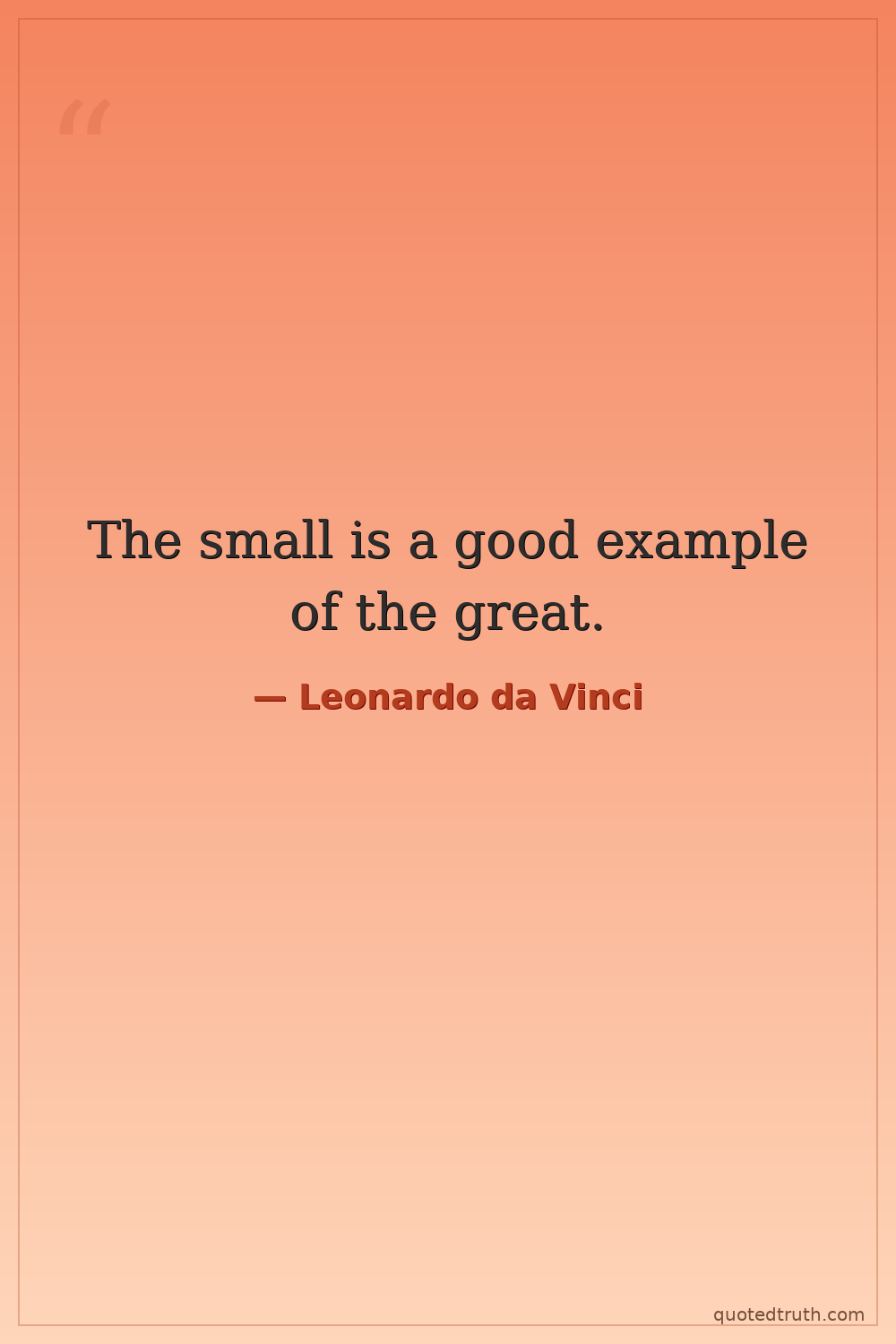
Leonardo da Vinci — "The small is a good example of the great."
The small is a good example of the great.
The small is a good example of the great.
Click any product to generate a realistic preview. Up to 3 at a time.
* Initial load can take up to 90 seconds — revising the preview in another color is nearly instant.
"Truth was the only daughter of time."
"To develop a complete mind: Study the art of science; Study the science of art. Learn how to see. Realize that everything connects to everything else."
"The human foot is a masterpiece of engineering and a work of art."
"I have been impressed with the urgency of doing. Knowing is not enough; we must apply. Being willing is not enough; we must do."
"The more subtle we are, the more we are deceived."
Found in 1 providers: grok
1 source checked
Small-scale phenomena mirror and illuminate large-scale ones. Understanding a single leaf reveals how forests function; studying a ripple teaches ocean dynamics. Scale does not change underlying principles — the same rules govern the tiny and the enormous. By closely examining what is near and observable, we can deduce the nature of what is vast and inaccessible. Small things are not lesser versions of reality; they are precise windows into universal truths.
Leonardo spent decades filling notebooks with observations of water currents, muscle fibers, rock strata, and bird wings — all to decode larger systems. His anatomical dissections revealed universal human structure through individual specimens. His engineering designs scaled mechanical principles from small models to enormous machines. This conviction that microcosm reflects macrocosm drove his entire method: observe the particular to grasp the universal, threading through his painting, anatomy, geology, and fluid dynamics work.
The Italian Renaissance was reshaping how Europeans understood nature. Scholars rejected pure scholastic authority and turned to direct observation, but lacked modern instruments — the microscope wouldn't exist until after Leonardo's death. Studying small, accessible phenomena was the only practical path into natural philosophy. The ancient microcosm-macrocosm framework — the human body reflecting the cosmos — remained culturally powerful, lending Leonardo's empirical version of this idea both philosophical legitimacy and radical, forward-looking scientific ambition.
AI-generated insights based on extensive research and information for context. Factual errors? Email [email protected].
Your cart is empty