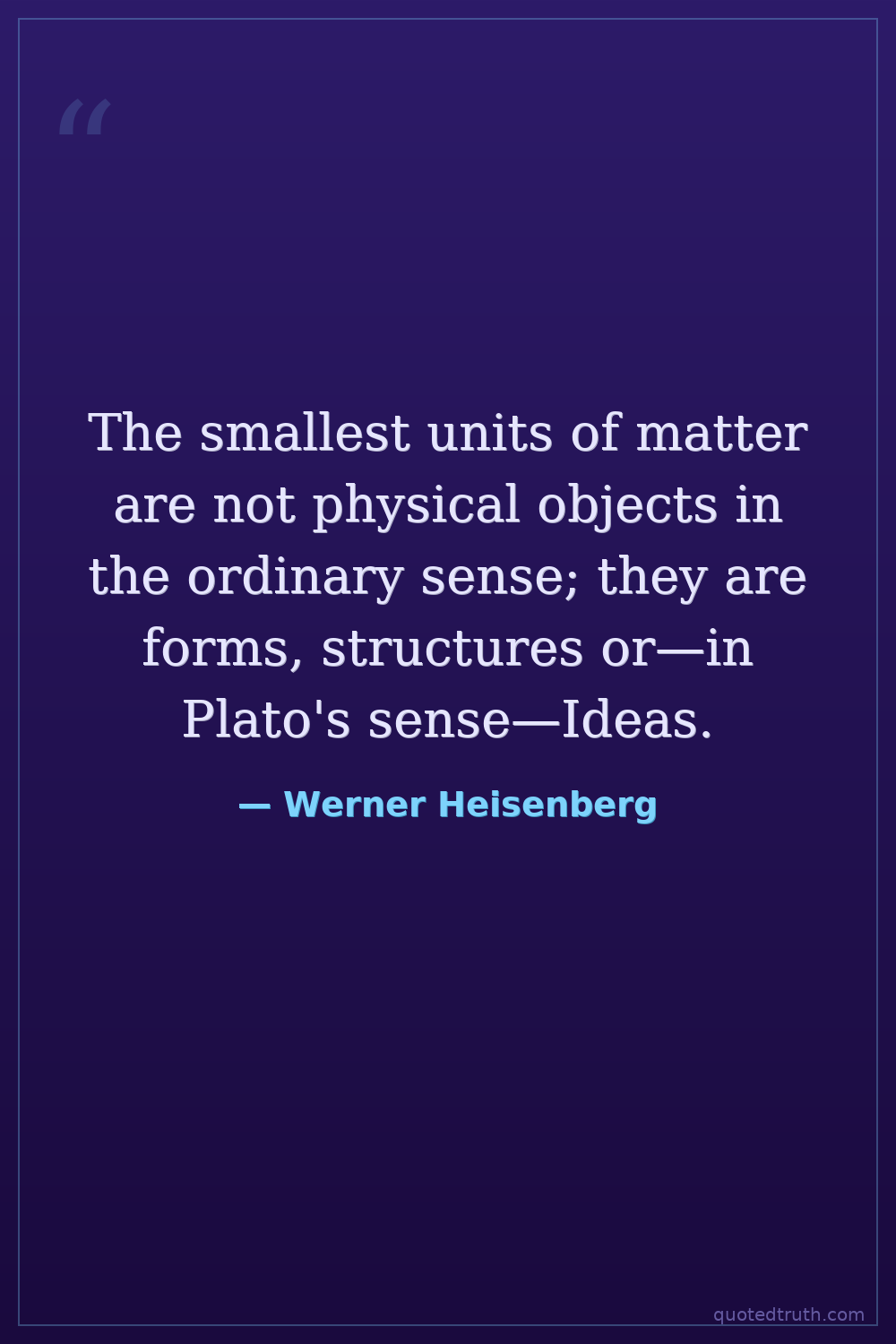
Werner Heisenberg — "The smallest units of matter are not physical objects in the ordinary sense; the…"
The smallest units of matter are not physical objects in the ordinary sense; they are forms, structures or—in Plato's sense—Ideas.
The smallest units of matter are not physical objects in the ordinary sense; they are forms, structures or—in Plato's sense—Ideas.
Click any product to generate a realistic preview. Up to 3 at a time.
* Initial load can take up to 90 seconds — revising the preview in another color is nearly instant.
"It is not surprising that our language should be incapable of describing the processes occurring within the atoms, for, as has been remarked, it was invented to describe the experiences of daily life,…"
"The path to the new physics was paved by the discovery of the quantum of action."
"The world is not composed of 'things' but of 'events'."
"When we speak of a picture of reality, we always mean a classical picture."
"The history of physics is not only a sequence of experimental discoveries and observations, but also a history of concepts."
Philosophical interpretation of elementary particles
Date: 1955 (Physics and Philosophy)
WisdomFound in 1 providers: grok
1 source checked
At the deepest level, matter isn't made of tiny solid pieces you can picture like marbles. What exists are patterns, relationships, and mathematical forms that give rise to what we call particles. Reality at its foundation is closer to abstract structure than to stuff. The building blocks behave more like ideas expressed in equations than like miniature objects with definite shape, location, or substance.
Heisenberg pioneered quantum mechanics and formulated the uncertainty principle, showing that electrons have no fixed position and momentum simultaneously. Trained in philosophy alongside physics, he openly drew on Plato, whose Timaeus he read as a teenager. His matrix mechanics abandoned visualizable orbits for abstract mathematical relations, and he spent his later career defending the view that symmetries and mathematical forms, not tiny billiard balls, are fundamental reality.
Written in the mid-20th century, as physicists confronted results that shattered classical intuitions: wave-particle duality, nuclear fission, and antimatter. Postwar Europe was rebuilding while Cold War physics poured money into ever-smaller probes of matter. Philosophers and scientists debated whether reality was knowable at all. Heisenberg's Platonism pushed back against crude materialism at a moment when atomic weapons made 'what matter really is' an urgent cultural question.
AI-generated insights based on extensive research and information for context. Factual errors? Email [email protected].
Your cart is empty