Werner Heisenberg — "The history of physics is not only a sequence of experimental discoveries and ob…"
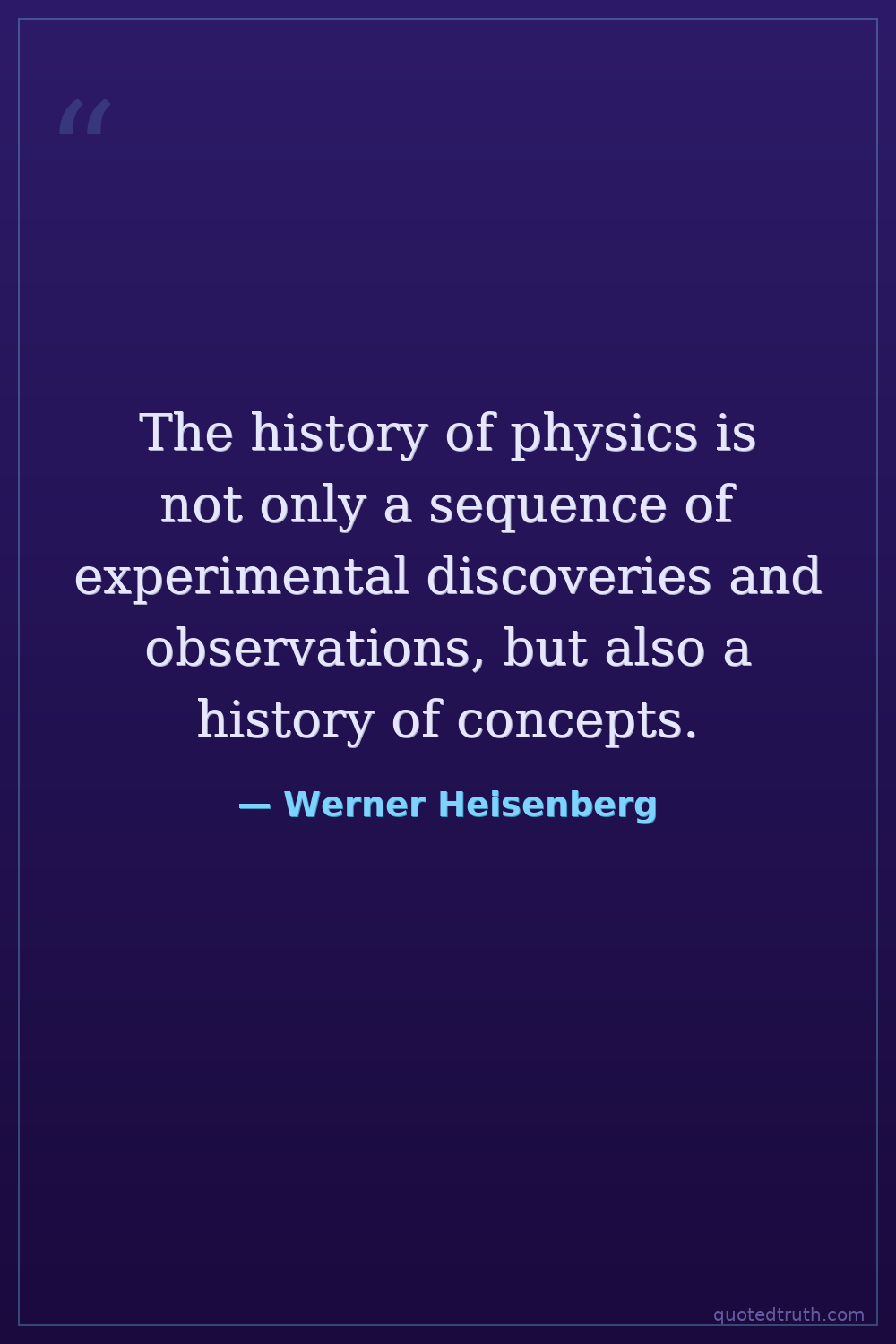
The history of physics is not only a sequence of experimental discoveries and observations, but also a history of concepts.
The history of physics is not only a sequence of experimental discoveries and observations, but also a history of concepts.
Click any product to generate a realistic preview. Up to 3 at a time.
* Initial load can take up to 90 seconds — revising the preview in another color is nearly instant.
"I was forced to find a new way of expressing the fundamental laws of nature, one which would not rely on the outdated concepts of classical physics."
"Can nature possibly be so absurd as it seemed to us in these atomic experiments?"
"You spoke in a manner that could only give me the firm impression that under your leadership everything was being done in Germany to develop atomic weapons."
"The more profound the knowledge, the more clear is the awareness of the limits of our knowledge."
"I would say that I was absolutely convinced of the possibility of our making a uranium engine. but I never thought that we would make a bomb. and at the bottom of my heart. I was really glad that it w…"
Found in 1 providers: grok
1 source checked
Progress in physics isn't just about running experiments and recording data. It also involves the evolution of ideas, frameworks, and mental models used to interpret the world. New concepts like force, energy, field, or probability reshape how scientists understand reality. Observations only gain meaning once a concept exists to explain them, so intellectual breakthroughs matter as much as empirical ones in shaping the science.
Heisenberg helped overturn classical concepts by formulating quantum mechanics and the uncertainty principle, which demanded entirely new ways of thinking about position, momentum, and measurement. He wrestled directly with the philosophical weight of concepts, debating Bohr and Einstein over how reality should be described. His matrix mechanics wasn't just a discovery but a conceptual rebuild, making him acutely aware that physics advances through reframed ideas, not data alone.
Heisenberg worked during the 1920s-1970s, when physics underwent its deepest conceptual revolution since Newton. Relativity and quantum theory shattered classical intuitions about space, time, causality, and observation. Scientists openly debated the philosophical foundations of their field, alongside wartime pressures, the atomic bomb, and Cold War science policy. In this climate, physicists like Heisenberg saw firsthand that experiments alone couldn't drive progress; new conceptual frameworks were required to make sense of an increasingly counterintuitive universe.
AI-generated insights based on extensive research and information for context. Factual errors? Email [email protected].
Your cart is empty