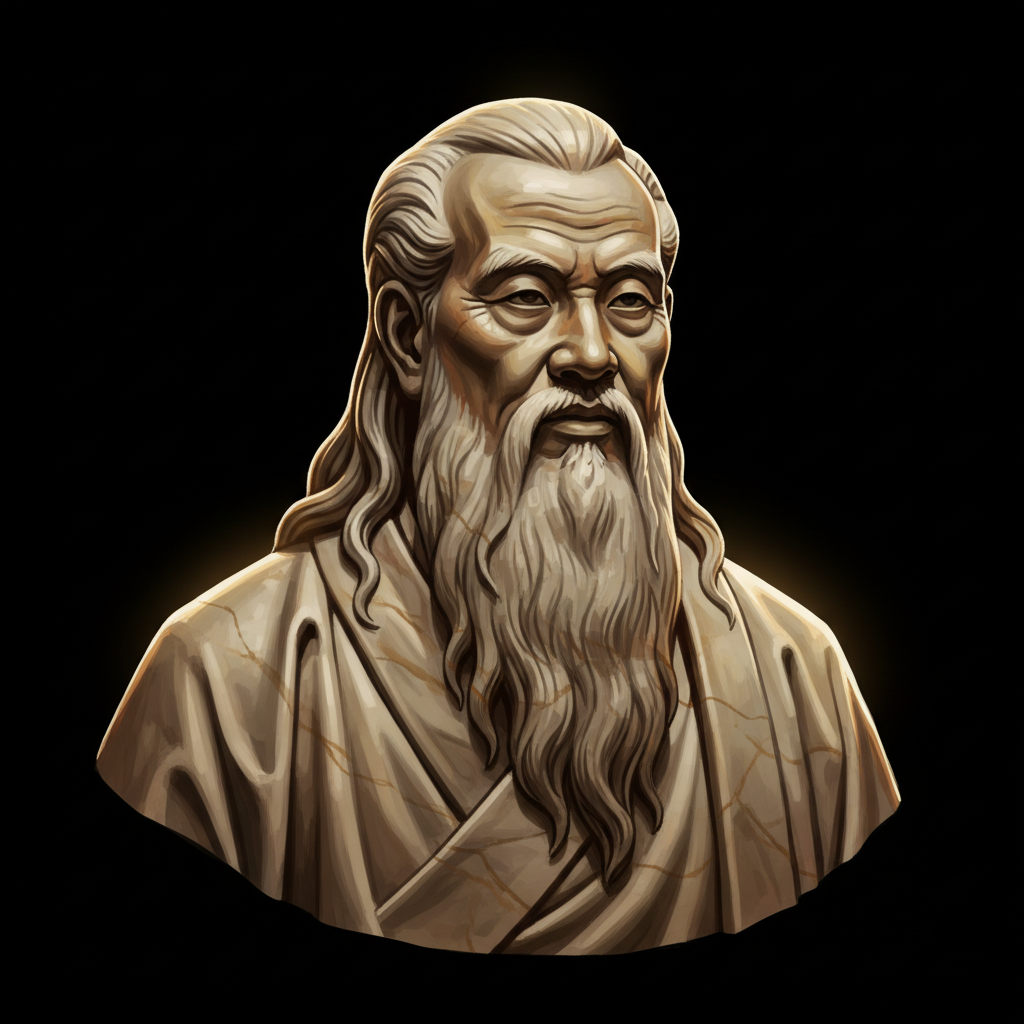
Laozi — "The softest thing in the world can overcome the hardest thing in the world."
The softest thing in the world can overcome the hardest thing in the world.
The softest thing in the world can overcome the hardest thing in the world.
Click any product to generate a realistic preview. Up to 3 at a time.
* Initial load can take up to 90 seconds — revising the preview in another color is nearly instant.
"When the government is lax, the people are simple. When the government is meddlesome, the people are discontented."
"The sage attends to the belly, and not to what he sees."
"Govern a great nation as you would cook a small fish. (Do not overdo it.)"
"When the Master governs, the people are hardly aware that he exists. Next best is a leader who is loved. Next, one who is feared. The worst is one who is despised."
"Let people return to making knots on ropes, instead of writing."
Reputed founder of Taoism and author of the Tao Te Ching, whose wu wei (effortless action) shaped East Asian philosophy. Closely associated with Zhuangzi (later Taoist who extended Laozi's framework). For an intellectual contrast, see Confucius, near-contemporary Chinese sage of social ritual and duty — Confucius systematized social order through ritual and hierarchy; Laozi argued that all such systems were the disease, not the cure — the two founding poles of Chinese moral philosophy.
Found in 3 providers: deepseek,grok,gemini
3 sources checked
Gentleness and flexibility ultimately defeat rigid force. Water, seemingly weak, carves through stone; a yielding approach outlasts brute strength. What seems fragile or passive holds hidden power because it adapts, persists, and flows around obstacles rather than crashing into them. Strength through softness means patience, suppleness, and not forcing outcomes. Rigid things break; flexible things endure. The quote urges choosing adaptability over aggression when facing resistance.
Laozi built Taoism around wu wei, effortless action, and the power of yielding. He used water as his central metaphor for the Tao, praising its humility and ability to reshape landscapes without struggle. As a reclusive sage and archivist who reportedly withdrew from court life rather than fight its politics, he embodied the soft-overcomes-hard principle. The Tao Te Ching repeatedly elevates weakness, emptiness, and receptivity above dominance, force, and calculated ambition.
Laozi lived during China's turbulent Spring and Autumn period, around the 6th century BCE, when rival states waged constant war and Confucian thinkers pushed rigid hierarchy, ritual, and moral duty as society's fix. Against that militarized, rule-bound backdrop, teaching that softness defeats hardness was radical counterprogramming. It challenged warlords and bureaucrats alike, offering rulers and commoners a quieter path rooted in nature's rhythms rather than force, conquest, or imposed order.
AI-generated insights based on extensive research and information for context. Factual errors? Email [email protected].
Your cart is empty