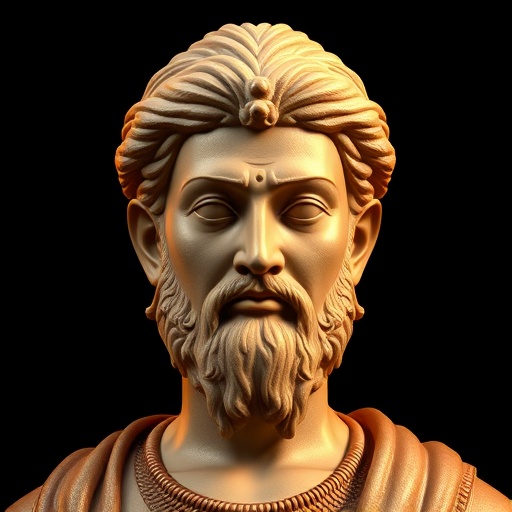
Mahavira — "The soul is entangled in the web of karma."
The soul is entangled in the web of karma.
The soul is entangled in the web of karma.
Click any product to generate a realistic preview. Up to 3 at a time.
* Initial load can take up to 90 seconds — revising the preview in another color is nearly instant.
"The world is full of illusion, and the truth is hidden."
"There is no quality of soul more subtile than non-attachment."
"The essence of knowledge is to know the self."
"A man should wander about treating all creatures as he himself would be treated."
"Do not be proud of wealth, people, relations, or youth; time takes all away in a moment."
24th and last Tirthankara of Jainism, whose teachings of strict ahimsa (non-violence), aparigraha (non-attachment), and karma reshaped ancient Indian religion. Closely associated with The Buddha (near-contemporary moral revolutionary, also reacting against Vedic ritualism). For an intellectual contrast, see Vedic Brahmanical ritual sacrifice, the animal-sacrifice-centered Vedic religion of his era — Mahavira's ahimsa demanded total non-violence, including not eating root vegetables that kill the plant — a maximum-distance ethical move from the Vedic priestly tradition that ritually sacrificed cattle and horses. The two cleanest poles of ancient Indian religious ethics.
Found in 1 providers: grok
1 source checked
Every action, thought, and intention leaves a residue that binds the soul to a cycle of rebirth and suffering. The soul isn't free — it's caught in consequences of past deeds. Liberation requires deliberately breaking those bonds through disciplined, non-harmful living. In modern terms: we are shaped and constrained by the accumulated weight of our choices, and freedom demands real effort to undo that buildup.
Mahavira spent 12 years in intense ascetic practice — fasting, celibacy, silence — specifically to burn off accumulated karma and free his soul. Jainism's entire ethical framework, including ahimsa and non-attachment, exists to stop adding new karmic weight. As the 24th Tirthankara, he claimed to have achieved full liberation himself, making this quote a personal diagnosis of the human condition he dedicated his life to escaping.
Mahavira lived around 599–527 BCE in northeastern India, during the Axial Age — a period of intense philosophical questioning about suffering and liberation. Vedic Brahminism dominated, emphasizing ritual sacrifice and priestly authority. Mahavira's karma doctrine challenged this, arguing liberation was entirely self-earned through ethical conduct, not ritual or divine favor — a radical democratizing of spiritual accountability in a deeply caste-stratified society.
AI-generated insights based on extensive research and information for context. Factual errors? Email [email protected].
Your cart is empty