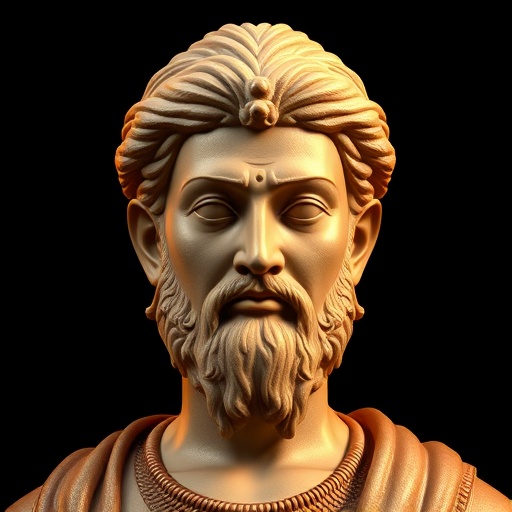
Mahavira — "The soul is pure, eternal, and full of infinite knowledge, vision, power, and bl…"
The soul is pure, eternal, and full of infinite knowledge, vision, power, and bliss.
The soul is pure, eternal, and full of infinite knowledge, vision, power, and bliss.
Click any product to generate a realistic preview. Up to 3 at a time.
* Initial load can take up to 90 seconds — revising the preview in another color is nearly instant.
"The soul is the only reality; the rest is illusion."
"Live and allow others to live; hurt no one; life is dear to all living beings."
"One should not speak ill of others."
"All living beings are endowed with consciousness."
"The universe is governed by immutable laws."
24th and last Tirthankara of Jainism, whose teachings of strict ahimsa (non-violence), aparigraha (non-attachment), and karma reshaped ancient Indian religion. Closely associated with The Buddha (near-contemporary moral revolutionary, also reacting against Vedic ritualism). For an intellectual contrast, see Vedic Brahmanical ritual sacrifice, the animal-sacrifice-centered Vedic religion of his era — Mahavira's ahimsa demanded total non-violence, including not eating root vegetables that kill the plant — a maximum-distance ethical move from the Vedic priestly tradition that ritually sacrificed cattle and horses. The two cleanest poles of ancient Indian religious ethics.
Samayasara (a later text reflecting Mahavira's teachings)
Date: circa 5th-6th century BCE (core teaching)
BiblicalFound in 1 providers: grok
1 source checked
Every living being possesses a soul that is inherently perfect, immortal, and contains boundless capacity for understanding, perception, strength, and happiness. This isn't earned or granted by gods — it's the soul's natural state. Human suffering stems not from the soul itself but from karma and material attachments obscuring these qualities. Liberation means stripping away that obscuration to reveal what was always there.
Mahavira, the 24th Tirthankara, spent 12 years in severe ascetic practice precisely to realize this truth personally. He abandoned his kingdom, family, and possessions — not because the world was evil, but because attachment concealed the soul's inherent perfection. His enlightenment at age 42 was understood as uncovering, not acquiring, infinite knowledge. His entire teaching centered on this conviction about the soul's innate divinity.
6th century BCE India witnessed intense religious ferment alongside Vedic Brahmanism's dominance, which stratified spiritual access through caste and ritual. Mahavira's radical assertion that every soul — regardless of caste, gender, or birth — possesses infinite perfection was profoundly subversive. It challenged priestly intermediaries, hereditary spiritual hierarchies, and the notion that divine grace determined liberation, instead placing full responsibility and capacity within each individual.
AI-generated insights based on extensive research and information for context. Factual errors? Email [email protected].
Your cart is empty