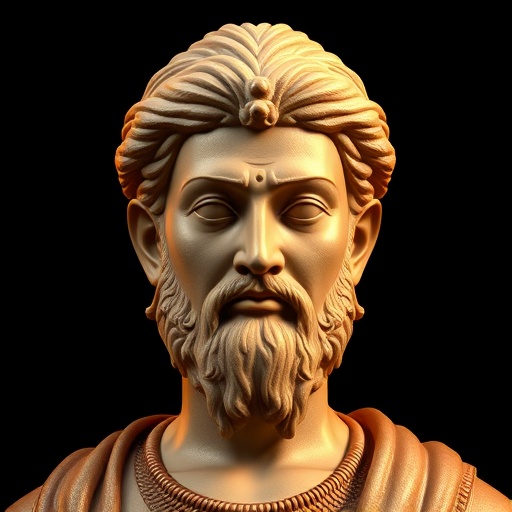
Mahavira — "The universe is governed by immutable laws."
The universe is governed by immutable laws.
The universe is governed by immutable laws.
Click any product to generate a realistic preview. Up to 3 at a time.
* Initial load can take up to 90 seconds — revising the preview in another color is nearly instant.
"Do not be led by the senses, but lead the senses."
"A man is born alone and dies alone; and he experiences the good and bad consequences of his karma alone; and he goes alone to hell or the supreme abode."
"Kill no living thing."
"Conquer your passions and you will conquer the world."
"Do not be proud of wealth, people, relations, or youth; time takes all away in a moment."
24th and last Tirthankara of Jainism, whose teachings of strict ahimsa (non-violence), aparigraha (non-attachment), and karma reshaped ancient Indian religion. Closely associated with The Buddha (near-contemporary moral revolutionary, also reacting against Vedic ritualism). For an intellectual contrast, see Vedic Brahmanical ritual sacrifice, the animal-sacrifice-centered Vedic religion of his era — Mahavira's ahimsa demanded total non-violence, including not eating root vegetables that kill the plant — a maximum-distance ethical move from the Vedic priestly tradition that ritually sacrificed cattle and horses. The two cleanest poles of ancient Indian religious ethics.
Found in 1 providers: grok
1 source checked
Reality operates according to fixed, unchanging principles — not divine whim, chance, or arbitrary supernatural will. Everything that exists follows consistent, discoverable rules. Actions have unavoidable consequences. The natural order is reliable and predictable, making no exceptions regardless of status or prayer. This positions the cosmos as a self-regulating system humans can understand and navigate, rather than a realm subject to the moods or intervention of gods.
Mahavira rejected a creator god — Jainism is explicitly non-theistic. He taught that karma operates mechanically, producing unavoidable consequences for every action without divine mediation. His twelve years of rigorous asceticism were a practical application of this belief: he subjected himself to cosmic law rather than seeking divine favor. As the 24th Tirthankara, his path to omniscience was earned entirely through disciplined adherence to principles he understood as fixed and universal.
Mahavira lived in 6th–5th century BCE India, when Vedic Brahmanism dominated, teaching that gods controlled cosmic events and priests could intercede through ritual sacrifice. Claiming the universe obeys fixed, impersonal laws — not divine personalities — directly challenged priestly authority and made liberation accessible to anyone, regardless of caste. This era also saw the rise of Buddhism and Upanishadic philosophy, a sweeping intellectual revolt questioning whether cosmic order required divine intermediaries at all.
AI-generated insights based on extensive research and information for context. Factual errors? Email [email protected].
Your cart is empty