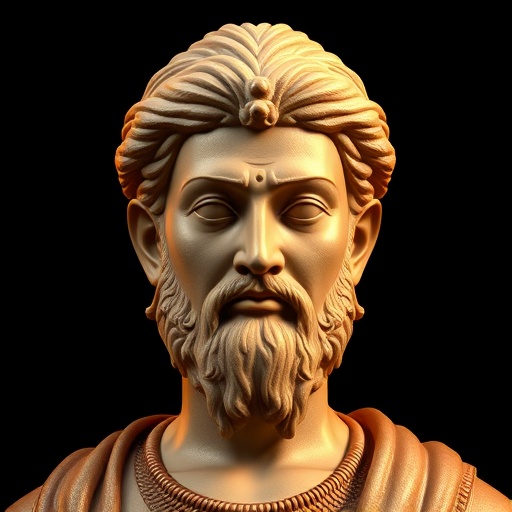
Mahavira — "All living beings are endowed with consciousness."
All living beings are endowed with consciousness.
All living beings are endowed with consciousness.
Click any product to generate a realistic preview. Up to 3 at a time.
* Initial load can take up to 90 seconds — revising the preview in another color is nearly instant.
"The highest form of worship is to serve humanity."
"The self is the friend and enemy of the self."
"The virtuous person is never afraid of death."
"The soul is the only thing that is eternal; everything else is temporary."
"The wise man is free from all attachments."
24th and last Tirthankara of Jainism, whose teachings of strict ahimsa (non-violence), aparigraha (non-attachment), and karma reshaped ancient Indian religion. Closely associated with The Buddha (near-contemporary moral revolutionary, also reacting against Vedic ritualism). For an intellectual contrast, see Vedic Brahmanical ritual sacrifice, the animal-sacrifice-centered Vedic religion of his era — Mahavira's ahimsa demanded total non-violence, including not eating root vegetables that kill the plant — a maximum-distance ethical move from the Vedic priestly tradition that ritually sacrificed cattle and horses. The two cleanest poles of ancient Indian religious ethics.
Found in 1 providers: grok
1 source checked
Every living creature — from humans to insects to microorganisms — carries some form of inner awareness or experience. This is not just a philosophical observation but a moral claim: consciousness confers worth, and worth demands ethical consideration. It flattens hierarchies that privilege some lives over others, insisting that the capacity to experience existence is not a human monopoly but a universal feature of life itself.
Mahavira renounced his royal household at 30 to live as a wandering ascetic, sweeping the ground before each step to avoid crushing insects and straining water before drinking. His doctrine of jīva — the soul present in all living beings — directly grounded these radical practices. This belief in universal consciousness was not abstract theology for him; it was the lived justification for ahimsa, the non-violence that defined every dimension of his existence.
Mahavira lived in northeastern India during the 6th–5th century BCE, when Vedic Brahmanism sanctioned ritual animal sacrifice and a rigid caste hierarchy determined whose lives held spiritual weight. This was the Axial Age — the Buddha teaching simultaneously nearby, Confucius in China, Socrates in Greece. Asserting that all beings hold consciousness was a direct challenge to priestly authority and caste logic, democratizing moral standing at a moment when violence toward lower castes and animals was religiously normalized.
AI-generated insights based on extensive research and information for context. Factual errors? Email [email protected].
Your cart is empty