What it means
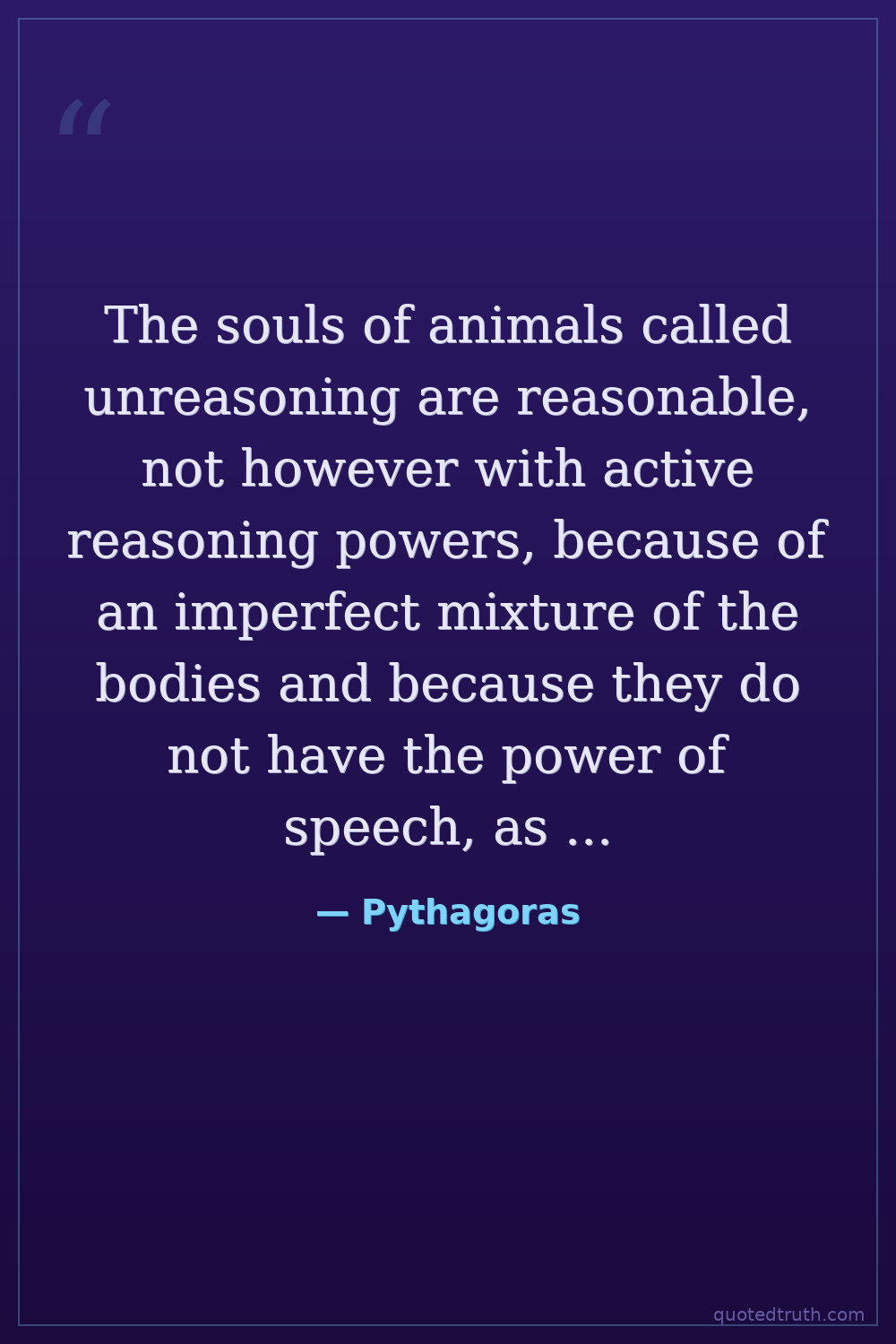
Animals typically labeled 'irrational' actually possess a latent form of reason, but two constraints prevent its full exercise: imperfect bodily composition and the absence of speech. Apes and dogs serve as examples — they clearly demonstrate intelligence through behavior yet cannot articulate thoughts verbally. The argument reframes animal 'irrationality' not as an absence of mind but as a limitation of physical form and communication, suggesting their inner life is richer than their outward behavior can fully convey.
Relevance to Pythagoras
Pythagoras taught metempsychosis — that souls migrate between human and animal bodies across lifetimes, making animals morally significant kin. He famously abstained from meat and founded a community around strict dietary rules. This quote is the philosophical backbone of that ethics: animals reason imperfectly, not not-at-all, so they deserve moral consideration. His drive to find deep unities beneath surface differences — evident in his mathematics — extended naturally to asserting a shared rational substrate across species.
The era
In 6th-century BCE Greece, logos — rational speech — defined the boundary between human and animal, civilized and wild. Animal sacrifice was central to Greek religion, which required animals to be morally lesser. Pythagoras worked in Magna Graecia, where Orphic mysticism and possibly Eastern philosophies had penetrated mainstream thought. Asserting animal intelligence directly challenged both religious ritual and philosophical consensus, positioning his school as radically revisionary precisely when Greek natural philosophy was first attempting to systematize questions about life, soul, and reason.
AI-generated insights based on extensive research and information for context. Factual errors? Email [email protected].