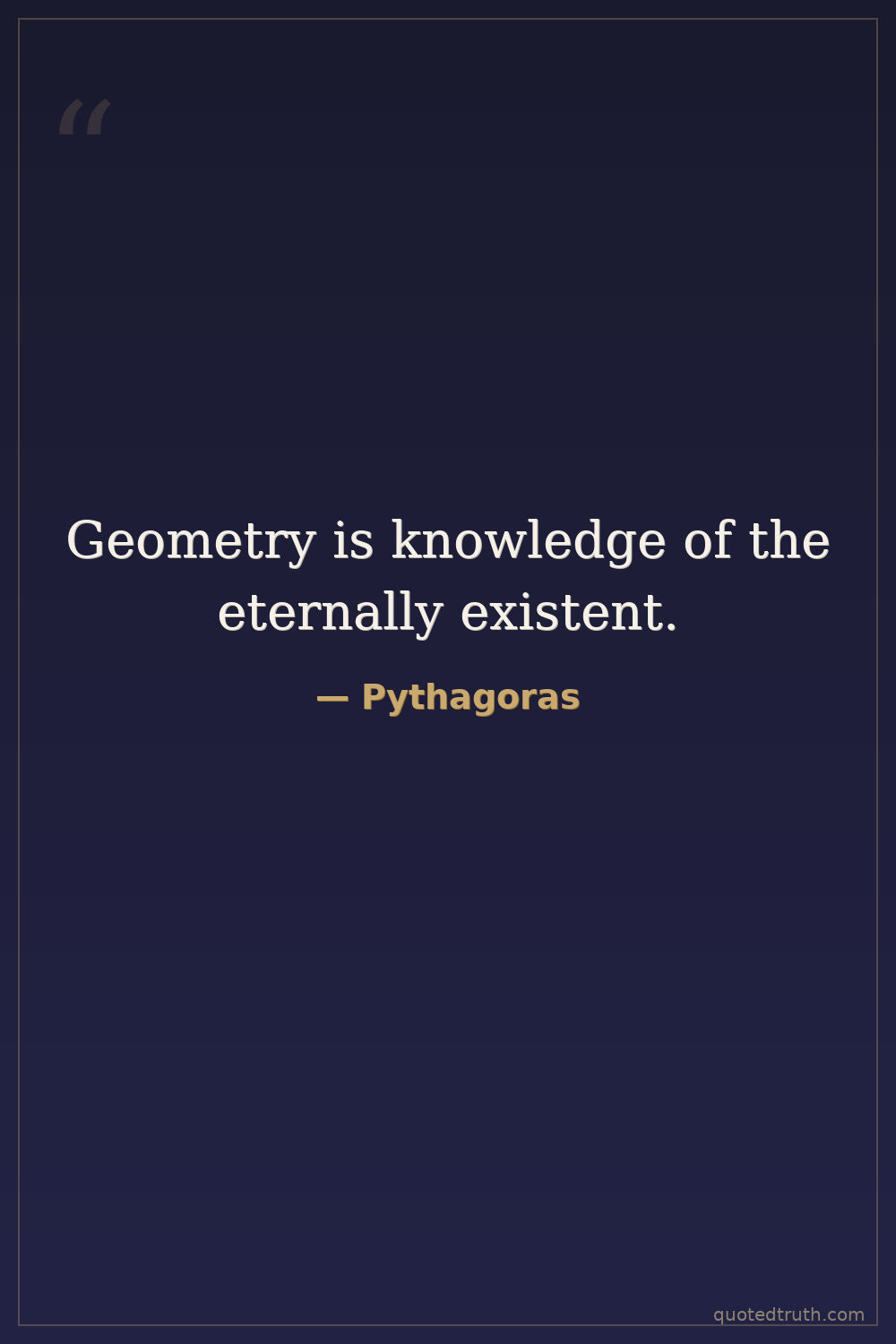
Pythagoras — "Geometry is knowledge of the eternally existent."
Geometry is knowledge of the eternally existent.
Geometry is knowledge of the eternally existent.
Click any product to generate a realistic preview. Up to 3 at a time.
* Initial load can take up to 90 seconds — revising the preview in another color is nearly instant.
"Educate the children and it won't be necessary to punish the men."
"Not to speak of Pythagorean beans, from which, it is said, Pythagoras himself abstained."
"Wisdom thoroughly learned will never be forgotten."
"Above the cloud with its shadow is the star with its light. Above all things reverence thyself."
"It is difficult to walk at one and the same time many paths of life."
Greek philosopher and mathematician whose school in Croton combined geometry (the Pythagorean theorem), number-mysticism, and a religious-vegetarian way of life. Closely associated with Thales of Miletus (earlier pre-Socratic and the first philosopher). For an intellectual contrast, see Heraclitus, pre-Socratic Greek philosopher of flux — Heraclitus called Pythagoras 'the chief of swindlers' — among the founding insults of the philosophical-rivalry tradition. Their 'all is flux' vs 'all is number' poles still organize the philosophy of mathematics today (Platonist vs anti-realist).
Highlights the timeless and unchanging nature of geometric truths.
Date: c. 5th Century BCE
PhilosophicalFound in 1 providers: gemini
1 source checked
Geometry studies truths that never change. Triangles, circles, and ratios behave the same way today as a thousand years ago and will behave the same way forever. Unlike opinions, politics, or physical objects that decay, geometric relationships are permanent features of reality. When you learn geometry, you are not learning a human invention but uncovering something that exists independently of people, minds, or time itself.
Pythagoras founded a religious-philosophical brotherhood that treated numbers and shapes as sacred, divine objects. He taught that mathematical truth was the path to purifying the soul and understanding the cosmos. His famous theorem about right triangles is one example of the permanent relationships he revered. For him, geometry was not a practical tool for surveying land but a spiritual discipline revealing the unchanging order beneath appearances.
In 6th-century BCE Greece, most people explained the world through myth, oracles, and shifting stories about capricious gods. Pythagoras lived when early philosophers in Ionia and southern Italy were first proposing that the universe runs on stable, discoverable principles. Declaring geometry eternal was a radical move: it claimed that rigorous human reasoning, not priestly revelation, could access permanent truths, planting seeds for Plato, Euclid, and the entire Western scientific tradition.
AI-generated insights based on extensive research and information for context. Factual errors? Email [email protected].
Your cart is empty