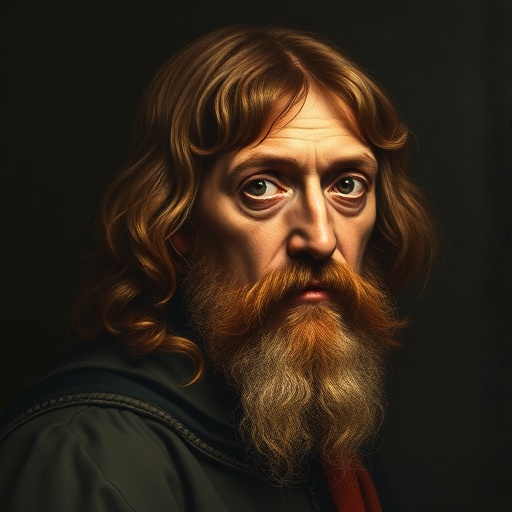
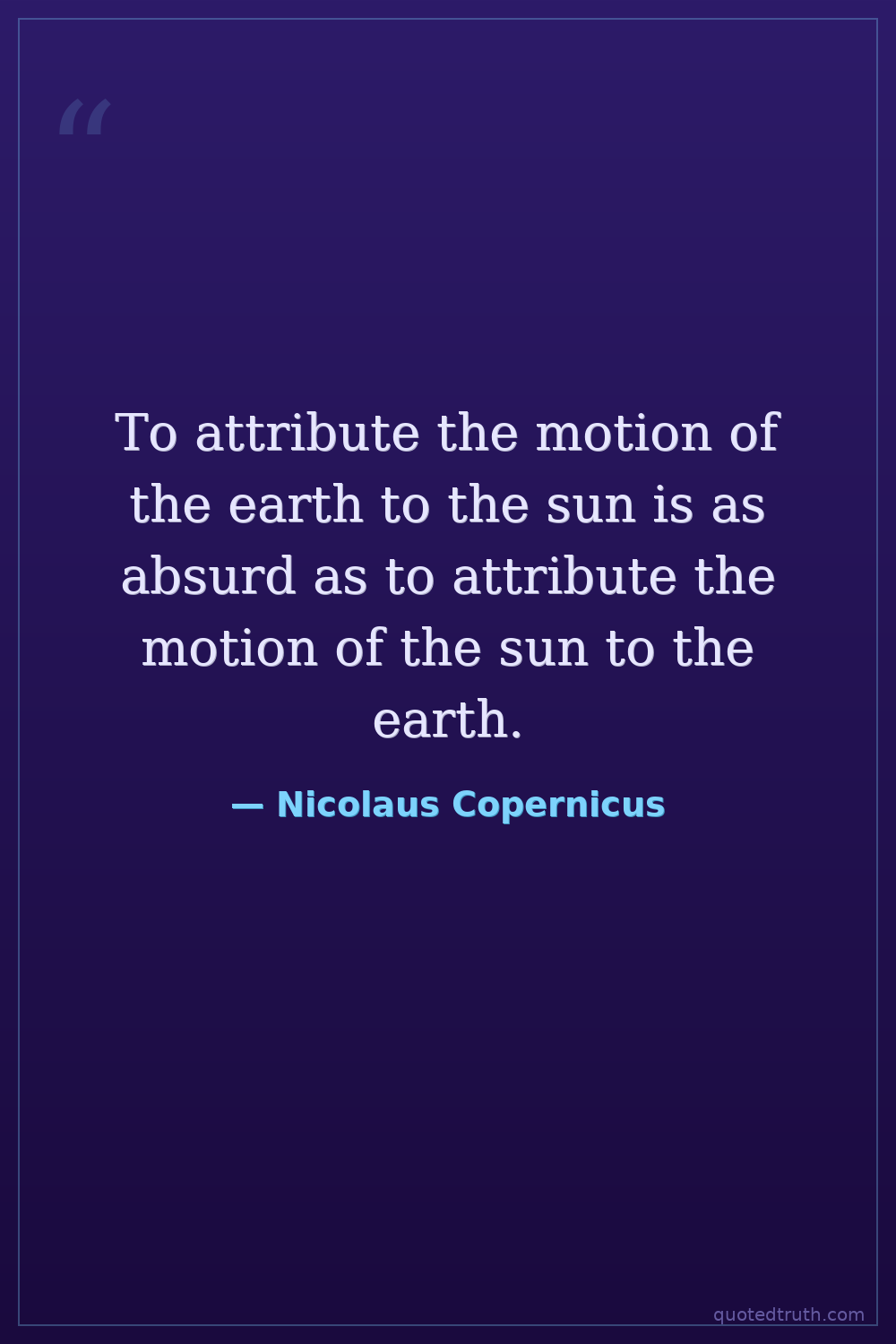
Nicolaus Copernicus — "To attribute the motion of the earth to the sun is as absurd as to attribute the…"
To attribute the motion of the earth to the sun is as absurd as to attribute the motion of the sun to the earth.
To attribute the motion of the earth to the sun is as absurd as to attribute the motion of the sun to the earth.
Click any product to generate a realistic preview. Up to 3 at a time.
* Initial load can take up to 90 seconds — revising the preview in another color is nearly instant.
"Therefore, let us not be afraid to follow truth wherever it may lead us, even if it contradicts our preconceived notions."
"The Sun, as if seated on a royal throne, governs the family of stars which wheel around it."
"For it is clear that the earth performs a double motion: one about its axis, and another about the sun."
"When, therefore, I had long considered the uncertainty of the traditional mathematical doctrines concerning the order of the spheres of the universe, I began to be annoyed that no more accurate explan…"
"For the motion of the earth is not a simple motion, but a composite of many motions."
Misattribution, often cited but not a direct quote from his work. He argued for Earth's motion, not against it.
Date: N/A
Nature & WorldFound in 1 providers: grok
1 source checked
The quote flips the geocentric critique back on itself. Critics called heliocentrism absurd — how could the Earth move? Copernicus counters that accepting a moving sun is equally absurd by the same logic. In modern terms, he exposes the arbitrary nature of labeling one reference frame correct. Neither model is self-evidently more natural; the real question is which better explains observed planetary motion with mathematical simplicity.
Copernicus spent decades quietly developing his heliocentric theory, aware of the Church's power and public resistance. A canon at Frombork Cathedral, he worked within the establishment while overturning its cosmology. This quote reflects his careful, logical temperament — not revolutionary fervor but reasoned argument. He published De Revolutionibus only as he lay dying in 1543, suggesting he understood the personal cost of challenging 1,400 years of Ptolemaic consensus.
In early 16th-century Europe, Ptolemy's Earth-centered cosmos was not merely scientific consensus but theological truth — the Church taught that humanity, created in God's image, stood at the universe's center. Challenging this risked charges of heresy. Yet the Renaissance was awakening empirical inquiry, and navigational demands were exposing cracks in the Ptolemaic model. Copernicus's era balanced reverence for ancient authority against mounting evidence that the old framework could not hold.
AI-generated insights based on extensive research and information for context. Factual errors? Email [email protected].
Your cart is empty