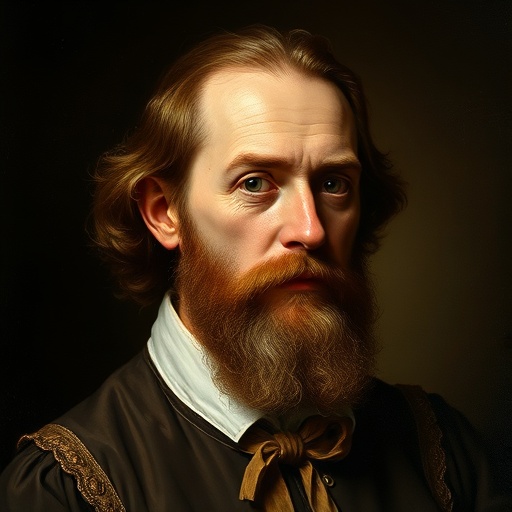
William Harvey — "The study of anatomy is the study of God's handiwork."
The study of anatomy is the study of God's handiwork.
The study of anatomy is the study of God's handiwork.
Click any product to generate a realistic preview. Up to 3 at a time.
* Initial load can take up to 90 seconds — revising the preview in another color is nearly instant.
"It is not by words, but by facts and arguments, that we must seek for truth."
"I have always preferred to learn and teach anatomy from actual dissection and not from books."
"The semen is the efficient cause and the egg the material cause of generation."
"The motion of the blood is in a circle, and is in truth perpetual."
"The heart does not draw the blood, but propels it."
English physician whose On the Motion of the Heart and Blood in Animals (1628) demonstrated blood circulation, overturning 1,400 years of Galenic medicine. Closely associated with Francis Bacon (his contemporary in the new English empiricism). For an intellectual contrast, see Galenic medicine, the 2nd-century Greek medical tradition (humors, blood-as-consumed-fuel) — Harvey calculated that the heart pumps more blood per hour than the body could possibly produce as fuel — a single quantitative observation that demolished the entire Galenic-Aristotelian medical worldview. The cleanest example in medical history of arithmetic disproving 14 centuries of authority.
A theological statement on the religious significance of anatomical research.
Date: c. 1620s-1650s
EducationalFound in 1 providers: gemini
1 source checked
Studying the human body's structure and mechanics is a form of understanding divine creation. The body's complexity, precision, and elegance reveal an intelligence behind its design. To dissect, observe, and map how organs and systems work together is not merely science but a form of reverence, uncovering the deliberate craftsmanship embedded in living things.
Harvey spent decades meticulously dissecting animals and human corpses, ultimately proving blood circulates continuously through the heart. His 1628 work De Motu Cordis overturned Galenic dogma through careful observation. As a devout man in a religious age, Harvey saw his empirical investigations as compatible with faith, framing anatomical discovery as revealing divine order rather than challenging it.
In early modern Europe, natural philosophy and theology were deeply intertwined. The Reformation had unsettled religious authority, yet belief in divine creation remained universal. Anatomists like Vesalius had recently challenged ancient authorities, creating tension between scripture and observation. Framing anatomy as reading God's design was both intellectually honest for Harvey's era and politically prudent, reconciling empirical science with Church expectations.
AI-generated insights based on extensive research and information for context. Factual errors? Email [email protected].
Your cart is empty