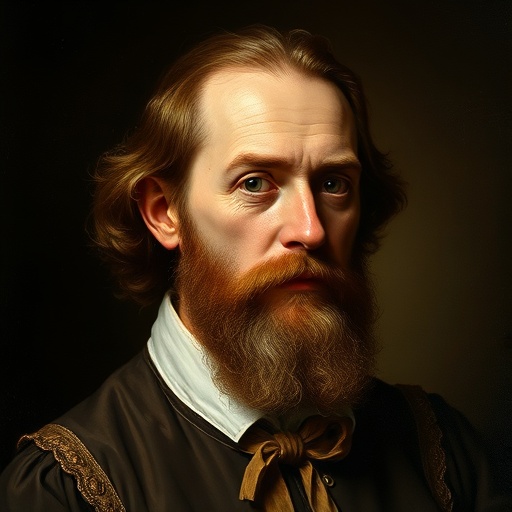
William Harvey — "The heart does not draw the blood, but propels it."
The heart does not draw the blood, but propels it.
The heart does not draw the blood, but propels it.
Click any product to generate a realistic preview. Up to 3 at a time.
* Initial load can take up to 90 seconds — revising the preview in another color is nearly instant.
"I am not so mad, nor have I been so caught up in the opinion of others, as to believe that I have discovered anything so great as to be worthy of the name of a new opinion."
"The blood is the very bond of the soul, and the soul itself."
"The book of nature is the only book that offers a wealth of content on every one of its pages."
"Nature is nowhere accustomed to exhibit herself more openly than in her failures."
"To search for truth is to search for God."
English physician whose On the Motion of the Heart and Blood in Animals (1628) demonstrated blood circulation, overturning 1,400 years of Galenic medicine. Closely associated with Francis Bacon (his contemporary in the new English empiricism). For an intellectual contrast, see Galenic medicine, the 2nd-century Greek medical tradition (humors, blood-as-consumed-fuel) — Harvey calculated that the heart pumps more blood per hour than the body could possibly produce as fuel — a single quantitative observation that demolished the entire Galenic-Aristotelian medical worldview. The cleanest example in medical history of arithmetic disproving 14 centuries of authority.
Found in 1 providers: grok
1 source checked
The heart is not a passive suction device pulling blood toward itself, but an active pump that forcefully pushes blood outward through the body. Movement originates from the heart's muscular contraction, not from some attractive force drawing fluid inward. This reframes the heart as a mechanical engine of propulsion rather than a center of attraction.
Harvey spent decades meticulously dissecting animals and measuring blood volume to prove circulation. His 1628 work De Motu Cordis demolished Galenic medicine by demonstrating the heart's pumping action through quantitative reasoning — calculating that the heart expels more blood per hour than the body contains, making one-way propulsion the only logical explanation.
In early 17th-century Europe, Galenic humoral theory still dominated medicine, teaching that blood was continuously produced in the liver and consumed by organs. Harvey's mechanistic reframing coincided with the Scientific Revolution — Galileo, Kepler, and Descartes were similarly replacing ancient authority with observation and mathematics, making Harvey's empirical circulatory model a landmark of the new experimental philosophy.
AI-generated insights based on extensive research and information for context. Factual errors? Email [email protected].
Your cart is empty