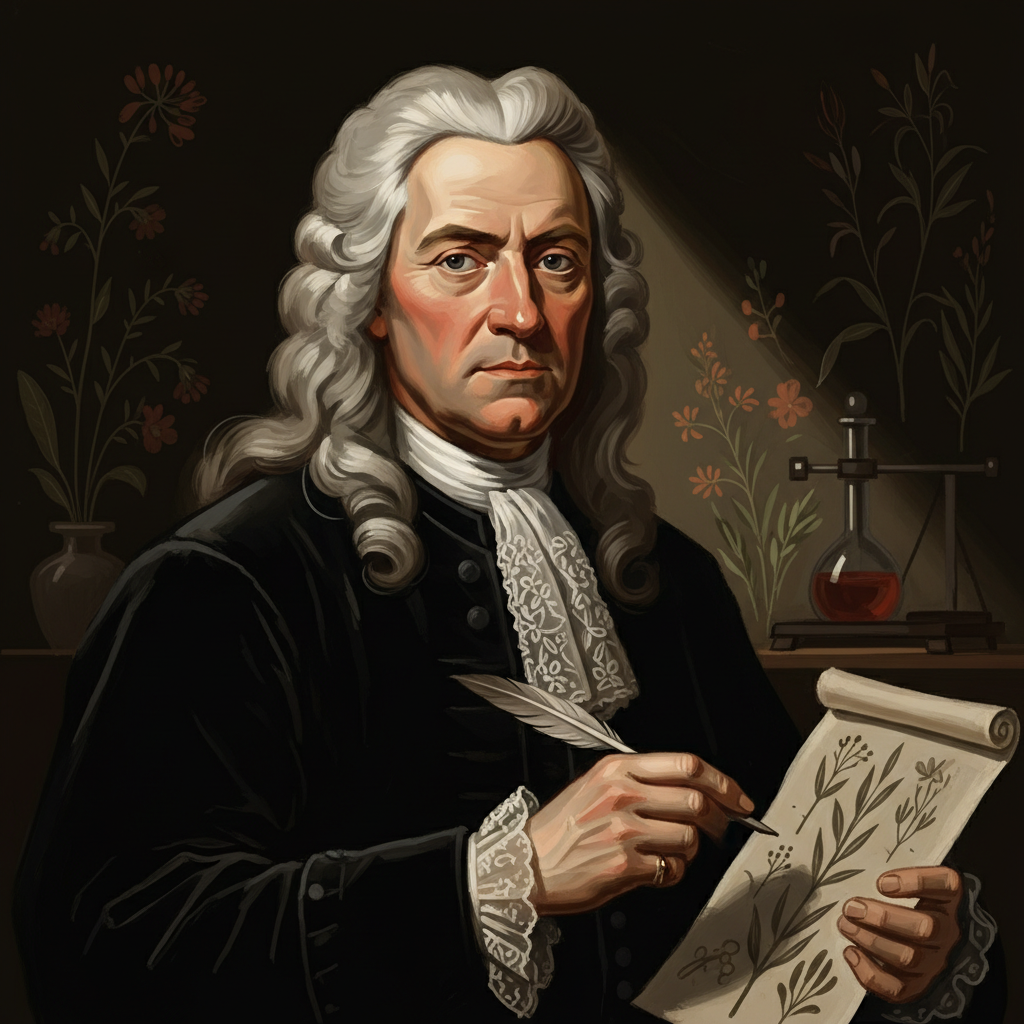
Carl Linnaeus — "The study of nature is the study of God."
The study of nature is the study of God.
The study of nature is the study of God.
Click any product to generate a realistic preview. Up to 3 at a time.
* Initial load can take up to 90 seconds — revising the preview in another color is nearly instant.
"The natural system will always remain the greatest goal for botanists."
"Women are by nature hysteria-prone because their wombs wander like restless animals inside them."
"¿Qué tiene de extraño que yo no vea a Dios si no puedo ver siquiera al Yo que vive en mí?"
"The whole world is a museum, and all its inhabitants are specimens."
"The world is ruled by three things: money, women, and botany."
Swedish botanist and the father of modern taxonomy whose Systema Naturae (1735) introduced binomial nomenclature for naming all species. Closely associated with Joseph Banks (British naturalist who carried Linnaean classification on Cook's voyages). For an intellectual contrast, see Comte de Buffon, French naturalist and Histoire Naturelle author (1749-1788) — Buffon explicitly attacked Linnaean fixed-categories taxonomy as artificial and rejected the binomial system; his gradualist, environment-shaped natural history was the explicit alternative. Anticipates the fixed-species-vs-evolution debate Darwin would later resolve.
Found in 2 providers: gemini,grok
2 sources checked
Examining the natural world and seeking to understand God are the same pursuit. Nature is not separate from the divine — it is God's direct creation, and studying its organisms, patterns, and systems is reading divine design firsthand. Science and faith are not in conflict; rigorous observation of plants, animals, and ecosystems reveals the mind and intent of the Creator. Knowledge of nature is, at its core, theological knowledge.
Linnaeus built binomial nomenclature — the two-part Latin naming system still used today — and explicitly framed that labor as mapping God's blueprint. He coined the phrase 'Deus creavit, Linnaeus disposuit' (God created, Linnaeus organized). A devout Lutheran, he believed each species was a discrete divine creation. Cataloguing thousands of plants and animals was not science divorced from faith; for him it was the most direct form of worship available to a naturalist.
In 18th-century Europe, natural theology dominated intellectual life — the conviction that God's existence and design could be read directly from creation. The Scientific Revolution had elevated empirical observation without yet forcing a rupture with Christianity. Scholars like Ray and Boyle had argued that cataloguing nature glorified God. Linnaeus's era treated taxonomy as devotional work. It would take Darwin a century later to fully separate biological inquiry from divine design, making this synthesis the last confident expression of that union.
AI-generated insights based on extensive research and information for context. Factual errors? Email [email protected].
Your cart is empty