Carl Linnaeus — "The Asiatic is haughty, greedy, and governed by opinions."
The Asiatic is haughty, greedy, and governed by opinions.
The Asiatic is haughty, greedy, and governed by opinions.
Click any product to generate a realistic preview. Up to 3 at a time.
* Initial load can take up to 90 seconds — revising the preview in another color is nearly instant.
"The more I study plants, the more I believe in God."
"The European is inventive, governed by laws, and wears tight clothing."
"Deus creavit, Linnaeus disposuit. (God created, Linnaeus arranged.)"
"The whole of natural history depends on the accurate knowledge of species."
"I have created order out of chaos."
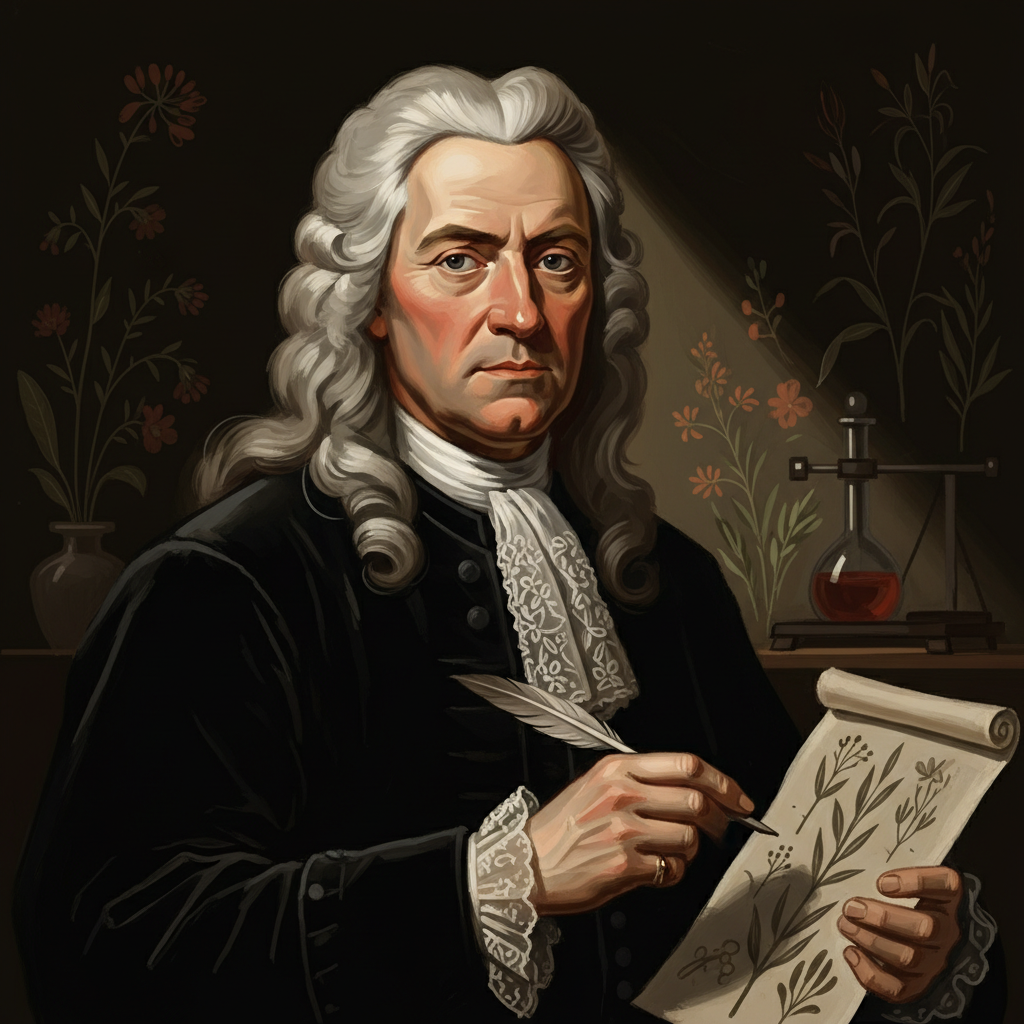
Swedish botanist and the father of modern taxonomy whose Systema Naturae (1735) introduced binomial nomenclature for naming all species. Closely associated with Joseph Banks (British naturalist who carried Linnaean classification on Cook's voyages). For an intellectual contrast, see Comte de Buffon, French naturalist and Histoire Naturelle author (1749-1788) — Buffon explicitly attacked Linnaean fixed-categories taxonomy as artificial and rejected the binomial system; his gradualist, environment-shaped natural history was the explicit alternative. Anticipates the fixed-species-vs-evolution debate Darwin would later resolve.
Found in 1 providers: deepseek
1 source checked
Linnaeus assigns fixed character traits to all people of Asian descent: arrogance, greed, and decision-making driven by custom or superstition rather than reason or law. Written as taxonomy, it treats an entire continent's population as a single biological subtype with uniform moral qualities. In modern terms, it is straightforward racial stereotyping dressed in scientific language, asserting that geography determines character.
Linnaeus applied his taxonomic method to humans in Systema Naturae (1758), dividing Homo sapiens into four continental varieties, each assigned physical and behavioral traits. Europeans were 'governed by laws,' Asians by 'opinions,' Africans by 'caprice.' His drive to classify everything—plants, animals, humans—led him to impose the same categorical rigor on culture and morality, embedding Eurocentric hierarchy into the scientific record under the authority of his binomial system.
In the mid-1700s, European colonial expansion into Asia was accelerating, and Orientalist intellectual traditions were solidifying—portraying Asian societies as tradition-bound, despotic, and stagnant. Enlightenment thinkers prized reason and law as European virtues, contrasting them with 'opinion' and 'custom' attributed to others. Linnaeus's taxonomy gave these prejudices scientific legitimacy at a moment when such frameworks were being used to justify colonial hierarchies and trade dominance across the continent.
AI-generated insights based on extensive research and information for context. Factual errors? Email [email protected].
Your cart is empty