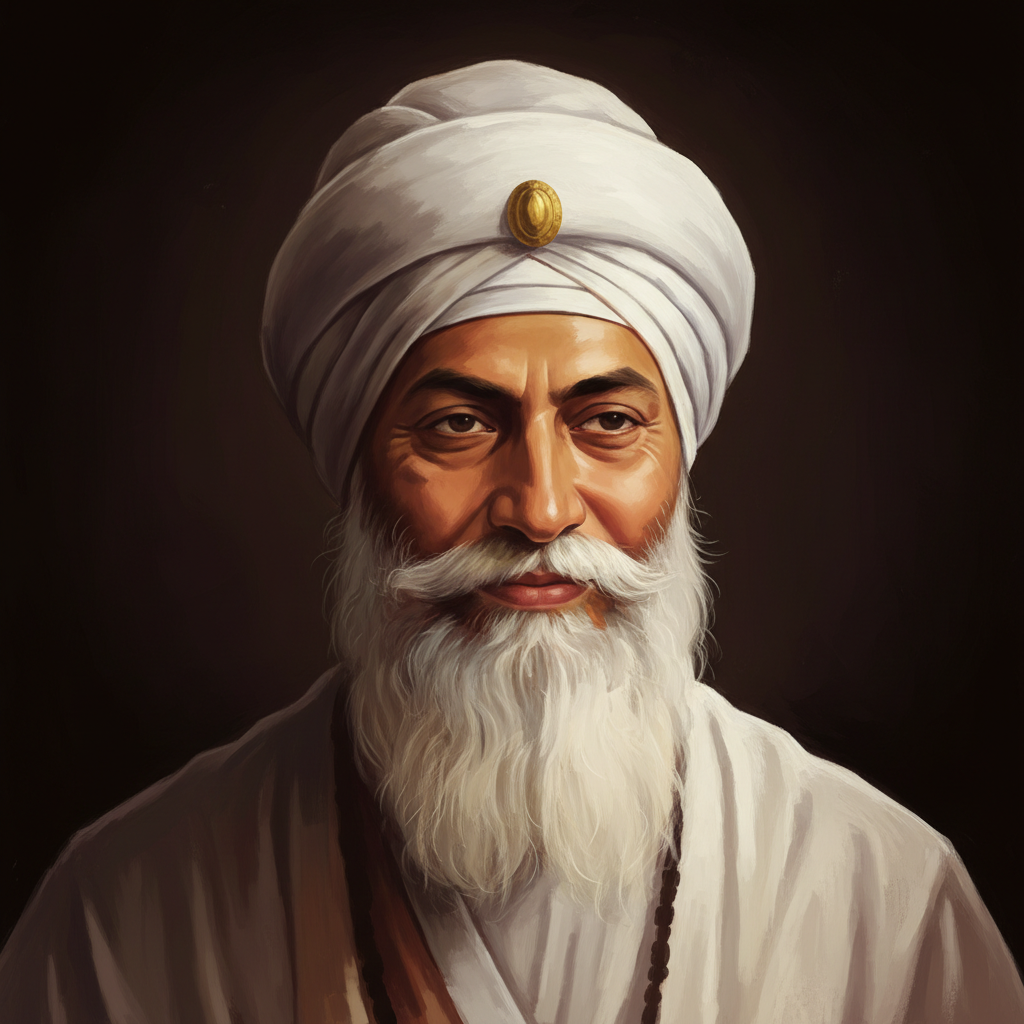
Guru Nanak — "Those who have loved, have found God."
Those who have loved, have found God.
Those who have loved, have found God.
Click any product to generate a realistic preview. Up to 3 at a time.
* Initial load can take up to 90 seconds — revising the preview in another color is nearly instant.
"To call woman inferior is to condemn humanity."
"Do not fear, for God is with you. Also, maybe bring a jacket, it's getting chilly."
"He who considers himself humble, is the highest of all."
"If we worship stone idols of gods and goddesses (or any other kind of idol for that matter), they can't give anything, (so) I don't ask anything from them. Their Poojaa is like churning water and hopi…"
"The one who eats what he earns through hard labor and shares it, he alone knows the path."
Founder of Sikhism and the first of the Ten Sikh Gurus, whose teachings of one universal God and rejection of caste shaped Punjab. Closely associated with Kabir (mystical poet whose verses appear in the Sikh Guru Granth Sahib). For an intellectual contrast, see Brahmanical orthodoxy, the Hindu caste-and-ritual establishment of his era — Sikhism was founded as a deliberate alternative to both Hindu ritual hierarchy and Islamic exclusivism — Nanak's universalism was a structural rejection of caste and priestly mediation.
Found in 1 providers: grok
1 source checked
Genuine love—for people, creation, or the divine—is itself the path to experiencing God. You don't reach the sacred through rituals, scripture memorization, or religious credentials. You reach it by opening your heart in devoted, selfless affection. The act of loving fully dissolves the ego that separates you from the ultimate reality. Anyone who has truly loved has already touched the divine, whether they called it that or not.
Guru Nanak built Sikhism on 'Ik Onkar'—one universal God accessible through love and devotion, not caste or clergy. As a traveling poet-teacher who composed devotional hymns across India, Arabia, and Tibet, he rejected empty ritual in favor of 'naam simran' (loving remembrance) and 'seva' (selfless service). He famously declared 'there is no Hindu, no Muslim'—only lovers of the divine, reflecting this quote's radical inclusivity.
Guru Nanak (1469–1539) lived in Punjab during intense Hindu-Muslim tension under the early Mughal and Lodi dynasties. Caste rigidity, Brahminical ritualism, and Islamic orthodoxy dominated religious life, with forced conversions and communal violence common. Babur's 1526 invasion devastated Punjab. Against this backdrop, Nanak's message that love—not birth, law, or ritual—unites humanity with God was revolutionary, drawing both Hindu and Muslim followers and seeding the Bhakti-Sufi devotional synthesis.
AI-generated insights based on extensive research and information for context. Factual errors? Email [email protected].
Your cart is empty