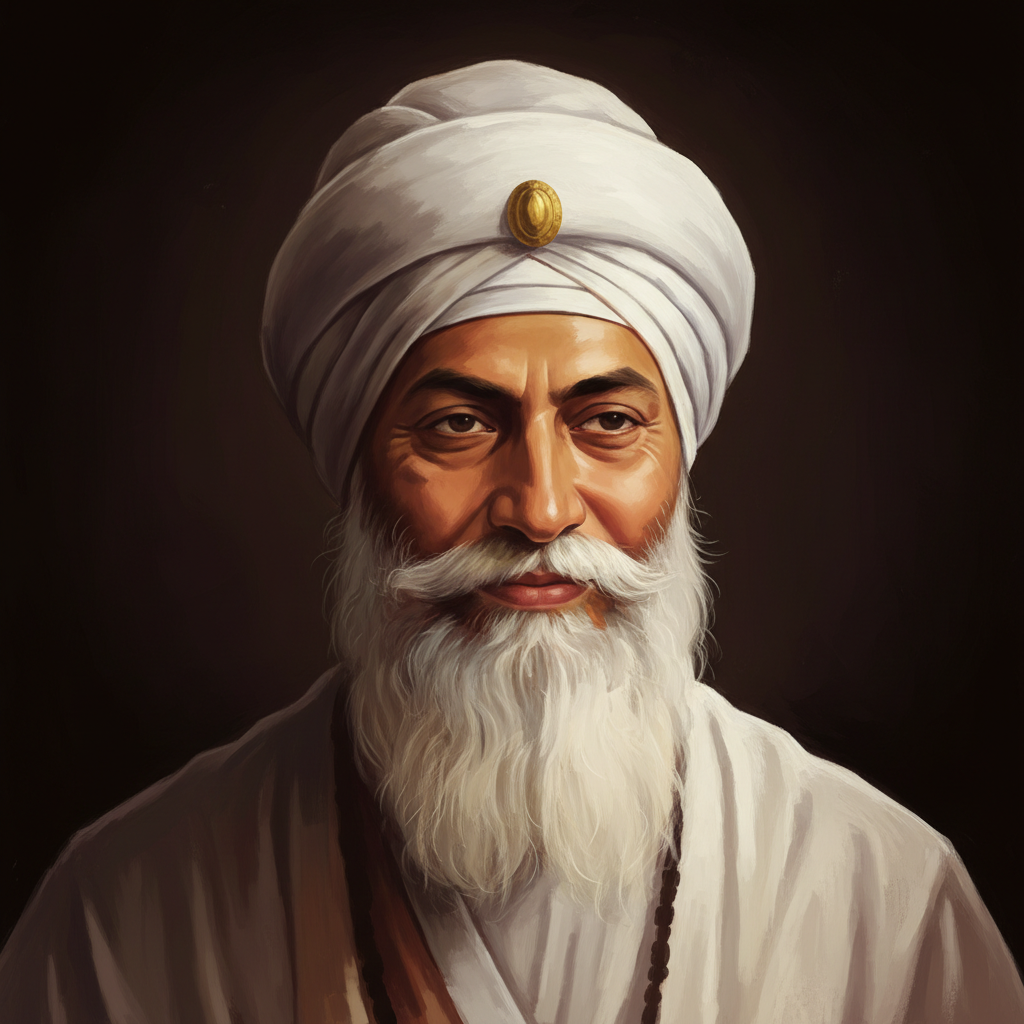
Guru Nanak — "Without the Guru, no one has found God."
Without the Guru, no one has found God.
Without the Guru, no one has found God.
Click any product to generate a realistic preview. Up to 3 at a time.
* Initial load can take up to 90 seconds — revising the preview in another color is nearly instant.
"The nights are wasted sleeping, and the days are wasted eating; the human spends his life in vain."
"A true yogi does not wander around, but fixes his mind on God within."
"Whatever is in the universe is in the body of the devotee."
"There is but One God. His Name is Truth; He is the Creator, Sustainer of all, Free from fear and hate, Immortal, Unborn, Self-existent, Realized by the Guru's Grace."
"Make compassion the cotton, contentment the thread, modesty the knot and truth the twist. This is the sacred thread of the soul; if you have it, then go ahead and put it on me."
Founder of Sikhism and the first of the Ten Sikh Gurus, whose teachings of one universal God and rejection of caste shaped Punjab. Closely associated with Kabir (mystical poet whose verses appear in the Sikh Guru Granth Sahib). For an intellectual contrast, see Brahmanical orthodoxy, the Hindu caste-and-ritual establishment of his era — Sikhism was founded as a deliberate alternative to both Hindu ritual hierarchy and Islamic exclusivism — Nanak's universalism was a structural rejection of caste and priestly mediation.
Found in 1 providers: grok
1 source checked
This saying argues that genuine connection with the divine is not something a person can reach alone. A seeker needs a true teacher, a Guru, who passes on real insight and shows the inner path. Book learning, rituals, or self-made effort are not enough on their own. Only through surrender to an enlightened guide does a person cut through ego and illusion and actually experience God directly.
Guru Nanak built Sikhism around exactly this principle. He rejected Hindu priestly gatekeeping and Muslim clerical hierarchy and instead taught that a living Guru transmits the Word that links a soul to the One Creator. He established a line of successor Gurus and later enshrined the Guru Granth Sahib as eternal teacher. His own life of travel, singing hymns, and disciple-making embodied the conviction that truth flows through the Guru.
Guru Nanak lived 1469 to 1539 in Punjab, where Hindu caste Brahmins and Muslim mullahs competed to mediate God through Sanskrit rites, Arabic scripture, pilgrimage taxes, and sectarian walls. The Lodi and early Mughal rulers enforced religious hierarchies. Against this backdrop, telling ordinary farmers, women, and low-caste laborers that any sincere seeker could reach God through a Guru, bypassing priests and language barriers, was a radical leveling act.
AI-generated insights based on extensive research and information for context. Factual errors? Email [email protected].
Your cart is empty