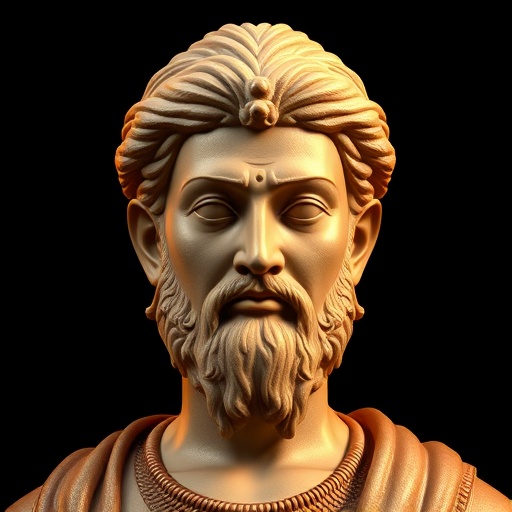
Mahavira — "The true happiness lies in detachment."
The true happiness lies in detachment.
The true happiness lies in detachment.
Click any product to generate a realistic preview. Up to 3 at a time.
* Initial load can take up to 90 seconds — revising the preview in another color is nearly instant.
"He who knows one, knows all."
"Have compassion towards all living beings. Hatred leads to destruction."
"Look at the world with the eyes of a friend."
"All breathing, existing, living, sentient creatures should not be slain, nor treated with violence, nor abused, nor tormented, nor driven away."
"Live and allow others to live; hurt no one; life is dear to all living beings."
24th and last Tirthankara of Jainism, whose teachings of strict ahimsa (non-violence), aparigraha (non-attachment), and karma reshaped ancient Indian religion. Closely associated with The Buddha (near-contemporary moral revolutionary, also reacting against Vedic ritualism). For an intellectual contrast, see Vedic Brahmanical ritual sacrifice, the animal-sacrifice-centered Vedic religion of his era — Mahavira's ahimsa demanded total non-violence, including not eating root vegetables that kill the plant — a maximum-distance ethical move from the Vedic priestly tradition that ritually sacrificed cattle and horses. The two cleanest poles of ancient Indian religious ethics.
Found in 1 providers: grok
1 source checked
Real happiness doesn't come from possessions, relationships, status, or outcomes you cling to. When you stop needing things to go a certain way — acting without attachment to results, comfort, or approval — you free yourself from anxiety and disappointment. Detachment isn't indifference; it's releasing the grip of desire so your inner state stops being hostage to external circumstances. That freedom is the only happiness that can't be taken from you.
Mahavira renounced a royal upbringing at age 30, abandoning family, wealth, even clothing, to wander India for twelve years as a naked ascetic. His core doctrine of aparigraha — non-possession — declared that accumulating anything, material or emotional, binds the soul with karma. He reached enlightenment only after stripping away every attachment. His own life was the proof of concept: detachment was not a metaphor but a literal, practiced discipline.
Mahavira lived in the Gangetic plains during the 6th–5th century BCE, when the Vedic sacrificial order tied salvation to ritual, caste hierarchy, and priestly mediation — a system built on desire for heavenly reward. The shramana movements, including Jainism and Buddhism, arose as a direct challenge, arguing that renunciation of craving, not elaborate ceremony, leads to liberation. Detachment was therefore a politically and spiritually radical claim against the dominant religious culture.
AI-generated insights based on extensive research and information for context. Factual errors? Email [email protected].
Your cart is empty