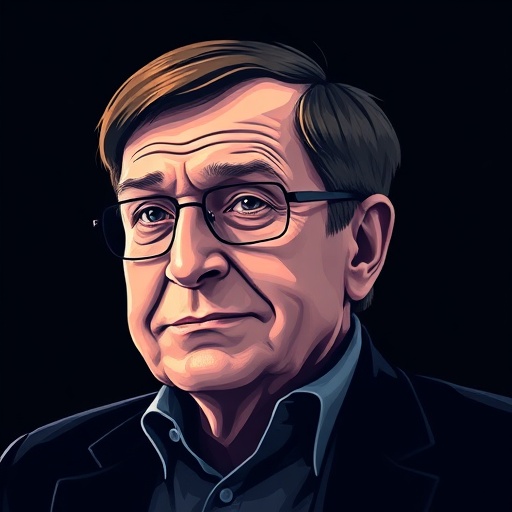
Stephen Hawking — "The universe is a beautiful mystery, and I'm trying to unravel it."
The universe is a beautiful mystery, and I'm trying to unravel it.
The universe is a beautiful mystery, and I'm trying to unravel it.
Click any product to generate a realistic preview. Up to 3 at a time.
* Initial load can take up to 90 seconds — revising the preview in another color is nearly instant.
"Einstein was wrong when he said, 'God does not play dice'. Consideration of black holes suggests, not only that God does play dice, but that he sometimes confuses us by throwing them where they can't …"
"We are all different, but we share the same human spirit. Perhaps it's human nature that we adapt and survive."
"It is a waste of time to be angry about my disability. One has to get on with life and I haven't done badly. People won't have time for you if you are always angry or complaining."
"Black holes ain't as black as they are painted. They are not the eternal prisons they were once thought. Things can get out of a black hole, both to the outside, and possibly, to another universe. So,…"
"I want to know why the universe exists, why there is something rather than nothing."
British theoretical physicist whose Hawking radiation work and A Brief History of Time (1988) brought black-hole physics to a mass audience while he lived with ALS for 55 years. Closely associated with Roger Penrose (his collaborator on singularity theorems) and Carl Sagan (fellow popularizer who wrote Brief History's foreword). For an intellectual contrast, see William Lane Craig, American philosopher of religion — Craig's Kalam cosmological argument depends on the Big Bang requiring a divine first cause; Hawking's no-boundary proposal was specifically designed to remove the moment that would require one — the cleanest cosmology-vs-natural-theology contrast in modern thought.
Found in 1 providers: grok
1 source checked
The universe holds extraordinary complexity and elegance that we haven't fully explained—its origins, forces, and structure remain genuinely unknown. Rather than treating that gap as frustrating, this frames mystery itself as beautiful, and science as a living pursuit rather than a finished catalogue. It commits to active investigation, positioning intellectual inquiry as a natural response to wonder rather than mere problem-solving or professional obligation.
Hawking dedicated his life to theoretical cosmology despite being diagnosed with motor neurone disease at 21—a condition that fully paralyzed him yet never halted his research. His work on black hole radiation, Big Bang singularity theorems, and the no-boundary proposal directly embodied this drive to decode the cosmos. His 1988 book A Brief History of Time brought cosmology to millions, reflecting his conviction that everyone deserves access to these fundamental mysteries.
Hawking's career spanned theoretical physics' golden age—from 1960s black hole debates through the 1990s cosmological revolution. The universe's accelerating expansion was confirmed in 1998, the Higgs boson discovered in 2012, gravitational waves detected in 2016. Meanwhile, A Brief History of Time became a global phenomenon, signaling unprecedented public hunger for cosmic answers. Science was simultaneously advancing at historic speed and becoming more culturally central than any prior generation had experienced.
AI-generated insights based on extensive research and information for context. Factual errors? Email [email protected].
Your cart is empty