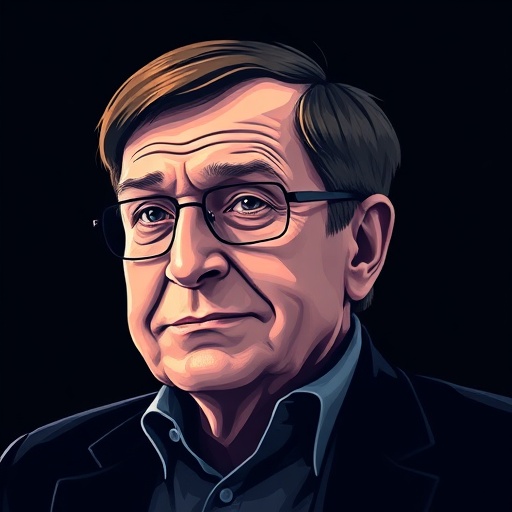
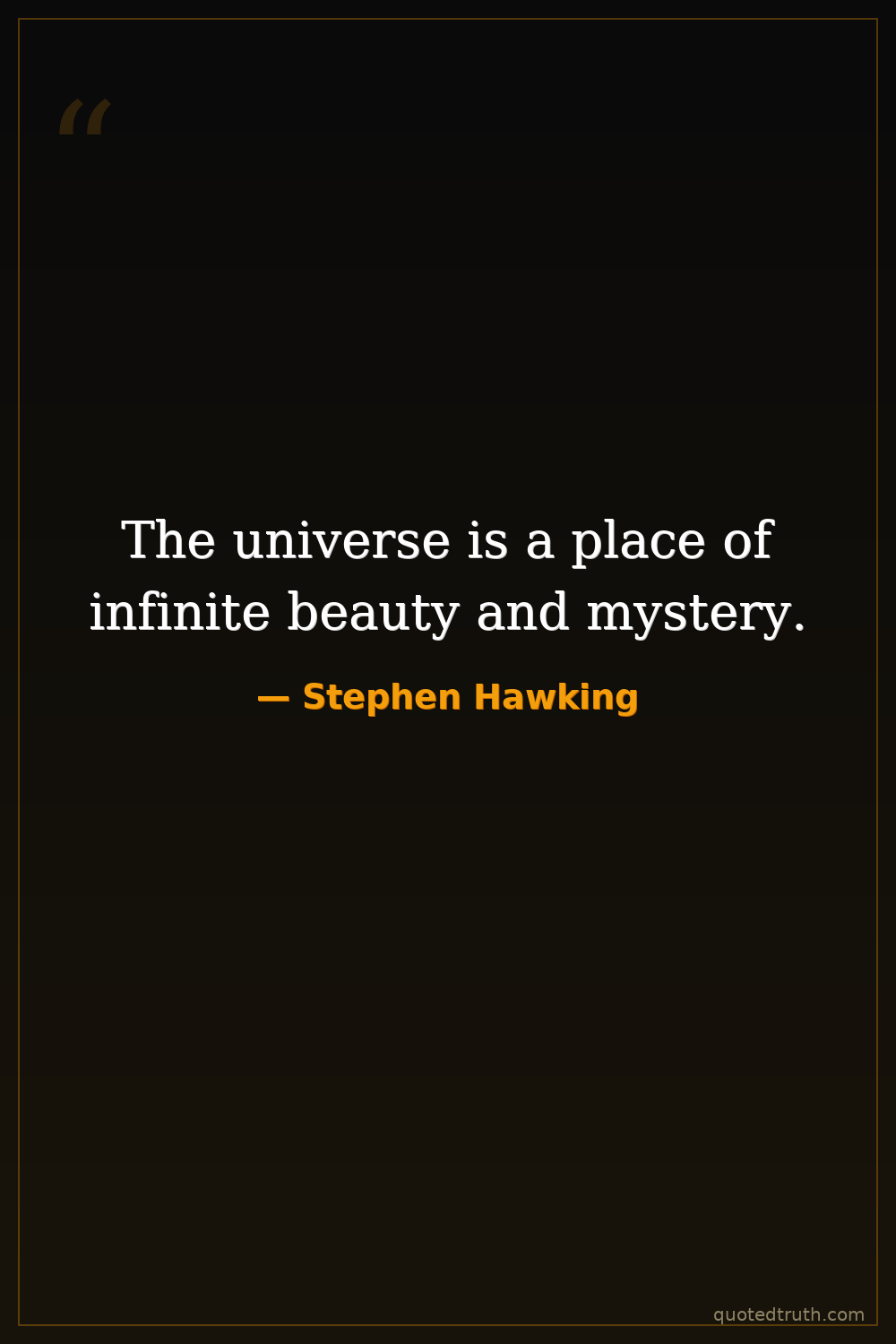
Stephen Hawking — "The universe is a place of infinite beauty and mystery."
The universe is a place of infinite beauty and mystery.
The universe is a place of infinite beauty and mystery.
Click any product to generate a realistic preview. Up to 3 at a time.
* Initial load can take up to 90 seconds — revising the preview in another color is nearly instant.
"The human race is a single genetic stock, and we are all brothers and sisters. It's time that we started to act like it."
"The human race is just a chemical scum on a moderate-sized planet, orbiting a very average star in the outer suburb of one among a hundred billion galaxies. We are so insignificant that I can't believ…"
"The ultimate goal of science is to provide a single theory that describes the whole universe."
"The greatest achievement of the human race is not the invention of the wheel, but the ability to communicate."
"I regard the brain as a computer which will stop working when its components fail. There is no heaven or afterlife for broken-down computers; that is a fairy story for people afraid of the dark."
British theoretical physicist whose Hawking radiation work and A Brief History of Time (1988) brought black-hole physics to a mass audience while he lived with ALS for 55 years. Closely associated with Roger Penrose (his collaborator on singularity theorems) and Carl Sagan (fellow popularizer who wrote Brief History's foreword). For an intellectual contrast, see William Lane Craig, American philosopher of religion — Craig's Kalam cosmological argument depends on the Big Bang requiring a divine first cause; Hawking's no-boundary proposal was specifically designed to remove the moment that would require one — the cleanest cosmology-vs-natural-theology contrast in modern thought.
Found in 1 providers: grok
1 source checked
The universe contains boundless wonders that exceed human comprehension — vast scales, strange phenomena, and questions that resist easy answers. Rather than seeing this as overwhelming, the statement frames it as cause for awe and continued inquiry. Mystery here isn't ignorance to be ashamed of, but an invitation to keep looking deeper into reality's fundamental structure.
Hawking spent his career probing the universe's most extreme environments — black holes, the Big Bang, quantum gravity. Paralyzed by ALS from his twenties, he explored the cosmos entirely through mathematics and imagination. His popular works like A Brief History of Time aimed to share genuine scientific wonder with ordinary readers, making this sentiment central to his public mission.
Hawking worked through the late 20th and early 21st centuries, when cosmology transformed from speculation into precision science. The Hubble Space Telescope, cosmic microwave background mapping, and gravitational wave detection all revealed an astonishingly complex universe. Yet each discovery deepened the mystery — dark matter, dark energy, and quantum gravity remained unsolved, reinforcing that beauty and unknowing coexist.
AI-generated insights based on extensive research and information for context. Factual errors? Email [email protected].
Your cart is empty