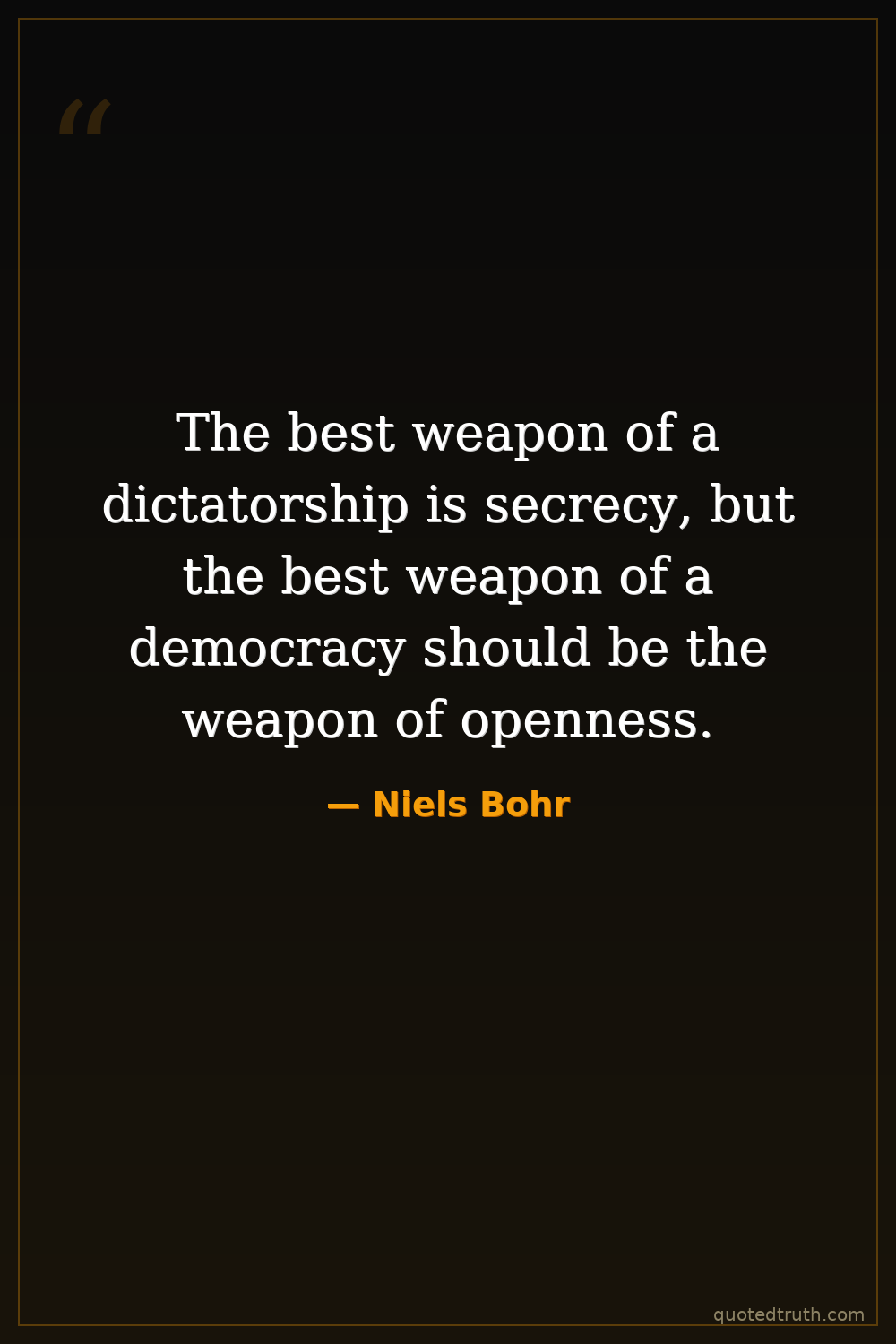
Niels Bohr — "The best weapon of a dictatorship is secrecy, but the best weapon of a democracy…"
The best weapon of a dictatorship is secrecy, but the best weapon of a democracy should be the weapon of openness.
The best weapon of a dictatorship is secrecy, but the best weapon of a democracy should be the weapon of openness.
Click any product to generate a realistic preview. Up to 3 at a time.
* Initial load can take up to 90 seconds — revising the preview in another color is nearly instant.
"The opposite of a correct statement is a false statement. But the opposite of a profound truth may well be another profound truth."
"When it comes to atoms, language can be used only as in poetry. The poet, too, is not nearly so concerned with describing facts as with creating images and establishing mental connections."
"The history of science is full of examples of how new ideas have been met with resistance, only to be accepted later."
"We are all in the same boat, in a stormy sea, and we owe each other a terrible loyalty."
"The great thing is to be able to make a mistake without knowing it."
Found in 1 providers: gemini
1 source checked
Secrecy is the lifeblood of authoritarian rule — dictators control populations by controlling information. Democracies gain legitimacy and resilience through transparency: open debate, public accountability, and shared knowledge. Rather than hiding power to consolidate it, free societies should wield openness as their defining strength. Suppressing information breeds distrust and enables abuse; sharing it builds informed citizens capable of holding power accountable.
Bohr fled Nazi-occupied Denmark in 1943 and joined the Manhattan Project, but grew alarmed by nuclear secrecy. He personally wrote to Churchill and Roosevelt urging the Allies share atomic knowledge with the Soviet Union before deploying weapons — believing transparency was the only path to preventing a catastrophic arms race. A man of open science by conviction, he saw information hoarding as existentially dangerous.
Bohr operated at the height of WWII and the early Cold War — an era defined by state secrecy, nuclear terror, and ideological confrontation. The Manhattan Project was classified at the highest level; post-war, atomic secrets fueled a US-Soviet arms race. McCarthyism punished dissent in America. Against this backdrop, Bohr's insistence on international scientific openness was genuinely radical, challenging the security logic both superpowers were embedding into civilization.
AI-generated insights based on extensive research and information for context. Factual errors? Email [email protected].
Your cart is empty