What it means
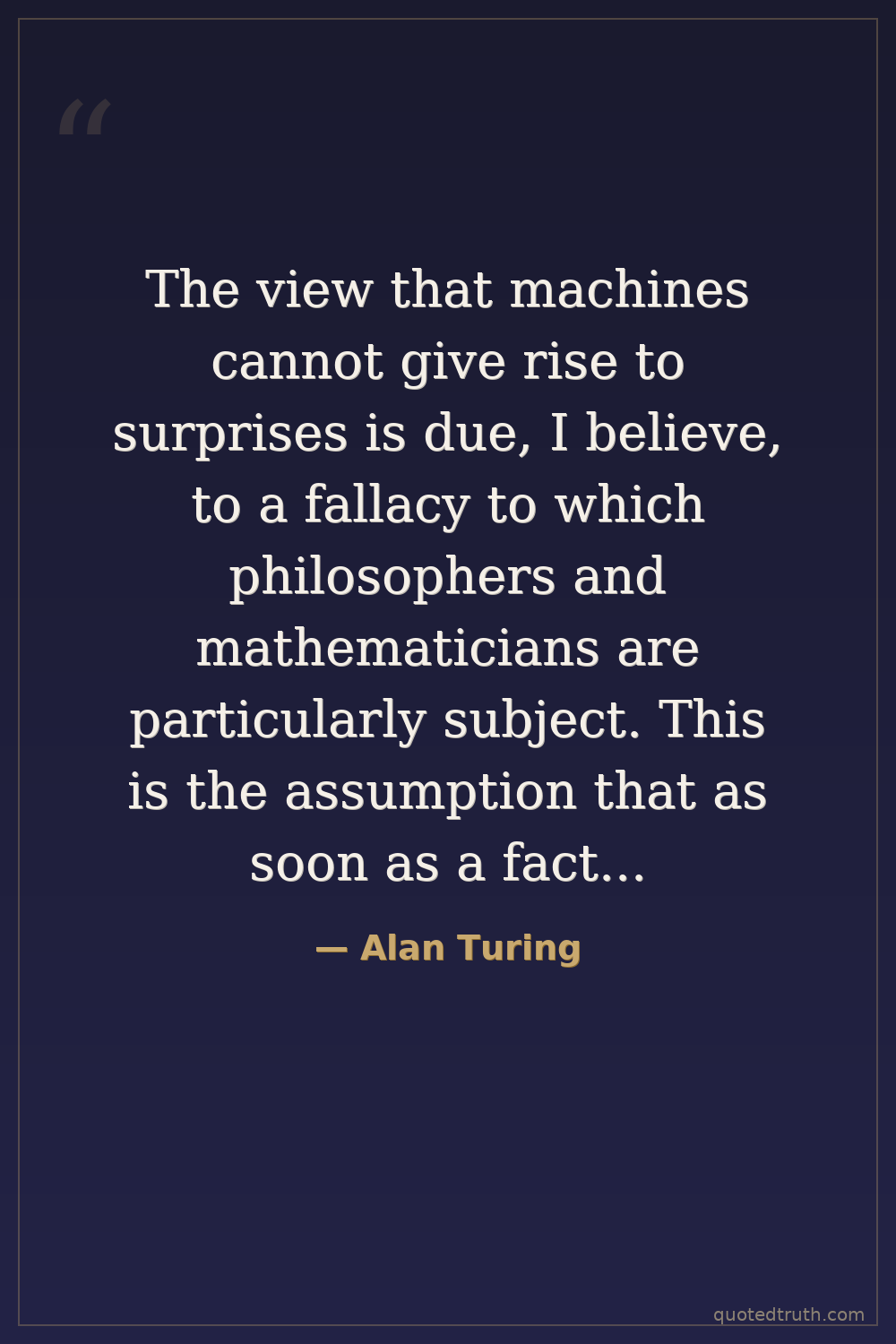
Turing challenges a widespread logical error: the assumption that understanding a fact means instantly grasping all its implications. Minds, human or machine, don't automatically derive every consequence the moment they receive information—working out implications requires actual effort and time. Because of this fallacy, people wrongly conclude machines cannot surprise us. Since deduction isn't instantaneous even for humans, machines working through logic can produce genuinely unexpected, novel results.
Relevance to Alan Turing
Turing published this in his landmark 1950 paper 'Computing Machinery and Intelligence,' which introduced the Turing Test. As designer of the Bombe machine that cracked Nazi Enigma codes—producing war-changing outputs its operators hadn't anticipated—he knew machines generated genuine surprises. His theoretical work on computability showed that even simple rule-following systems produce outputs unpredictable without actually running them, grounding this observation in concrete mathematical and engineering experience.
The era
In 1950, the first programmable computers—Manchester Mark 1, ENIAC—had just become operational, and society had no framework for thinking about machine intelligence. Cold War pressures were accelerating computing research while philosophers still debated whether calculation could constitute thought. Turing's paper arrived precisely when these questions shifted from abstract philosophy to urgent engineering reality, making his defense of machine surprise foundational for the emerging field of artificial intelligence.
AI-generated insights based on extensive research and information for context. Factual errors? Email [email protected].