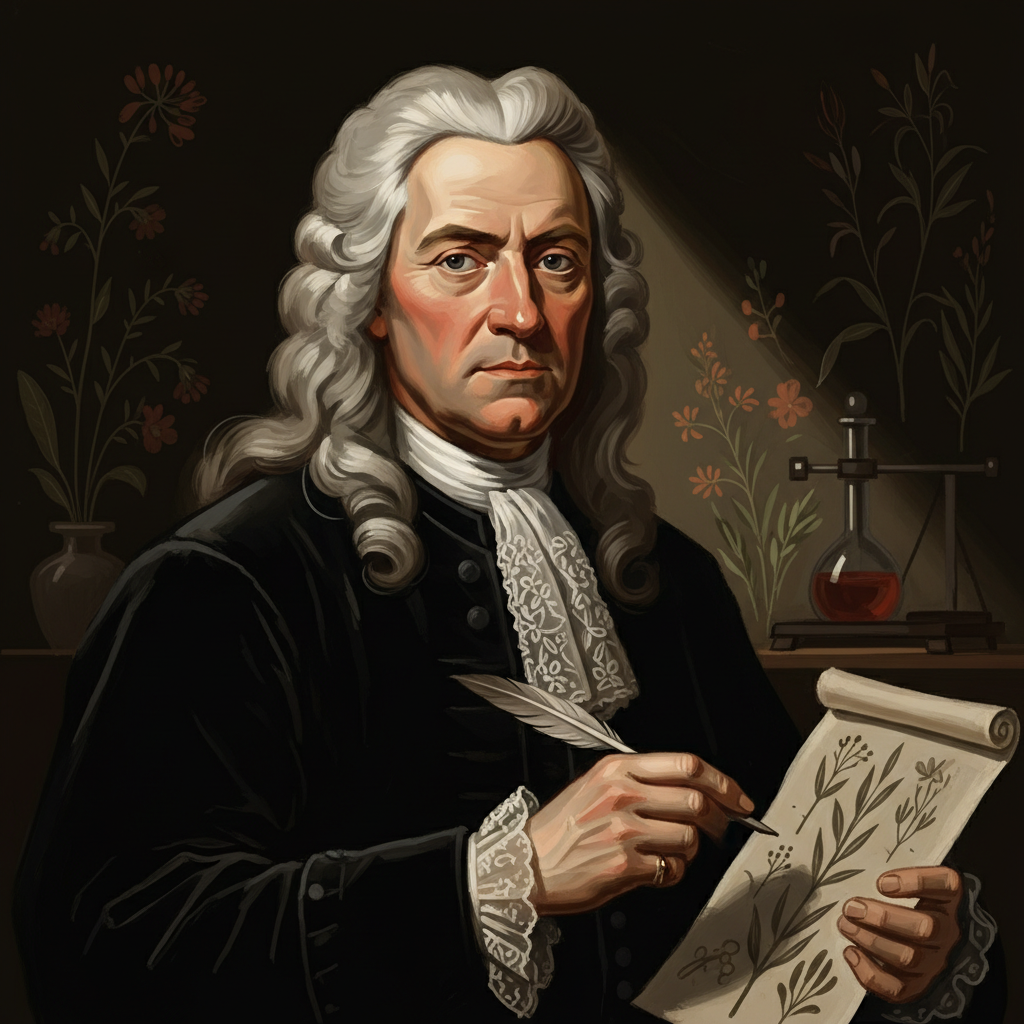
Carl Linnaeus — "I have explored the whole world of nature."
I have explored the whole world of nature.
I have explored the whole world of nature.
Click any product to generate a realistic preview. Up to 3 at a time.
* Initial load can take up to 90 seconds — revising the preview in another color is nearly instant.
"Every plant is a book, which, if we want to understand, we must learn its language."
"The first step in wisdom is to know the things themselves; this notion consists in having a true idea of the objects; objects are distinguished and known by classifying them methodically and giving th…"
"¿Qué tiene de extraño que yo no vea a Dios si no puedo ver siquiera al Yo que vive en mí?"
"There are no species in nature, only individuals."
"I have classified all plants and animals."
Swedish botanist and the father of modern taxonomy whose Systema Naturae (1735) introduced binomial nomenclature for naming all species. Closely associated with Joseph Banks (British naturalist who carried Linnaean classification on Cook's voyages). For an intellectual contrast, see Comte de Buffon, French naturalist and Histoire Naturelle author (1749-1788) — Buffon explicitly attacked Linnaean fixed-categories taxonomy as artificial and rejected the binomial system; his gradualist, environment-shaped natural history was the explicit alternative. Anticipates the fixed-species-vs-evolution debate Darwin would later resolve.
Found in 1 providers: grok
1 source checked
Nature contains everything that exists — plants, animals, minerals. This is a bold declaration of intellectual mastery: the speaker has studied, catalogued, and made sense of it all. In modern terms, it is like claiming to have built a complete index of every species on Earth — an act of supreme confidence that one person's systematic work has brought the entire living world under rational, organized human understanding.
Linnaeus spent decades cataloguing thousands of plant and animal species, creating the binomial nomenclature system still used in biology today. His Systema Naturae unified rocks, plants, and animals under one framework across twelve editions. Known for supreme self-confidence — he reportedly said 'God creates, Linnaeus arranges' — this statement reflects his genuine belief that his taxonomic system had achieved what no human had before: a complete, rational map of the living world.
Linnaeus worked during the Enlightenment and the Age of Exploration, when European voyages were flooding science with hundreds of newly discovered species. No standardized naming system existed — the same organism might carry dozens of conflicting names across countries and languages. The Enlightenment's central conviction was that reason could impose order on chaos. Against this backdrop, Linnaeus's claim felt genuinely achievable: his binomial system gave naturalists the universal language they had desperately needed.
AI-generated insights based on extensive research and information for context. Factual errors? Email [email protected].
Your cart is empty