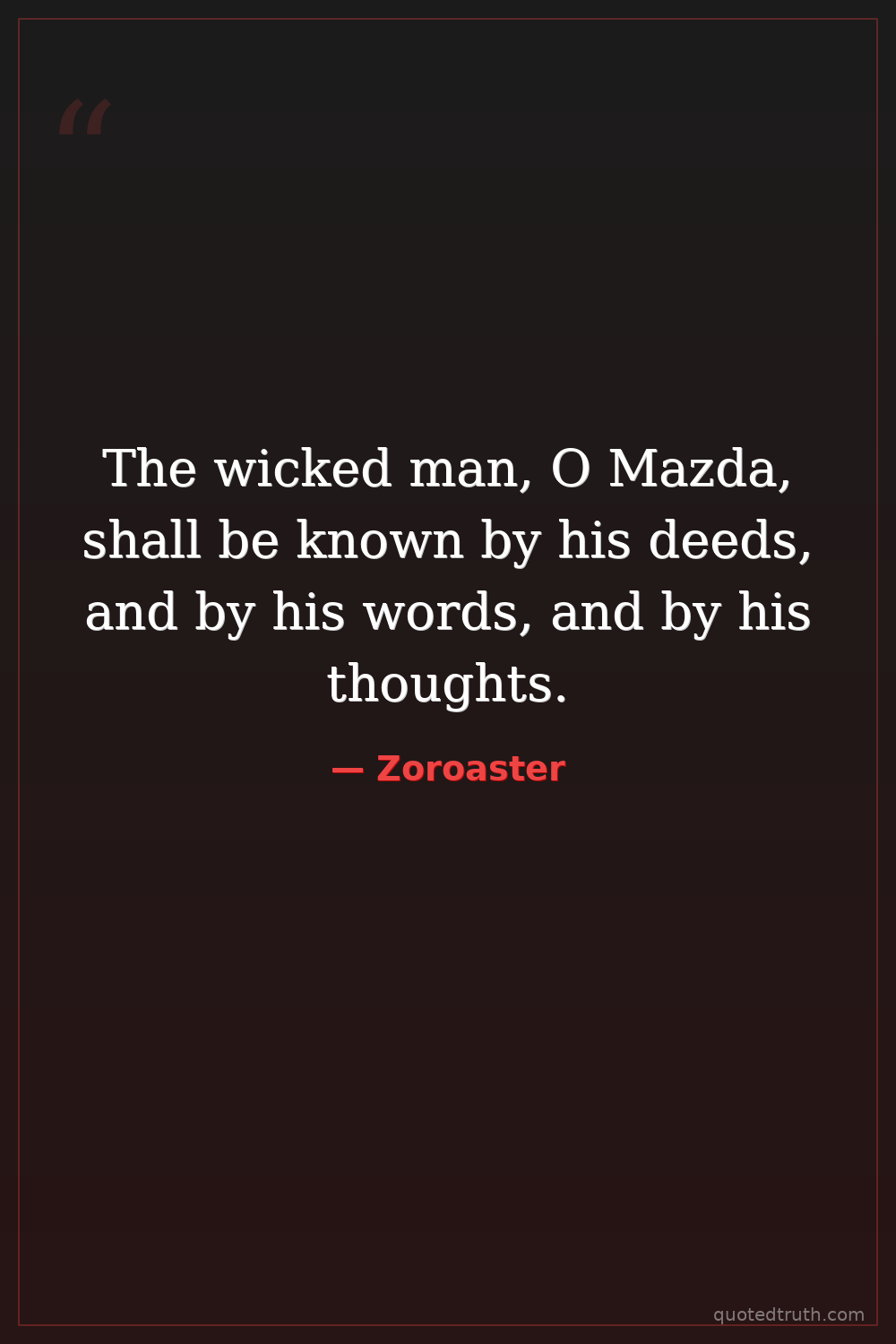
Zoroaster — "The wicked man, O Mazda, shall be known by his deeds, and by his words, and by h…"
The wicked man, O Mazda, shall be known by his deeds, and by his words, and by his thoughts.
The wicked man, O Mazda, shall be known by his deeds, and by his words, and by his thoughts.
Click any product to generate a realistic preview. Up to 3 at a time.
* Initial load can take up to 90 seconds — revising the preview in another color is nearly instant.
"I will now tell you who are assembled here the wise sayings of Mazda, the praises of Ahura and the hymns of the Good Spirit, the sublime truth which I see rising out of these flames. You shall therefo…"
"Do not to others what ye do not wish Done to yourself; and wish for others too. What ye desire and long for, for yourself. This is the whole of righteousness, heed it well."
"I will sing praises to You, O Ahura Mazda, with good thoughts and truthful words."
"The best word is that which speaks of truth, the best deed is that which is done for truth."
"The soul of the righteous shall go to the Best Existence, the soul of the wicked to the Worst Existence."
Iranian prophet who founded Zoroastrianism, the first major religion of cosmic dualism between good (Ahura Mazda) and evil (Angra Mainyu). Closely associated with The Buddha (near-contemporary Eastern moral-cosmological revolutionary). For an intellectual contrast, see Friedrich Nietzsche, German philosopher of 'beyond good and evil' — Nietzsche appropriated Zarathustra's name for Thus Spoke Zarathustra (1883) precisely to invert the original's moral cosmology — the historical Zoroaster founded the good-versus-evil framework Nietzsche's character announces the end of.
Found in 1 providers: grok
1 source checked
A person's true moral character is revealed through three channels: what they do, what they say, and what they think. You cannot hide wickedness behind a polished image because behavior, speech, and private thoughts all eventually expose the same inner truth. Judgment of a person should rest on the full pattern across these three dimensions, not on appearances or isolated moments, since consistent evil shows itself in every layer of life.
This reflects Zoroaster's foundational teaching of the threefold path: good thoughts, good words, good deeds (Humata, Hukhta, Hvarshta). As a priest-prophet who reformed ancient Iranian religion, he framed existence as a moral contest between truth (Asha) and the lie (Druj), addressed directly to Ahura Mazda. His ministry emphasized personal accountability over ritual sacrifice, making an individual's thoughts, speech, and actions the true measure of righteousness or wickedness before the supreme god.
Zoroaster lived in Bronze Age Iran, likely between 1500 and 1000 BCE, among pastoral tribes practicing polytheistic sacrifice, cattle raiding, and priest-dominated ritualism. His era lacked codified ethical systems tying inner intent to divine judgment; morality was largely tribal and ceremonial. By insisting that wickedness manifests in thoughts, words, and deeds, he introduced one of the earliest doctrines of personal moral responsibility, shaping later Persian empires and influencing Jewish, Christian, and Islamic concepts of heaven, hell, and final judgment.
AI-generated insights based on extensive research and information for context. Factual errors? Email [email protected].
Your cart is empty