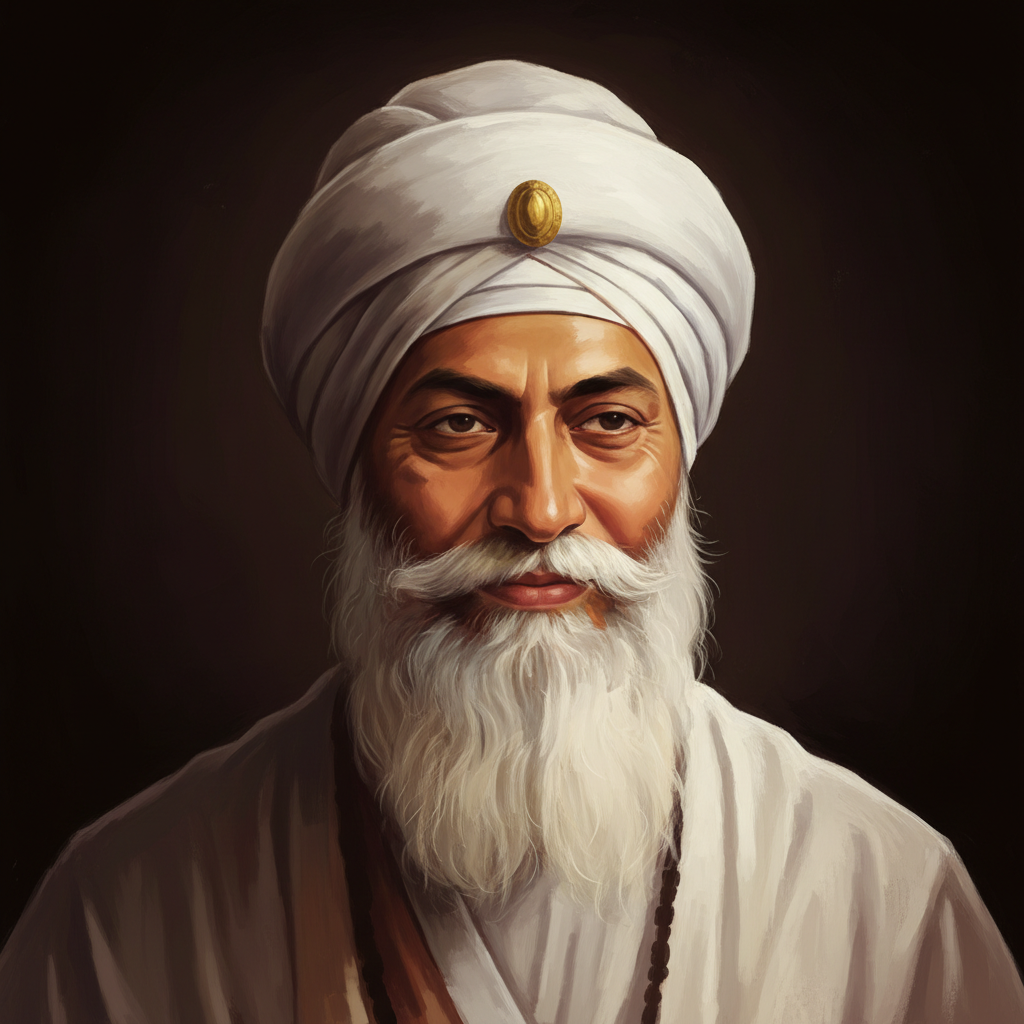
Guru Nanak — "The world is a garden, O Nanak, and the Gardener is God."
The world is a garden, O Nanak, and the Gardener is God.
The world is a garden, O Nanak, and the Gardener is God.
Click any product to generate a realistic preview. Up to 3 at a time.
* Initial load can take up to 90 seconds — revising the preview in another color is nearly instant.
"Let no one be proud of his caste; he who knows God is a Brahmin."
"The world is a garden, and we are its gardeners; we must sow the seeds of truth and righteousness."
"There is but One God. His Name is Truth; He is the Creator, Sustainer of all, Free from fear and hate, Immortal, Unborn, Self-existent, Realized by the Guru's Grace."
"Only by His Grace, can one be saved."
"Burn worldly love, rub the ashes and make ink of it, make the heart the pen, the intellect the writer, write that which has no end or limit."
Founder of Sikhism and the first of the Ten Sikh Gurus, whose teachings of one universal God and rejection of caste shaped Punjab. Closely associated with Kabir (mystical poet whose verses appear in the Sikh Guru Granth Sahib). For an intellectual contrast, see Brahmanical orthodoxy, the Hindu caste-and-ritual establishment of his era — Sikhism was founded as a deliberate alternative to both Hindu ritual hierarchy and Islamic exclusivism — Nanak's universalism was a structural rejection of caste and priestly mediation.
Found in 1 providers: gemini
1 source checked
This saying compares the world to a cultivated garden tended by a divine gardener. Every person, creature, and circumstance is a plant growing under the same caretaker's attention, nourished by the same source. Diversity of forms is natural and intended, not a flaw. The image asks readers to see life as something carefully cultivated rather than random, and to recognize a single creative intelligence behind all the variety they encounter.
Guru Nanak founded Sikhism on the conviction of one universal Creator (Ik Onkar) who authors all existence without favoring caste, gender, or creed. A traveler who walked thousands of miles through Hindu, Muslim, and Buddhist lands, he preached equality and the shared divine spark in every human. The garden metaphor mirrors his core teaching: humanity is one family under one God, and lived devotion matters more than ritual boundaries.
Guru Nanak lived 1469-1539 in Punjab, where Mughal expansion collided with entrenched Hindu caste hierarchy and Islamic rule. Religious communities viewed each other as rivals, and ritual purity laws dictated who could eat, worship, or marry whom. Into this fractured landscape Nanak introduced langar, the communal kitchen where all castes ate together. The one-Gardener image directly challenged the era's sectarian walls, insisting the same Creator tended Hindu and Muslim alike.
AI-generated insights based on extensive research and information for context. Factual errors? Email [email protected].
Your cart is empty