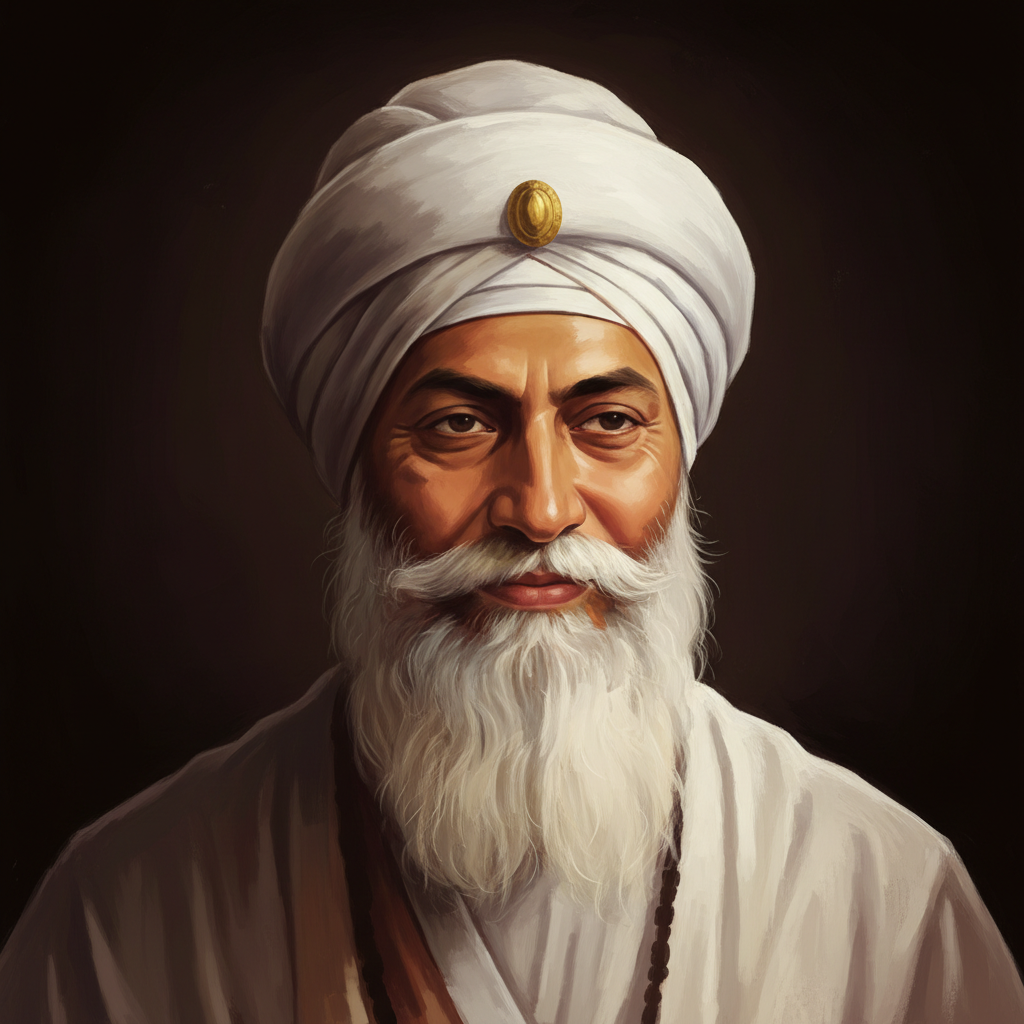
Guru Nanak — "Let no one be proud of his caste; he who knows God is a Brahmin."
Let no one be proud of his caste; he who knows God is a Brahmin.
Let no one be proud of his caste; he who knows God is a Brahmin.
Click any product to generate a realistic preview. Up to 3 at a time.
* Initial load can take up to 90 seconds — revising the preview in another color is nearly instant.
"By His Command, all forms came into being, by His Command, life descended into them."
"Without virtues, there is no devotion."
"False is the body that leads to lust and anger, and false are the clothes that lead to pride."
"Those who have loved, have found God."
"The true Guru is the one who shows the path of truth and righteousness."
Founder of Sikhism and the first of the Ten Sikh Gurus, whose teachings of one universal God and rejection of caste shaped Punjab. Closely associated with Kabir (mystical poet whose verses appear in the Sikh Guru Granth Sahib). For an intellectual contrast, see Brahmanical orthodoxy, the Hindu caste-and-ritual establishment of his era — Sikhism was founded as a deliberate alternative to both Hindu ritual hierarchy and Islamic exclusivism — Nanak's universalism was a structural rejection of caste and priestly mediation.
Found in 1 providers: gemini
1 source checked
Social rank at birth gives no one spiritual superiority. What truly elevates a person is direct knowledge of the divine, not the family, lineage, or priestly class they were born into. Anyone, regardless of background, who genuinely understands God holds the standing traditionally reserved for the highest caste. Pride rooted in inherited status is empty; real nobility comes from inner realization, moral conduct, and awareness of the sacred, accessible equally to every human being.
Guru Nanak founded Sikhism explicitly rejecting caste hierarchy. Born in 1469 into a Hindu Khatri family under Islamic rule, he famously declared 'There is no Hindu, there is no Muslim.' He instituted langar, the communal free kitchen where people of every caste ate side by side, and chose Bhai Mardana, a Muslim minstrel of low social standing, as his lifelong companion. This saying distills his foundational teaching that spiritual merit, not birth, defines a person's worth.
In early modern South Asia under the early Mughal era, rigid Hindu caste rules dictated occupation, marriage, and temple access, while Brahmins monopolized ritual authority. Hindu-Muslim tensions ran high, and the Bhakti and Sufi movements were challenging orthodoxy by preaching direct devotion over priestly mediation. Nanak's travels across India, Tibet, and Arabia exposed him to these currents. Declaring a God-knower a Brahmin directly subverted the hereditary priesthood and offered a radical egalitarian vision to a deeply stratified society.
AI-generated insights based on extensive research and information for context. Factual errors? Email [email protected].
Your cart is empty