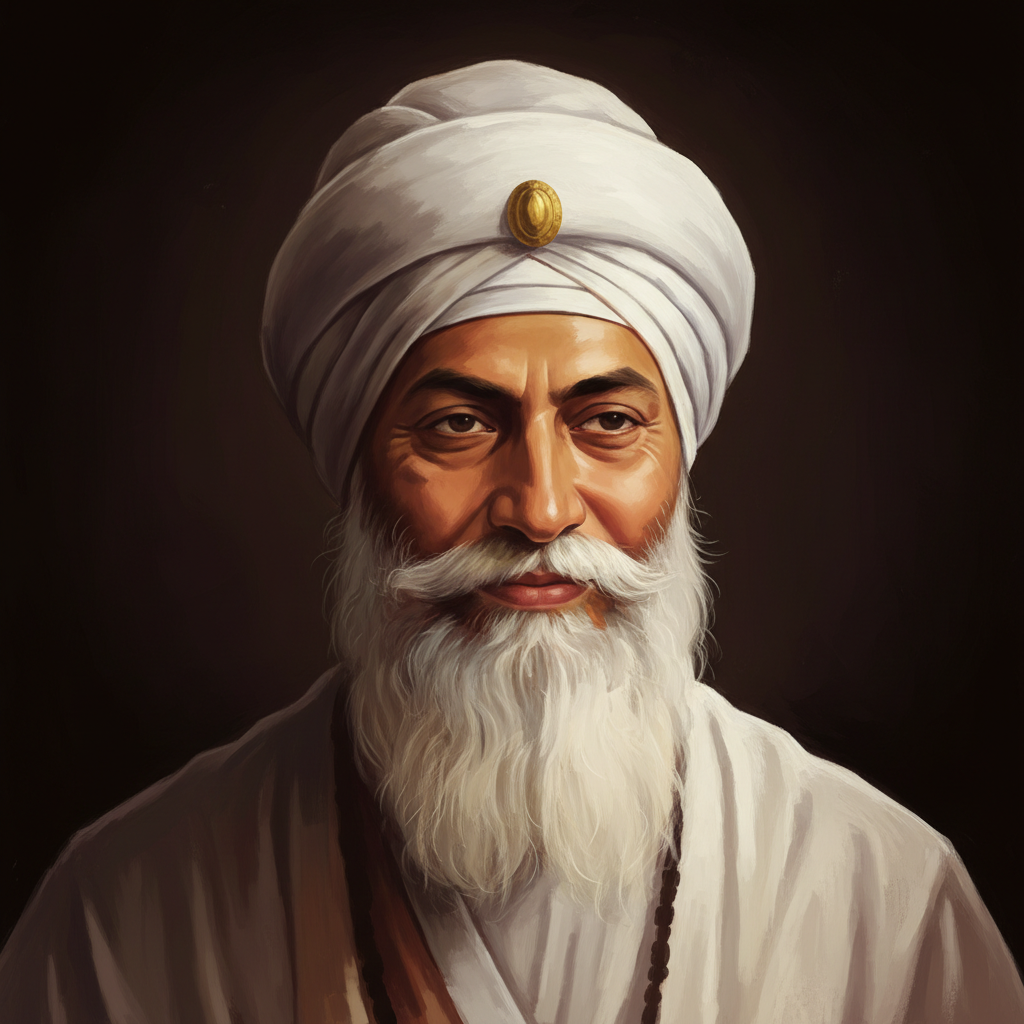
Guru Nanak — "The world is burning in the fire of desire, hatred, and ego. Save it, O Lord, by…"
The world is burning in the fire of desire, hatred, and ego. Save it, O Lord, by Your Grace.
The world is burning in the fire of desire, hatred, and ego. Save it, O Lord, by Your Grace.
Click any product to generate a realistic preview. Up to 3 at a time.
* Initial load can take up to 90 seconds — revising the preview in another color is nearly instant.
"The mind is the elephant, and the body is the rider."
"Keep your mind pure, like the lotus in the water, untouched by its impurities."
"There is no Hindu and no Musalman."
"False is the body that leads to lust and anger, and false are the clothes that lead to pride."
"Death would not be called bad, O people, if one knew how to truly die."
Founder of Sikhism and the first of the Ten Sikh Gurus, whose teachings of one universal God and rejection of caste shaped Punjab. Closely associated with Kabir (mystical poet whose verses appear in the Sikh Guru Granth Sahib). For an intellectual contrast, see Brahmanical orthodoxy, the Hindu caste-and-ritual establishment of his era — Sikhism was founded as a deliberate alternative to both Hindu ritual hierarchy and Islamic exclusivism — Nanak's universalism was a structural rejection of caste and priestly mediation.
Found in 1 providers: gemini
1 source checked
Humanity suffers because people are consumed by craving what they don't have, resenting others, and inflating their own importance. These three inner forces create constant pain, conflict, and restlessness, spreading like a wildfire across society. The speaker pleads for divine mercy to rescue people from this self-made destruction, recognizing that willpower alone cannot extinguish these deep-rooted tendencies. Only grace, received through humility and devotion, can cool the burning and restore peace.
Guru Nanak (1469-1539) built Sikhism around rejecting exactly these three poisons, teaching that ego (haumai) is the root barrier between humans and the divine. A traveling preacher who walked thousands of miles across South Asia and the Middle East, he witnessed caste cruelty, religious hatred, and greed firsthand. His response was naam simran (meditation on God's name) and reliance on divine grace, not ritual, as the cure for inner fire.
Nanak lived during the violent transition from the Delhi Sultanate to Mughal rule, witnessing Babur's 1526 invasion and its massacres, which he condemned in verse. Hindu-Muslim tensions, rigid caste hierarchies, and exploitative clergy defined the era. Ordinary people endured war, forced conversions, and economic ruin. Against this backdrop, Nanak's image of a world ablaze with desire, hatred, and ego was not metaphorical abstraction but a literal diagnosis of sixteenth-century Punjab's political and spiritual crisis.
AI-generated insights based on extensive research and information for context. Factual errors? Email [email protected].
Your cart is empty