Martin Luther — "The world is like a drunken peasant. If you lift him into the saddle on one side…"
The world is like a drunken peasant. If you lift him into the saddle on one side, he will fall off on the other.
The world is like a drunken peasant. If you lift him into the saddle on one side, he will fall off on the other.
Click any product to generate a realistic preview. Up to 3 at a time.
* Initial load can take up to 90 seconds — revising the preview in another color is nearly instant.
"Whoever sticks his nose in every corner will get it stuck."
"The greatest good in marriage is the love of husband and wife."
"Melanchthon is a miserable little worm of a man."
"Reason is the Devil's greatest whore."
"The inner man cannot be forced to do out of his own free will, what he should do, except the grace of God change the heart and make it willing."
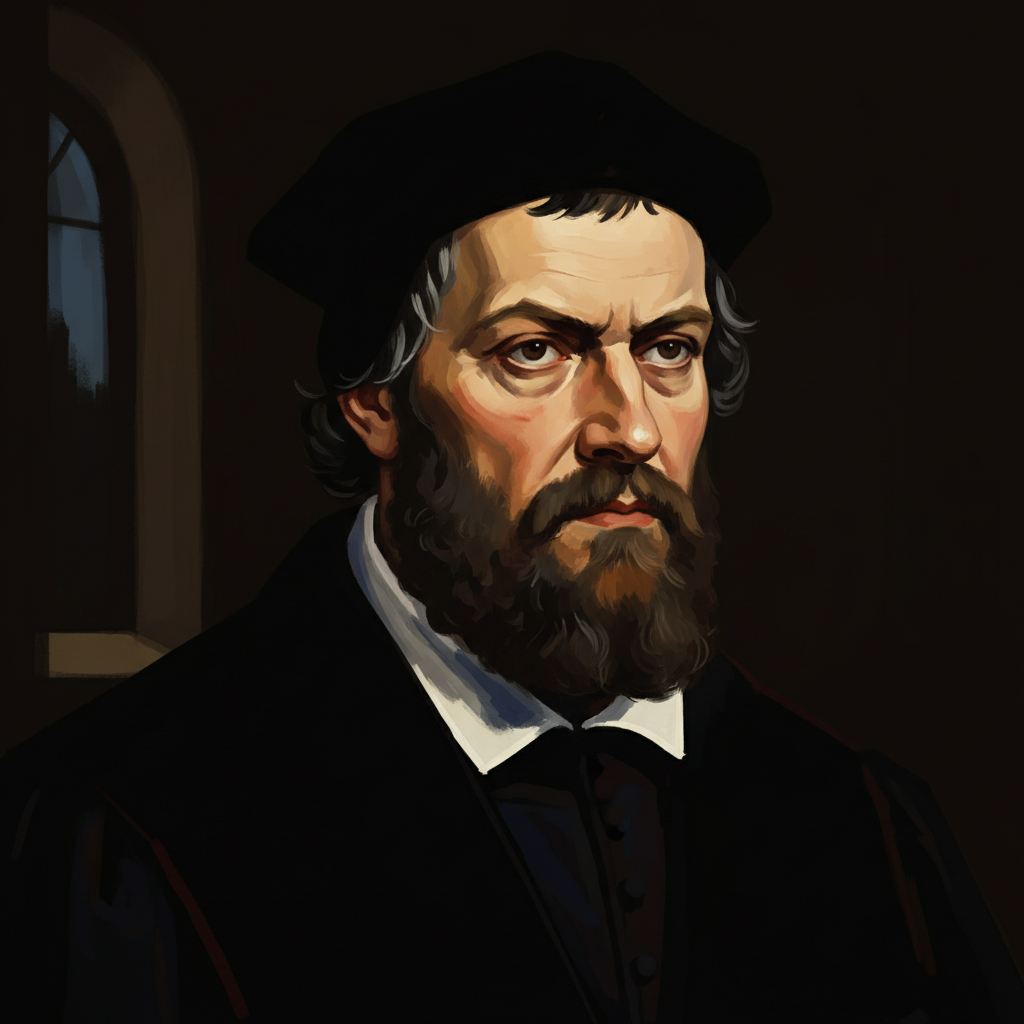
German theologian whose 95 Theses (1517) launched the Protestant Reformation and broke the Catholic Church's monopoly on Western Christianity. Closely associated with Philipp Melanchthon (Lutheran systematizer) and John Calvin (later Reformer who built on Luther's break). For an intellectual contrast, see Pope Leo X, Renaissance pope (1513-1521) — Leo X's indulgence sales triggered Luther's break and Leo excommunicated him in 1521 — Luther's entire Reformation is structured as a direct answer to the indulgence-funded Vatican Leo represented.
Found in 1 providers: deepseek
1 source checked
People and societies tend to overcorrect. When you push someone away from one mistake, they usually swing too far the other way and land in the opposite error. Balance is rare and unstable; most attempts to fix a problem just trade it for its mirror image. The image of a drunk who can't stay upright captures how human nature resists steady moderation, lurching between extremes instead of settling sensibly in the middle.
Luther watched his own reform movement do exactly this. He broke from Rome to fight indulgences and clerical abuse, then spent years battling former allies like Karlstadt and the Anabaptists who pushed his ideas into radicalism, iconoclasm, and the Peasants' War. Having seen reform tip into chaos, Luther grew deeply pessimistic about human self-government, a view rooted in his doctrine of original sin and humanity's bondage to a fallen will.
Early-modern Europe was lurching violently between extremes: the 1525 Peasants' War killed 100,000 after commoners weaponized Luther's gospel-freedom language, while Catholic territories swung toward harsher counter-reform. Printing presses spread pamphlets faster than anyone could moderate them, and confessional lines were hardening into wars. Luther wrote amid constant evidence that loosening one authority simply unleashed another excess, making his peasant-on-horseback metaphor a blunt diagnosis of Reformation-era Europe.
AI-generated insights based on extensive research and information for context. Factual errors? Email [email protected].
Your cart is empty