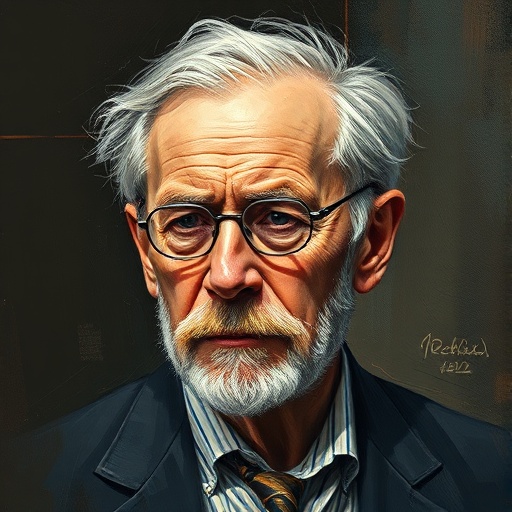
Erwin Schrodinger — "The world is not 'out there' independent of our consciousness. It is a construct…"
The world is not 'out there' independent of our consciousness. It is a construction of our minds.
The world is not 'out there' independent of our consciousness. It is a construction of our minds.
Click any product to generate a realistic preview. Up to 3 at a time.
* Initial load can take up to 90 seconds — revising the preview in another color is nearly instant.
"The most beautiful thing we can experience is the mysterious."
"The only possible way of avoiding paradoxes is to admit that the 'observer' is not something that stands outside the world, but is part of it."
"The present quantum mechanics is not a theory in the sense of the old theories, but rather a collection of rules for the calculation of probabilities."
"But the truth is that we are not living in a world of objects, but in a world of events."
"The more deeply we penetrate into nature, the more we find that it is full of mysteries."
Austrian physicist who shared the 1933 Nobel for the wave equation that bears his name and the famous cat thought-experiment. Closely associated with Werner Heisenberg (matrix-mechanics rival who reached the same physics by different math) and Albert Einstein (his pen-pal on quantum interpretation). For an intellectual contrast, see Niels Bohr, Danish physicist and architect of the Copenhagen interpretation — Schrödinger's cat thought-experiment was specifically designed to ridicule Bohr's 'observer-dependent reality' reading of quantum mechanics — Schrödinger thought the Copenhagen interpretation was absurd; the cat was meant as reductio ad absurdum.
Found in 1 providers: grok
1 source checked
Reality isn't a fixed, objective thing existing separately from whoever perceives it. Our minds actively shape and construct what we experience as the world. Consciousness isn't a passive receiver of pre-existing facts — it's a participant in creating what counts as real. Strip away perception and observation, and the notion of an independent, definite physical world becomes philosophically unstable.
Schrödinger formalized wave mechanics in 1926, describing particles not as definite objects but as probability waves collapsing only upon measurement. His famous cat paradox directly challenged the idea of observer-independent reality. Late in life he immersed himself in Vedantic philosophy, which similarly holds that consciousness underlies existence — making this quote a natural convergence of his physics and his personal metaphysics.
The early-to-mid 20th century saw quantum mechanics demolish classical determinism. Copenhagen interpretation debates between Bohr, Heisenberg, and Einstein centered precisely on whether observation creates reality. Simultaneously, logical positivism and phenomenology in philosophy questioned objective knowledge. Schrödinger wrote this against a backdrop where physics and philosophy were colliding, forcing scientists to reckon seriously with the role of mind in nature.
AI-generated insights based on extensive research and information for context. Factual errors? Email [email protected].
Your cart is empty