What it means
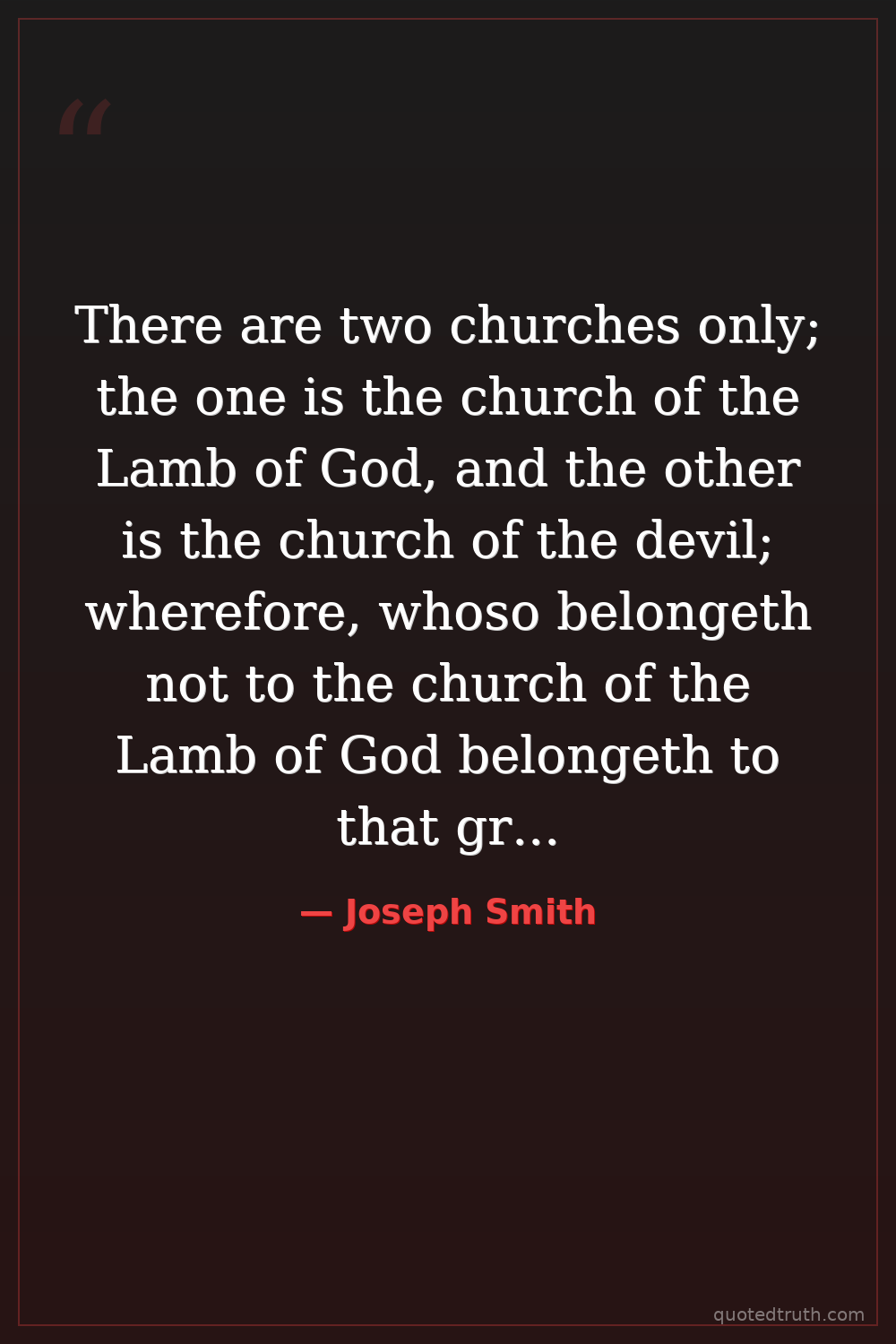
Every person and institution belongs to one of only two categories — God's true church or a corrupt, devil-aligned one. There is no neutral ground, no middle position. Those outside the one true church are automatically affiliated with spiritual corruption. This is an exclusivist religious claim where salvation and divine truth belong entirely to one group, and every other religious body is categorically condemned as part of an opposing, malevolent spiritual order.
Relevance to Joseph Smith
Smith founded the Church of Christ in 1830, claiming divine authority to restore original Christianity lost through centuries of apostasy. This binary framework was foundational to his prophetic mission — his First Vision account explicitly described God declaring all existing churches wrong. The quote, from the Book of Mormon he dictated, justified his movement's radical separation from mainstream Protestantism and positioned him as the sole conduit of legitimate religious authority on earth.
The era
The Second Great Awakening (1790s–1840s) produced explosive competition among Methodist, Baptist, and Presbyterian revivals across the American frontier, especially in upstate New York's so-called 'burned-over district' where Smith lived. Competing denominations each claimed authentic Christianity. Smith's absolute either/or framing cut through this theological confusion by denying all rivals any legitimacy whatsoever, offering converts certainty and belonging in an era of intense, disorienting religious upheaval and denominational fragmentation.
AI-generated insights based on extensive research and information for context. Factual errors? Email [email protected].